Quick Korean Fresh Kimchi
User Reviews
5
Quick Korean Fresh Kimchi
Description
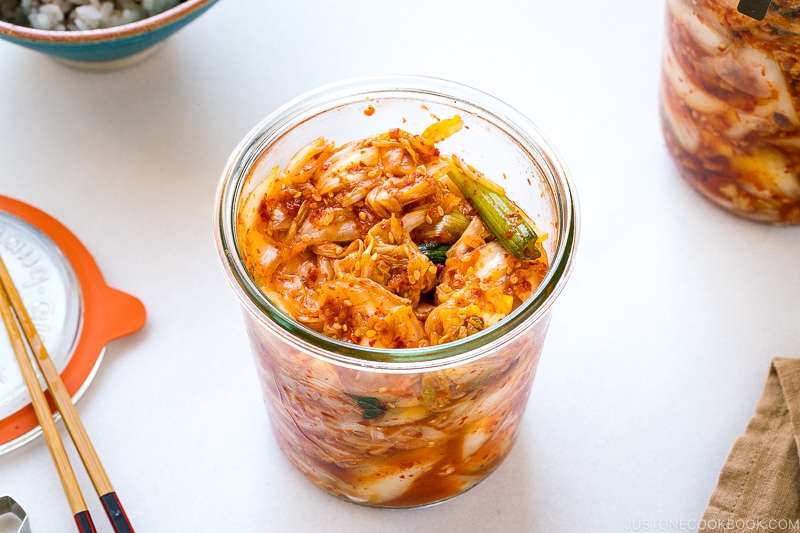
Quick Korean Fresh Kimchi uses Napa cabbage that is salted in a brine made with water and coarse sea salt. The cabbage is cut into irregular pieces to enhance texture after fermentation. The cabbage soaks in the salted water for 40 minutes to soften and release moisture, being turned halfway to ensure even salting.
The kimchi paste consists of green onions, garlic, gochugaru (Korean red pepper flakes), fish sauce (or a vegan umami seasoning alternative), apricot jam to add sweetness and balance the spice, and white sesame seeds for nuttiness. This blend is mixed thoroughly with the drained cabbage to create the kimchi.
The resulting kimchi features a fresh, crisp texture with a blend of spicy, sweet, savory, and umami flavors. It can be served soon after preparation for a fresh style or allowed to ferment further as preferred.
This recipe is shared with permission from the original creator and focuses on authentic ingredients and preparations for traditional Korean kimchi.
Ingredients
- 2 cups water
- ⅓ cup sea salt coarse
- 2½ lb Napa cabbage
For the Kimchi Paste
- 3 green onion or scallions
- 5 cloves garlic (1.2 oz, 35 g)
- 4 Tbsp gochugaru coarse powder, Korean pepper flakes
- 2 Tbsp fish sauce (use an umami seasoning sauce for vegan)
- 2 Tbsp apricot jam (I use 2 heaping Tbsp; you can also use apple jam or maesilaek, the Korean plum extract)
- 1 Tbsp white sesame seeds toasted
Instructions
- Gather all the ingredients.
To Make the Salted Napa Cabbage
- Mix 2 cups water and ⅓ cup coarse sea salt until the salt has dissolved.
- Cut 2½ lb napa cabbage into quarters. Then, cut off and discard the tough core at the stem end of the cabbage quarters.
- Remove the small and tender yellow leaves from the center and transfer them to a large bowl. Then, cut each quarter into 1-inch (2.5-cm) pieces that are about 3 inches (7.5 cm) at their widest part. They don‘t need to be uniform in size; actually, uneven-sized pieces are better for the kimchi‘s texture.
- Put the napa cabbage pieces into the large bowl. Pour the prepared salted water over the cabbage. Toss to mix well and press down on the cabbage as much as possible. Let it soak for 40 minutes.
- Halfway through (after 20 minutes), toss so that the cabbage pieces at the top of the bowl are now at the bottom. We want all the cabbage to soak evenly in the salted water. Press down and soak for another 20 minutes.
- After 40 minutes, you can see that the salted water has drawn out the liquid from the cabbage. Now, drain the salted cabbage.
- Rinse under cold running water for about 1 minute to get rid of the excess salt (you may see some dirt since this is the first time you‘re rinsing the cabbage). Drain completely for about 5 minutes.
To Make the Kimchi Paste
- Meanwhile, make the kimchi paste. Cut 3 green onions/scallions in half lengthwise, then cut into pieces about 1 inch (2.5 cm) long. Put them into a large bowl.
- Mince or press 5 cloves garlic (I use my garlic press to crush them). Add the garlic, 4 Tbsp gochugaru (Korean pepper flakes), 2 Tbsp fish sauce, 2 Tbsp apricot jam, and 1 Tbsp toasted white sesame seeds.
- Mix it all together and set it aside.
To Make the Fresh Kimchi
- Mix the well-drained napa cabbage and the kimchi paste together with your hand (I wear a plastic glove). Mix with gentle pressure and squeeze the cabbage so that it absorbs the color and flavor of the kimchi paste very well. Transfer to a serving plate and serve immediately with an extra sprinkling of sesame seeds.
To Store
- Keep the fresh kimchi in airtight containers (I use 2 Weck jars, 850 ml and 580 ml) and store in the refrigerator for up to 7 days.
Notes
- This Fresh Kimchi recipe is provided with permission from the original creator, Seonkyong Longest.
Nutrition Information
Show DetailsNutrition Facts
Serving: 8(1.4
Amount Per Serving
Calories 60 kcal
% Daily Value*
| Calories | 60kcal | 3% |
| Carbohydrates | 12g | 4% |
| Protein | 3g | 6% |
| Fat | 1g | 2% |
| Saturated Fat | 1g | 5% |
| Polyunsaturated Fat | 1g | 6% |
| Monounsaturated Fat | 1g | 5% |
| Sodium | 435mg | 18% |
| Potassium | 455mg | 10% |
| Fiber | 3g | 12% |
| Sugar | 5g | 10% |
| Vitamin A | 1652IU | 33% |
| Vitamin C | 40mg | 44% |
| Calcium | 151mg | 15% |
| Iron | 1mg | 6% |
* Percent Daily Values are based on a 2,000 calorie diet.
User Reviews
Overall Rating
5
You'll Also Love