Ragi Mudde Recipe
User Reviews
5
-
Prep Time
5 mins
-
Cook Time
15 mins
-
Total Time
20 mins
-
Servings
5 ragi balls
-
Calories
155 kcal
-
Course
Main Course
-
Cuisine
Indian
Ragi Mudde Recipe
Description
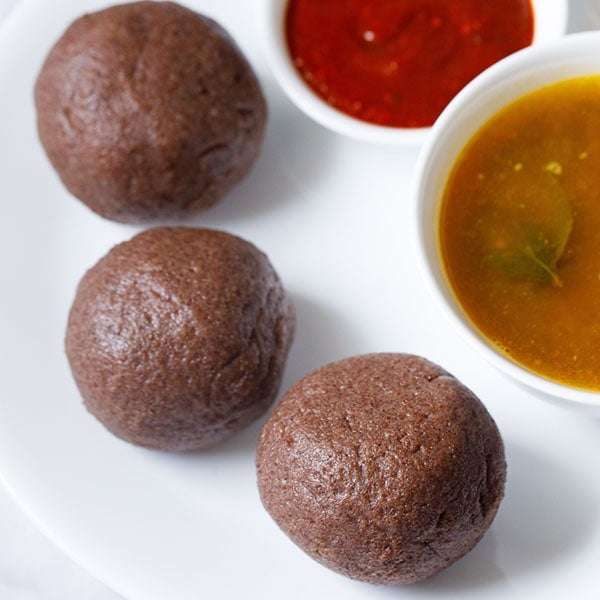
Ragi Mudde Recipe involves combining ragi flour with water and salt, starting with a slurry mixture that is brought to boil. Once boiling, the rest of the flour is evenly distributed over the surface without stirring, allowing it to cook and bind into a dough-like consistency as it absorbs water and thickens. The mixture is subsequently stirred vigorously to a smooth, firm dough that can be shaped into balls. This method ensures an even texture without lumps.
The dish traditionally pairs with a red chili chutney made from Kashmiri red chilies cooked and blended with tamarind, mustard seeds, curry leaves, asafoetida, and fenugreek seeds fried in oil. This chutney adds a spicy and tangy counterpoint to the mild ragi mudde. The final texture is soft but firm enough to hold shape, characteristic of this millet-based preparation.
Ragi Mudde is commonly eaten by hand, breaking off portions dipped in chutney or broth. It is a filling staple noted for its earthy flavor and nutritional benefits associated with finger millet. Salt is optional based on tradition or personal taste.
Ingredients
For Ragi Mudde
- 1 cup ragi flour - finger millet flour or sprouted finger millet flour
- 2 cups water or add as required
- ¼ teaspoon salt - optional
For Chilli Chutney
- 9 to 10 Kashmiri red chilli
- 1 teaspoon tamarind - tightly packed
- 1.25 cups water - for cooking red chillies
- 2 tablespoons water - for blending or grinding
- salt as required
- 1 tablespoon neutral cooking oil generic cooking oil
- ½ teaspoon mustard seeds
- 6 to 7 curry leaves
- 1 pinch asafoetida
- 5 to 6 fenugreek seeds (methi seeds)
Instructions
Prep Equipment and Make Ragi Slurry
- Before beginning, set aside a heavy bottomed pan or dutch oven with some water and wooden stick to mix the mixture. You can use a spatula with a wooden handle/base or the bottom of a wooden spatula. I used a wooden spatula.
- Measure 1 cup of ragi flour. Remove 2 teaspoons of the ragi flour and set aside.
- Add to 2 cups water in a sauce pan or pot. Add the 2 teaspoons ragi flour to the water and mix well.
- Add salt and mix again. Note that traditionally salt and ghee are not added, but I like to add some salt.
Boil Ragi Slurry
- Place the thick bottomed pan containing the slurry on the stove over medium heat.
- Stir occasionally. Let this slurry come to a boil.
Make Ragi Dough
- When the slurry begins to boil, lower the heat and sprinkle the remaining ragi flour evenly all over the pan.
- Ensure that the ragi flour is evenly distributed across the top of the liquid. Do not mix or stir.
- Let it cook undisturbed for 3 to 4 minutes on a low heat.
- After this undisturbed cooking period, mix very thoroughly with the wooden stick.
- Ensure that there are no dry flour specks or lumps visible.
- Incorporate any visible dry flour into the the wet mixture by continuing to stir. The mixture will thicken and become sticky. NOTE: 2 cups of water works perfect for me. But if the dough mixture looks dry, add in a few tablespoons of hot water. If it is too moist, then add 1 to 2 tablespoons of ragi flour.
- Keep on mixing for a few minutes and you will see the mixture clumping together and gathering around itself.
Steam Dough
- Scrape any remaining dough off the wooden stick and return to the pan. Cover and steam for 6 to 7 minutes on low heat.
- When the steaming is complete, turn off the stove and remove the pan from heat. Allow it to remain covered and continue to steam for 5 minutes.
- When you take a tiny portion of the dough and shape into a ball, it should easily form a ball without sticking to your fingers.
Knead and Shape Ragi Mudde
- Brush or spread some water on a plate.
- Transfer the cooked ragi mudde mixture onto the plate using the stick. Remove the small lump at the bottom of the pan. Leave the mixture that is stuck to the bottom or the sides; they cannot be removed without some soaking time.
- Spread water in your palms and begin to knead the mixture.
- This mixture will be very hot, so it the water in your palms and fingers will help you be able to knead.
- Knead very well to a smooth dough. If you like, add 1 teaspoon ghee.
- Portion the dough and make medium-sized balls from it. Shape into neat balls by rolling the dough between your palms.
- Place them in a steel box. I keep in the roti box, so that they stay warm and soft.
- Serve with saaru, basaru, Rasam, Sambar, red chili chutney*, Onion Chutney, Coconut Chutney or Tomato Chutney. *I have shared the recipe of red chili chutney below.
Making Chili Chutney
- Take 1.25 cups water, red chillies (broken and seeds removed) and tamarind in a frying pan.
- Cook for about 5 to 6 minutes on medium-low to medium heat until the red chillies soften.
- Drain the water and set aside the softened tamarind and red chillies. When warm, add them to a spice grinder or blender. Add salt as needed and 2 to 3 tablespoon water. Blend to a smooth chutney. Transfer to a heat proof bowl.
- Heat 1 tablespoon oil in a small pan. Crackle ½ mustard seeds. Add 6 to 7 curry leaves, 1 pinch asafoetida and 5 to 6 methi seeds.
- When curry leaves become crisp, pour the tempering ingredients in the chutney. Mix and serve.
- Note that with kashmiri red chillies, the chutney is not very spicy. For spicy chutney use chillies which have a higher pungency.
Notes
- This nutrition info accounts for one Ragi Mudde serving without the accompanying chili chutney.
- Use a heavy-bottomed pan and wooden spatula to cook and stir the mixture for even heat distribution and mixing.
- Salt is optional and traditionally omitted, but can be added to preference.
Nutrition Information
Show DetailsNutrition Facts
Serving: 5ragi balls
Amount Per Serving
Calories 155 kcal
% Daily Value*
| Calories | 155kcal | 8% |
| Carbohydrates | 34g | 11% |
| Protein | 3g | 6% |
| Fat | 1g | 2% |
| Saturated Fat | 1g | 5% |
| Polyunsaturated Fat | 1g | 6% |
| Monounsaturated Fat | 1g | 5% |
| Sodium | 126mg | 5% |
| Potassium | 193mg | 4% |
| Vitamin B1 (Thiamine) | 1mg | |
| Vitamin B2 (Riboflavin) | 1mg | |
| Vitamin B3 (Niacin) | 1mg | |
| Calcium | 166mg | 17% |
| Vitamin B9 (Folate) | 9µg | |
| Iron | 2mg | 11% |
| Magnesium | 66mg | 17% |
| Phosphorus | 134mg | |
| Zinc | 1mg |
* Percent Daily Values are based on a 2,000 calorie diet.
User Reviews
Overall Rating
5
You'll Also Love