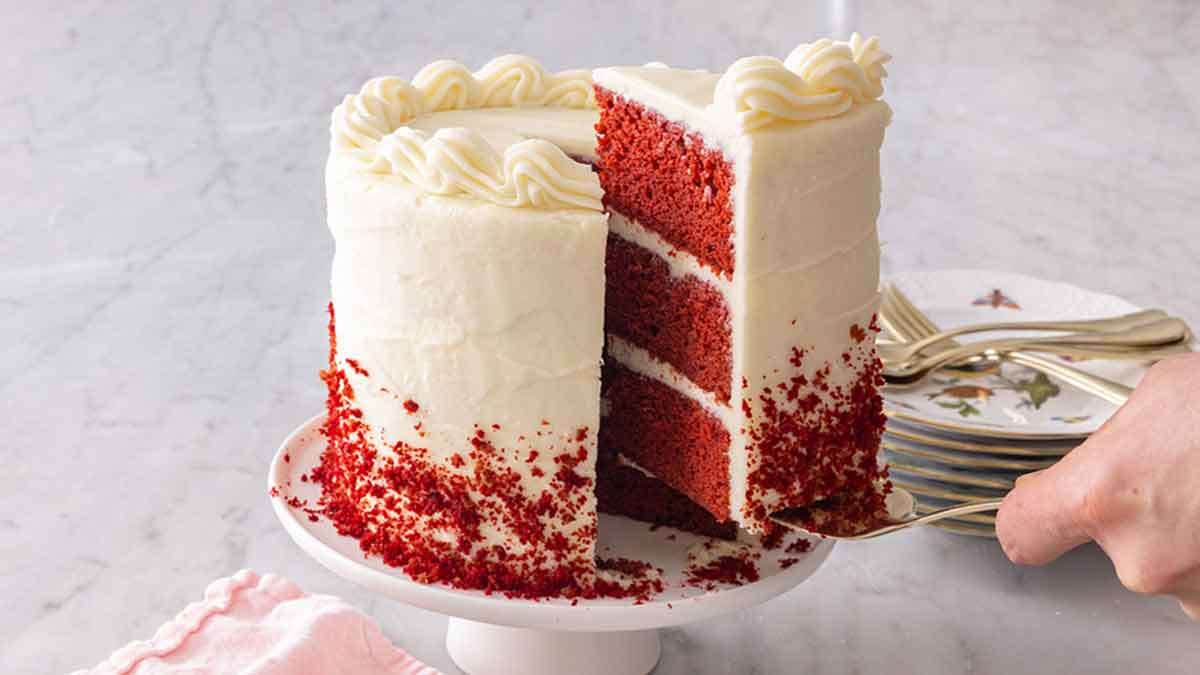
Red Velvet Cake
User Reviews
5
Red Velvet Cake
Description
The Red Velvet Cake begins with a mix of all-purpose flour, salt, baking soda, and cocoa powder to build structure and color. Creaming butter and sugar creates aeration followed by the addition of eggs and vanilla, resulting in a fluffy batter. Buttermilk, vinegar, and red food coloring combine to activate the baking soda and provide the cake’s signature velvety texture and color. Baking in prepared pans yields three layers that can be trimmed for even stacking if they develop domed tops.
The cake has a mild cocoa flavor with moistness imparted by the buttermilk and vinegar mixture. The cream cheese frosting blends softened cream cheese and butter with confectioners sugar to produce a smooth, rich layer that balances the cake's flavor and texture. The frosting's slight tang complements the sweetness of the cake layers.
This red velvet cake suits celebrations or special occasions where a striking layered cake is desired. It pairs well with a cup of coffee or tea and can be served as a dessert centerpiece. The recipe also provides guidance for pan size substitution and methods to measure flour accurately to ensure consistent results.
Careful ingredient temperature management is advised; room temperature eggs, buttermilk, and cream cheese improve mixing and texture. Cake strips or trimming domed layers help achieve flat, uniform tiers, and scaling flour weight instead of volume measurement yields better accuracy. The recipe shares alternatives for buttermilk if unavailable, adding flexibility in the kitchen.
Ingredients
For the Cake:
- 2 ½ cups all-purpose flour (300g)
- 1 teaspoon salt
- 1 teaspoon baking soda
- ½ cup butter room temperature (113g, unsalted
- 1 ½ cups granulated sugar (300g)
- 2 large egg room temperature
- 2 teaspoons vanilla extract
- 2 tablespoons cocoa powder
- 1 cup buttermilk room temperature (240ml)
- 1 tablespoon white vinegar
- 1 to 2 tablespoons red food coloring liquid
For the Cream Cheese Frosting:
- 2 ounce blocks cream cheese room temperature (454g)
- 1 ½ cups butter room temperature (340g, unsalted
- 1 teaspoon vanilla extract
- Pinch kosher salt
- 1 ½ pounds confectioners sugar sifted (5½ cups/675g)
Instructions
For the Cake:
- Preheat the oven to 350 degrees F. Butter and flour three 6-inch cake pans. (See notes about using two 9-inch cake pans.)
- In a medium bowl, sift together the flour, salt, and baking soda.
- In a large mixing bowl or the bowl of a stand mixer fitted with a paddle attachment, cream the butter on medium speed. Add in sugar and mix on medium until light and fluffy, about 3 minutes. Add the eggs in one at a time, beating each until well combined. Beat in the vanilla.
- Sift the cocoa powder into the butter mixture and beat just until combined. Scrape down the bowl.
- In a liquid measuring cup, mix together the buttermilk, vinegar, and red food coloring. (The more you use the brighter the color when baked.)
- With the mixer on low speed, add half of the flour mixture followed by half of the buttermilk mixture to the mixing bowl, beating just until combined. Repeat with the remaining flour and buttermilk. Stop and scrape down the bowl occasionally. Divide the batter among the prepared pans.
- Bake for about 30 to 35 minutes or until the centers are springy to the touch. When done, let them cool in their pans for about 10 minutes, then turn them out onto a wire rack to cool completely.
For the Cream Cheese Frosting:
- In a large mixing bowl or the bowl of a stand mixer fitted with the paddle attachment, beat the butter and cream cheese together on medium speed until smooth and fluffy, about 3 minutes.
- Add the vanilla and salt and beat until combined.
- Sift the confectioner's sugar into a large bowl.
- With the mixer on low speed, gradually the sugar into the butter mixture until combined. Stop and scrape down the bowl occasionally. Increase speed to medium and beat until fluffy, about 1 minute. Place about a cup of frosting to a piping bag with a decorative tip.
For the Assembly:
- Place a cake layer on a cake stand or serving plate. Spread about ½ cup of frosting on top of the cake. Place another cake layer on top and repeat with the frosting. Top with the final cake layer and spread the remaining frosting all over the top and sides of the cake.
- Use a bench scraper or offset spatula to smooth out the cake. Pipe a decorative border on top of the cake or as desired. Chill the cake for about 1 hour or until the frosting is set. Any leftover cake should be covered and can be stored at room temperature for up to 2 days or refrigerated for up to 1 week.
Notes
- If cake layers dome, trim the tops with a serrated knife to stack evenly or use cake strips to prevent doming by regulating pan temperature.
- Measure flour by weight for accuracy; fluff and spoon into measuring cups if weighing is not possible.
- Bring refrigerated ingredients like eggs, buttermilk, and cream cheese to room temperature before mixing for best texture.
- Use two 9-inch pans for fewer layers but adjust baking time slightly shorter by about 5 minutes.
- If buttermilk is unavailable, a milk and acid substitute can be used; see related instructions for making buttermilk.
Nutrition Information
Show DetailsNutrition Facts
Serving: 6servings
Amount Per Serving
Calories 1504 kcal
% Daily Value*
| Calories | 1504kcal | 75% |
| Carbohydrates | 212g | 71% |
| Protein | 22g | 44% |
| Fat | 66g | 102% |
| Saturated Fat | 41g | 205% |
| Polyunsaturated Fat | 3g | 18% |
| Monounsaturated Fat | 17g | 85% |
| Trans Fat | 2g | 100% |
| Cholesterol | 238mg | 79% |
| Sodium | 1177mg | 49% |
| Potassium | 392mg | 8% |
| Fiber | 2g | 8% |
| Sugar | 167g | 334% |
| Vitamin A | 2087IU | 42% |
| Calcium | 350mg | 35% |
| Iron | 3mg | 17% |
* Percent Daily Values are based on a 2,000 calorie diet.
User Reviews
Overall Rating
5
You'll Also Love