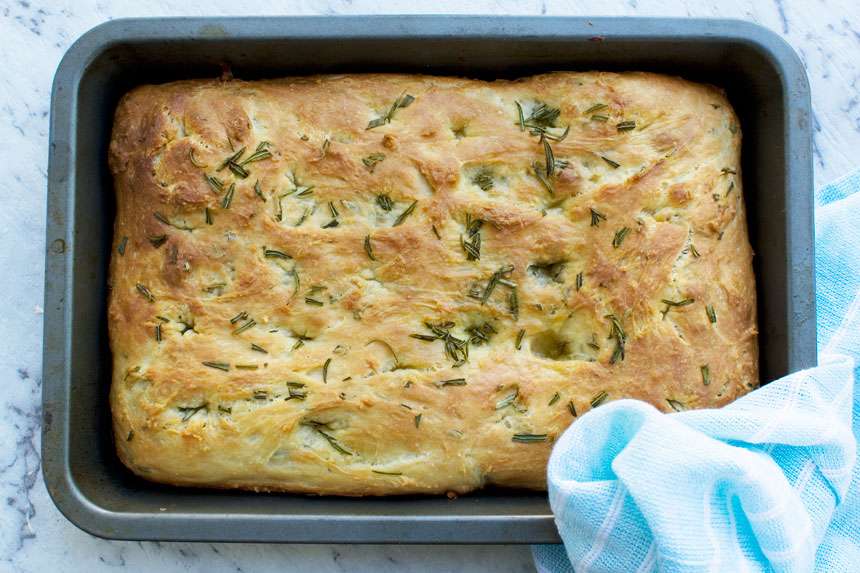
Shockingly easy Italian focaccia bread (no knead!)
User Reviews
5
Shockingly easy Italian focaccia bread (no knead!)
Description
Shockingly easy Italian focaccia bread (no knead!) uses all-purpose flour combined with yeast, olive oil, sugar, salt, and water to create a wet dough that requires minimal handling. Chopped rosemary can be mixed into the dough before pressing it into a baking pan. The dough rises over 1 to 3 hours or longer until doubled in size, fostering yeast activity and air pockets essential for focaccia's texture. Baking creates a crusty exterior while keeping the inside tender and moist.
This focaccia works well as a side with meals or served with olive oil and balsamic vinegar for dipping. Leftovers can be toasted for sandwiches or repurposed as crispy pangrattato topping for pasta. The dough's texture tolerates less-than-perfect spreading into the pan, maintaining its rustic appeal.
Notes emphasize gentle flour adjustments to keep the dough sticky, multistage rising times based on kitchen warmth, and options for storing and freezing dough for later baking. Using instant yeast encourages quicker rising, but standard dry yeast is effective with longer proofing. This versatile, approachable bread is a great introduction to yeasted baking without kneading.
Ingredients
- 2 cups all-purpose flour I usually just use plain flour, but strong bread flour may yield even better results!
- ½ tablespoon sugar
- 1 teaspoon yeast ('Instant' dry yeast is best, but just 'dry yeast' is fine too. It may take up to 15 minutes longer to rise, however.)
- 1 teaspoon salt
- 2 tablespoons olive oil plus extra for greasing the pan and drizzling over at the end
- 1 cup water it should feel neither warm nor cold, almost like nothing, tepid
- 3 tablespoons rosemary optional, chopped finely, fresh
- balsamic vinegar optional - for dipping!, and more olive oil
- olive oil optional - for dipping!, and more olive oil
Instructions
- Add the first 5 ingredients to a large bowl. Pour over the water.
- Stir vigorously with a wooden spoon until everything is combined and a ball of dough starts to form.
- Add a tiny bit more flour if the dough is still really sticky (but not too much - you want the dough to be on the wetter/stickier side). Then, with floured hands, knead just enough times to gather into a smooth ball of dough.
- Lift up the dough while you spray or brush a little oil over the bottom and sides of the bowl. Then cover the bowl of dough with a clean tea towel and leave to rise for 1 to 3 hours, or until roughly doubled in size (or leave for longer - see note below for details). If you leave the dough in a warm place it will rise faster (again, see notes below).
- Sprinkle 2 tablespoons of the chopped rosemary over the dough and mix it in with floured hands (optional). Add any other mix-ins at this point.
- Press the dough into a rectangular or circular cake pan or baking dish. I usually use a 10 x 7 inch cake pan or an 8 inch circular cake tin. Roughly push the dough right to the edges.
- Cover with a tea towel again and leave for about 30 minutes more. After 20 minutes, preheat the oven to 220C / 430F.
- Push your thumb into the dough in a few places to make indentations. Then sprinkle over the rest of the rosemary, if using. Drizzle over about a tablespoon of olive oil. Grind over some sea salt (optional).
- Bake for 20 to 25 minutes or until the bread is golden on top and has started to pull away from the sides of the pan.
- Serve warm with a meal, slice into 4-6 and make sandwiches, or slice into fingers and serve with a dish of olive oil and balsamic vinegar as an appetizer. The bread is best eaten the same day, but you can make a toasted sandwich or croutons the next day. You can also freeze leftovers for 3 to 6 months (but best eaten within a month).
Notes
- The dough should be sticky to support a good rise; add flour sparingly only to shape the dough.
- Rising time varies with temperature; warm environments speed doubling, cooler ones slow it, possibly up to 3 hours.
- For faster rising, place the covered dough in a warm oven (below 90°F/32°C) and turn off the heat.
- Instant dry yeast promotes quicker proofing, but regular dry yeast also works with longer rises.
- Dough can be made ahead and refrigerated for up to a week or frozen for several months; thaw and bring to room temperature before shaping.
- Pressing dough into the pan need not be exact; its softness allows some stretching during baking.
- Consume focaccia fresh or within two days; leftovers can be toasted or frozen in slices for longer storage.
- Leftover bread can be used as pangrattato, a crunchy topping for pasta dishes.
Nutrition Information
Show DetailsNutrition Facts
Serving: 4to 6
Amount Per Serving
Calories 307 kcal
% Daily Value*
| Calories | 307kcal | 15% |
| Carbohydrates | 51g | 17% |
| Protein | 8g | 16% |
| Fat | 8g | 12% |
| Saturated Fat | 1g | 5% |
| Sodium | 585mg | 24% |
| Potassium | 106mg | 2% |
| Fiber | 3g | 12% |
| Sugar | 2g | 4% |
| Vitamin A | 44IU | 1% |
| Vitamin C | 1mg | 1% |
| Calcium | 14mg | 1% |
| Iron | 3mg | 17% |
* Percent Daily Values are based on a 2,000 calorie diet.
User Reviews
Overall Rating
5
You'll Also Love