Thai Curry Recipe & Red Curry Paste
User Reviews
5
-
Prep Time
15 mins
-
Cook Time
25 mins
-
Total Time
40 mins
-
Servings
4
-
Calories
252 kcal
-
Course
Main Course
-
Cuisine
Thai, International
Thai Curry Recipe & Red Curry Paste
Description
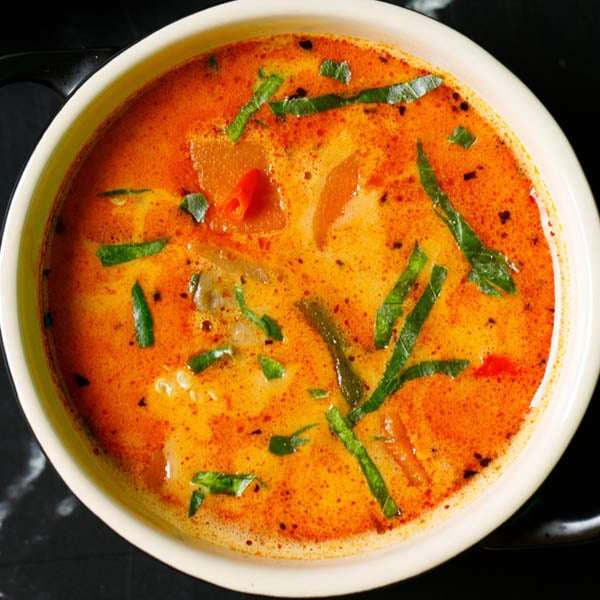
The Thai Curry Recipe begins by preparing red curry paste from fresh and dried ingredients including bird's eye chilies, Kashmiri red chilies, galangal, garlic, shallots, kaffir lime leaves, lemongrass, coriander seeds, cumin seeds, black peppercorns, soy sauce, lemon zest, water or coconut milk, and salt. These are combined and ground into a fine or semi-fine paste. The paste is then sautéed briefly in toasted sesame or coconut oil on low heat to release aromas.
Chopped vegetables such as carrot, baby corn, button mushrooms, bell pepper, green beans, cauliflower, and optional Thai pea eggplants are added to the pot and stirred with the curry paste. Coconut milk and water are poured in to create a rich, flavorful sauce that is gently simmered. Palm sugar and salt may be added for a balanced taste, finishing with fresh Thai basil to bring herbal notes.
The curry combines heat from the chilies, citrusy brightness from kaffir lime and lemon zest, and aromatic depth from lemongrass and spices. This makes a vibrant dish showcasing the fresh paste and diverse vegetables. It complements meals that benefit from bold flavors and a creamy texture.
Substitutions for Thai herbs are suggested when unavailable; for example, using ginger for galangal or lemon zest for kaffir lime leaves, although the flavor will differ. The paste can be made in large batches and frozen for convenience.
Ingredients
For red curry paste
- 2 to 3 bird's eye chilies - red colored
- 2 Kashmiri red chilli or low to medium hot variety of dry red chillies
- 1 inch galangal
- 4 to 5 garlic or 2 to 3 medium garlic cloves, small cloves
- 1 to 2 shallot or pearl onions
- 3 to 4 kaffir lime leaves - medium sized
- 2 lemongrass stalks
- 2 teaspoons coriander seeds
- 1 teaspoon cumin seeds
- ¼ teaspoon black peppercorns
- 1 teaspoon soy sauce - naturally fermented or brewed
- ½ teaspoon lemon optional, zest
- 2 tablespoons water or coconut milk, add as required
- ½ teaspoon salt or sea salt, add as required
For the thai red curry
- 2 tablespoons sesame oil or coconut oil, toasted
- ⅓ or ½ cup carrot chopped
- ⅓ cup baby corn chopped
- 1 cup button mushrooms chopped
- ¼ or ⅓ cup bell pepper any colored bell pepper, chopped
- ¼ cup green beans French beans
- 1 cup cauliflower chopped
- 8 to 10 Thai pea eggplant - turkey berry, optional
- 1.5 cups water or add as required
- 1 cup coconut milk thick
- ¼ teaspoon palm sugar or unrefined cane sugar - optional
- salt as required - optional
- 1 tablespoon Thai basil or whole, chopped or torn, chiffonade
Instructions
Making thai red curry paste
- Take the spices and set aside– bird’s eye chilies, dry red chillies, coriander seeds, cumin seeds and black peppercorns.
- Also rinse, peel and roughly chop the following herbs – galangal, garlic cloves, shallots (chopped), kaffir lime leaves and lemon grass stalks.
- Take the spices, herbs, shallots in a grinder jar.
- Add soy sauce, lemon zest (optional) and 2 tablespoon water or coconut milk. Also add salt.
- While grinding, scrape the sides and continue to grind. Grind to a fine or semi-fine paste.
Cooking Veggies
- In a pot or pan, heat the toasted sesame oil or coconut oil. Keep heat to a low. Add the prepared thai red curry paste.
- Sauté for a minute on a low flame stirring often.
- Add the chopped veggies including white button mushrooms. You can add your choice of vegetables. Stir and mix everything.
- Now add ½ cup thick coconut milk. Mix again. Keep heat to a low.
- Next add water. Mix again. Since salt was added in the thai curry paste, it need not be added. But do check the taste of the curry later and if required you can add more salt.
- For a thicker consistency in the curry, add less water.
- Cover the pan with its lid. Increase the heat to medium or a medium-low. Simmer the curry till the vegetables are cooked and tender. Keep them slightly al dente if you prefer.
- In between do check when the veggies are cooking. If water dries up, you can add more water.
Making thai red curry
- When the vegetables are cooked and tender, then reduce the heat to a low and add ½ cup thick coconut milk. At this step you can also add ¼ teaspoon palm sugar or raw sugar. Addition of sugar is optional and can be skipped. For a bit more sweet taste, increase the amount of sugar.
- Mix very well and let the entire curry come to a gentle boil on a low or medium-low heat. Lastly, add 1 tablespoon chopped or torn thai basil leaves. Mix and switch off the heat. Check the taste of curry and if required you can add some salt.
- Serve the thai red curry hot with lemongrass rice or plain steamed basmati rice or jasmine rice. You can garnish it with basil leaves while serving.
Notes
- Use the specified Thai herbs for authentic flavor; substitutes like ginger for galangal or lemon zest for kaffir lime leaves alter the taste.
- Increase bird's eye chilies for a spicier curry.
- Sweetener such as palm sugar is optional and adjustable.
- Store-bought Thai red curry paste can replace homemade, using 3 to 4 tablespoons.
- Make larger batches of curry paste and freeze for later use.
Nutrition Information
Show DetailsNutrition Facts
Serving: 4Serving
Amount Per Serving
Calories 252 kcal
% Daily Value*
| Calories | 252kcal | 13% |
| Carbohydrates | 18g | 6% |
| Protein | 5g | 10% |
| Fat | 20g | 31% |
| Saturated Fat | 12g | 60% |
| Polyunsaturated Fat | 3g | 18% |
| Monounsaturated Fat | 4g | 20% |
| Sodium | 700mg | 29% |
| Potassium | 566mg | 12% |
| Fiber | 3g | 12% |
| Sugar | 5g | 10% |
| Vitamin A | 2186IU | 44% |
| Vitamin B1 (Thiamine) | 1mg | |
| Vitamin B2 (Riboflavin) | 1mg | |
| Vitamin B3 (Niacin) | 2mg | |
| Vitamin B6 | 1mg | |
| Vitamin B12 | 1µg | 42% |
| Vitamin C | 62mg | 69% |
| Vitamin D | 1µg | 5% |
| Vitamin E | 1mg | |
| Vitamin K | 14µg | |
| Calcium | 65mg | 7% |
| Vitamin B9 (Folate) | 49µg | |
| Iron | 4mg | 22% |
| Magnesium | 59mg | 15% |
| Phosphorus | 148mg | |
| Zinc | 1mg |
* Percent Daily Values are based on a 2,000 calorie diet.
User Reviews
Overall Rating
5
You'll Also Love