Traditional kimchi (Pogi Kimchi)
User Reviews
4.6
Traditional kimchi (Pogi Kimchi)
Description
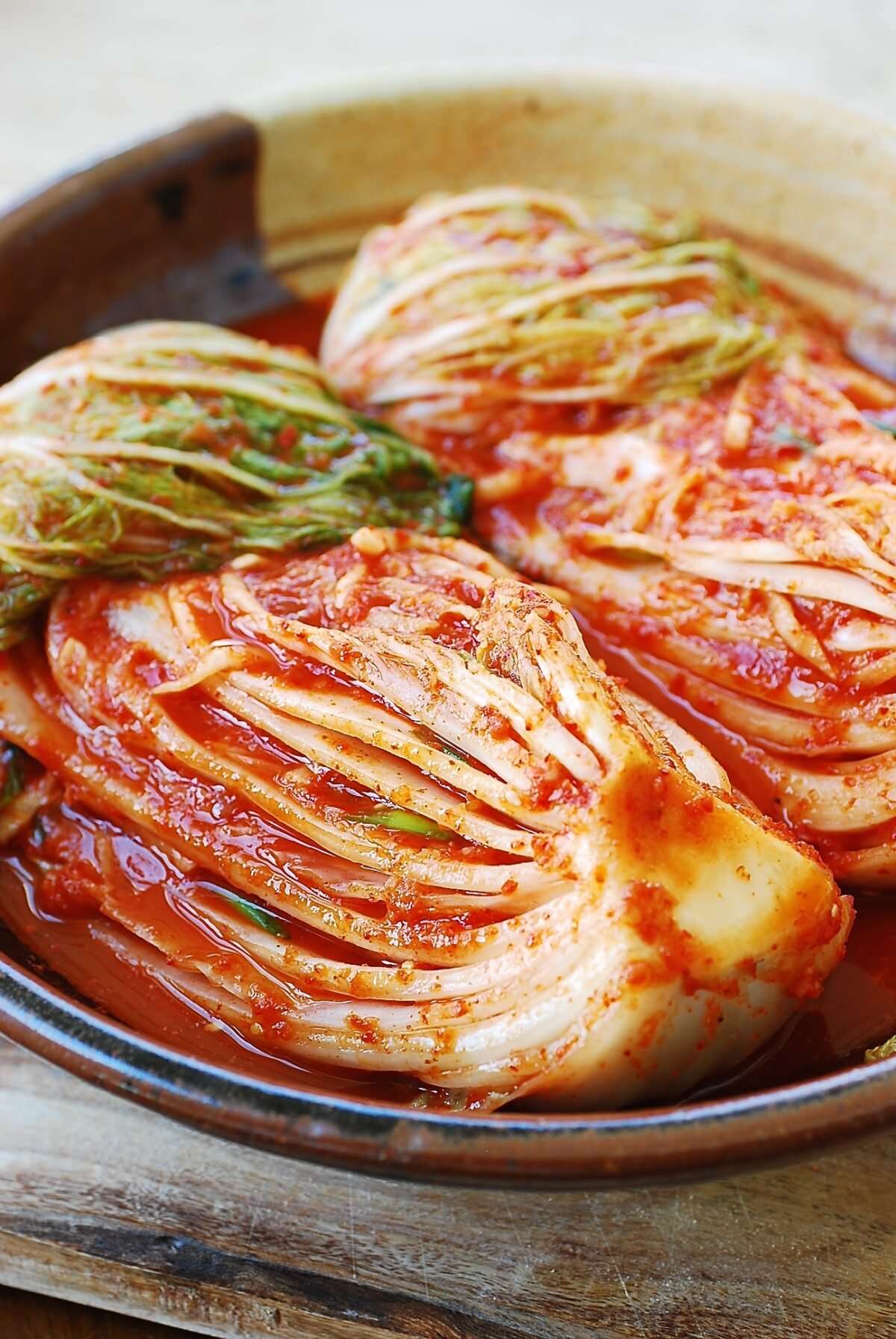
Traditional kimchi, known as Pogi Kimchi, centers on Napa cabbage prepared through salting and soaking in brine to soften the leaves. The process uses Korean coarse sea salt and water to draw moisture while preserving texture. After salting, the cabbage is rinsed and seasoned with a mixture including Korean radish, scallions, garlic, ginger, gochugaru (Korean red pepper powder), salted fermented shrimp, fish sauce, and optional ingredients like Korean pear and dried kelp to deepen flavor.
The seasoning paste is thickened with glutinous rice flour for better adherence. Once mixed, the cabbage quarters are packed tightly into an airtight container to ferment. The texture develops from crisp cabbage leaves to tender fermented layers, with flavors becoming mildly sour, spicy, and savory over about two weeks in refrigeration. The combination of ingredients results in a complex umami profile characteristic of traditional Korean fermented vegetables.
Kimchi is often served as a side dish with meals or incorporated into recipes like stews and pancakes. It maintains its flavor and texture over several weeks when refrigerated. Covering the top with outer leaves or plastic wrap can protect the surface during fermentation, especially for smaller batches.
Ingredients
- 1 Napa cabbage about 5 to 6 pounds, or 2 small (about 3 pounds each, aka baechu (배추), large
- 1 cup sea salt Korean coarse, aka gulgeun soguem (굵은소금
- 5 cups water
- 1 pound Korean radish aka mu (무
- 1/4 Korean pear optional, large, aka 배
- 3 - 4 scallions
- 1 piece dried kelp aka dasima, 다시마, about 2 to 3 inch square, optional
Seasonings
- 1 tablespoon glutinous rice flour aka chapssal garu (찹쌀가루
- 1/2 cup gochugaru adjust to taste, Korean red pepper powder; aka 고추가루
- 1/4 cup salted fermented shrimp roughly chopped, saeujeot, 새우젓
- 3 tablespoons fish sauce aka myulchiaekjeot, 멸치액젓
- 3 - 4 Shrimp optional, raw, about 2 ounces, finely minced or ground
- 3 tablespoons garlic minced
- 1 teaspoon ginger grated
- 1/2 cup water or dasima broth
Kitchen tools
- 2 large bowls or pots 7 - 8 quarts
- a large colander
- kitchen gloves
- 3/4 - 1 gallon airtight container or jar
Instructions
- Cut the thick white part of the cabbage in half lengthwise. Then, slowly pull it apart to separate into two pieces. Do the same for each half to make quarters. Running the knife through all the way would unnecessarily cut off the cabbage leaves.
- In a large bowl, dissolve 1/2 cup of salt in 5 cups of water. Thoroughly bathe each cabbage quarter in the salt water one at a time, shake off excess water back into the bowl, and then transfer to another bowl.
- Using the other half cup of salt and starting from the outermost leaf, generously sprinkle salt over the thick white part of each leaf (similar to salting a piece of meat). Try to salt all the cabbage quarters with 1/2 cup salt, but you can use a little more if needed. Repeat with the rest of the cabbage quarters. Pour the remaining salt water from the first bowl over the cabbage. Set aside for about 6 - 8 hours, rotating the bottom ones to the top every 2 - 3 hours.
- The cabbages should be ready to be washed when the white parts of the leaves are bendable. It's okay to have a bit of resistance. Rinse thoroughly 3 times, especially between the white parts. Drain well, cut side down.
- Meanwhile, make the optional dasima broth by boiling a small piece (2 to 3 inch square) in 1.5 cups of water for 5 minutes, and cool. Mix the rice flour with 1/2 cup water (or optional dasima broth) and simmer over low heat, stirring occasionally, until it thickens to a thin paste, and cool. Yields about 3 - 4 tablespoons.
- Prepare the garlic, ginger and saeujeot. Combine all the seasoning ingredients, including the rice paste and about 1/2 cup water (or the optional dashima broth), and mix well. Set aside until the gochugaru dissolves slightly and becomes pasty.
- Cut the radish and optional pear into matchsticks (use a mandoline if desired), transferring to a large bowl. Cut the scallions diagonally into about 1-inch long pieces. Add the prepared seasoning mix to the radish, and mix well by hand. Throw in the scallions, and mix everything lightly. Taste a little bit. It should be a little too salty to eat as is. You can add salt, more salted shrimp or fish sauce, as needed. Let it sit for about 30 minutes to allow the flavors to meld nicely.
- Cut off the tough stem part from each cabbage quarter, leaving enough to hold the leaves together. Place one cabbage quarter in the bowl with the radish mix. Spread the radish mix over each leaf, one to two tablespoons for large leaves. (Eyeball the stuffing into 4 parts and use one part for each cabbage quarter.)
- Fold the leaf part of the cabbage over toward the stem and nicely wrap it with the outermost leaf. Place it, cut side up, in a jar or airtight container. Repeat with the remaining cabbages. If you have loose large leaves, you can use them to cover the top of the kimchi (see note 1). Once all the cabbages are in the jar or airtight container, press down hard to remove air pockets. To collect any remaining seasoning, rinse the bowl with 1/2 cup of water (or the remaining optional dasima broth), and add it to the kimchi container. Close the lid.
- Leave it out at room temperature for a full day or two. It can be longer, depending on the weather and how fast you want your kimchi to ripen. Then, store in the fridge. (see note 2)
Notes
- Cover kimchi with large outer cabbage leaves or plastic wrap during fermentation to protect the surface, especially in small batches.
- Kimchi develops its characteristic flavor after about two weeks in the refrigerator.
- The dish retains good flavor and texture for several weeks when stored properly cold.
User Reviews
Overall Rating
4.6
You'll Also Love