Traditional South African Vetkoek
User Reviews
5
-
Prep Time
15 mins
-
Cook Time
20 mins
-
Proofing time:
1 hr
-
Total Time
1 hr 35 mins
-
Servings
8 servings
-
Calories
319 kcal
-
Course
Main Course, Snacks
-
Cuisine
South African
Traditional South African Vetkoek
Description
This vetkoek recipe starts with combining plain flour, sugar, salt, and instant yeast, ensuring the salt is evenly mixed with the flour to avoid slowing yeast activity. Lukewarm water is gradually added to form a soft, slightly sticky dough, which is kneaded by hand or mixer until smooth and elastic. Dough proofing in a warm environment encourages rise before portioning into balls.
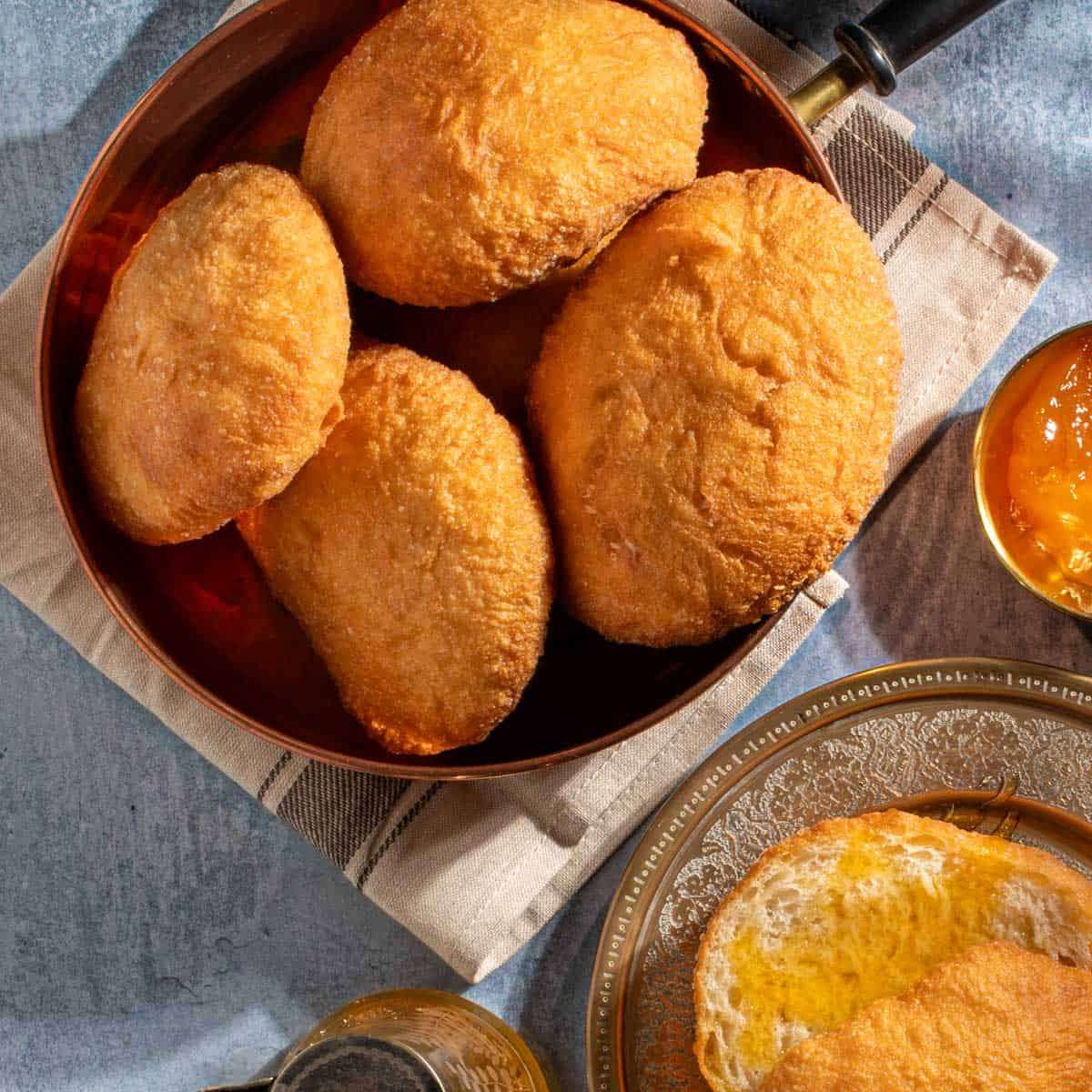
Balls of dough are shaped smoothly without cracks to ensure even puffing, then carefully lowered into hot oil with sufficient depth to float and fry evenly. Frying until golden brown creates a crunchy outer crust enclosing a soft, airy crumb. While frying, hot oil can be spooned over the tops to help them puff properly.
Vetkoek are typically served warm, often with savory fillings like curried mince or sweet toppings. Once fried, they can be kept in a covered pot to maintain the crisp exterior and soft inside. Proper oil temperature and dough handling are essential for best results.
The recipe includes practical guidance on yeast freshness, doughproofing environment, shaping techniques, and frying methods to produce consistently good vetkoek.
Ingredients
- 5 cups plain flour 1250ml in total
- 1 tablespoon sugar 15ml
- 1 teaspoon salt 5ml
- 3 teaspoons instant yeast 10g-11g of instant yeast
- 2 cups water 500ml in total, lukewarm
- cooking oil depending on the size of the pot, you will roughly need 1-1.5 litres of oil, for frying
Instructions
- Add the flour, sugar and salt to a large mixing bowl, or the bowl of a stand mixer. Give it a good stir. Note: Ensure that the salt blends evenly with the flour. When yeast directly meets salt, it might lose some of its oomph.
- Add the instant yeast to the flour mixture and combine well.
- Make a well in the centre of the flour mixture.
- Start adding some lukewarm water to the flour, a little at a time. Stir after each addition.
- Keep adding water until you have a soft, sticky dough. You might not need all the water.
- Kneading by hand: You can do it inside the bowl if your bowl is big enough (less mess) or on a lightly floured surface.Knead for about 10-15 minutes until it's smooth and stretchy. Sprinkle a bit of flour on your hands or the surface as needed to prevent sticking.Kneading with stand mixer: If you're using a stand mixer for kneading, attach the dough hook to the machine.In the stand mixer, knead the dough on low speed for 10 minutes or until it becomes smooth and stretchy.
- Lightly coat the inside walls of a large bowl with oil.
- Place the dough in the bowl and lightly oil the surface of the dough to prevent it from drying out. Cover the bowl with clingfilm or a clean kitchen towel.
- Put the dough in a warm spot to rise for about 1 hour until it doubles in volume.
- Lightly oil the work surface and your hands. Then, transfer the dough onto the oiled surface.
- Shape the dough into a long log-shape. Using a sharp knife, divide it into equal portions. For this recipe, dividing it into 150g portions will yield eight vetkoek of a good size.Pro Tip: When dividing the dough, push the knife down into the dough instead of 'sawing' through. This helps "seal" each portion of dough.
- Shape each portion of vetkoek dough by squeezing it into a ball through your thumb and index finger. This will give you a nice, smooth, round vetkoek.
- Cut squares of baking paper large enough to hold each dough ball individually (this is optional but helpful for easy transfer to the oil).
- Place each ball of dough onto its square of baking paper and flatten it with the palm of your hand until it's about 2.5cm thick. You can also choose to leave them round.
- Leave the vetkoek to rest whilst you heat the oil.
- Prepare an extra pot or container with a lid, lined with paper towels, to absorb excess oil and keep the vetkoek warm while you cook the rest.
- Add the oil to a large saucepan, ensuring that the oil reaches a minimum depth of 5cm.
- Begin heating the oil over medium-high heat.
- To check if the oil is hot enough, drop a small piece of dough into it. If it sizzles and quickly rises to the surface, the oil is ready. Turn the flame down to a medium heat.Pro tip: Fry the small piece of dough until it's browned on all sides before adding your first vetkoek. This confirms that the oil is truly ready.
- Lift a piece of dough with its baking paper and carefully tip or slide it into the hot oil. Drop it *away* from you to prevent any oil from splashing towards you.
- Using a large heat-proof spoon, immediately start spooning hot oil onto the top of the vetkoek. This will help it puff up beautifully.
- When the top of the vetkoek puffs up, flip it over and fry until the bottom is a rich, golden brown. Flip it back and cook the top until it matches the color of the bottom.
- If the vetkoek browns too quickly and the oil is bubbling too ferociously, turn the heat down slightly. Pro tip: You may notice the oil will bubble a lot when you drop a new piece of dough into it and then quiet down to very few bubbles after about 2 minutes. This is expected, don't be tempted to turn the heat up thinking it's not hot enough.
- Enjoy your freshly baked vetkoek with curried mince, golden syrup or jam and cheese.
Notes
- Add water gradually to achieve a soft, sticky dough that is easy to knead without excessive flour.
- Ensure your instant yeast is fresh and water is lukewarm for optimal yeast activation.
- Mix salt thoroughly with flour before adding yeast to protect yeast effectiveness.
- Use oil about 5cm deep in a suitable pan so the vetkoek floats during frying to prevent burning.
- Shape dough balls smoothly without cracks for even puffing and an attractive appearance.
- Use oiled surfaces rather than flour to shape dough balls to prevent burnt flour on the outside.
- Lower dough balls into hot oil using baking paper or a spatula to keep shape intact and avoid finger dents.
- After frying, place vetkoek in a covered container to retain crisp exterior and soft interior.
- Spoon hot oil over vetkoek tops as they fry to aid puffing, using a heat-resistant spoon.
Nutrition Information
Show DetailsNutrition Facts
Serving: 8servings
Amount Per Serving
Calories 319 kcal
% Daily Value*
| Calories | 319kcal | 16% |
| Carbohydrates | 63g | 21% |
| Protein | 12g | 24% |
| Fat | 2g | 3% |
| Saturated Fat | 0.2g | 1% |
| Polyunsaturated Fat | 1g | 6% |
| Monounsaturated Fat | 0.3g | 2% |
| Sodium | 302mg | 13% |
| Potassium | 126mg | 3% |
| Fiber | 3g | 12% |
| Sugar | 2g | 4% |
| Vitamin A | 2IU | 0% |
| Vitamin C | 0.01mg | 0% |
| Calcium | 16mg | 2% |
| Iron | 1mg | 6% |
* Percent Daily Values are based on a 2,000 calorie diet.
User Reviews
Overall Rating
5
You'll Also Love