Venison Landjaeger
User Reviews
5
-
Prep Time
2 hrs
-
Cook Time
3 hrs
-
Total Time
5 hrs
-
Servings
20 links
-
Calories
146 kcal
-
Course
Main Course
-
Cuisine
German
Venison Landjaeger
Description
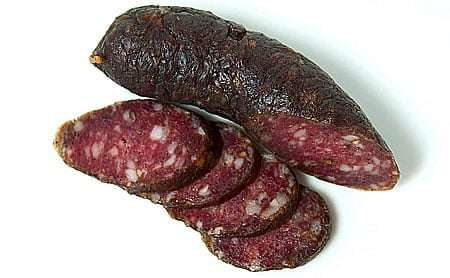
Venison Landjaeger combines venison with fatty pork shoulder to balance lean and fat content, ensuring a firm and flavorful dried sausage. The recipe uses kosher salt and Instacure No. 2 for curing and preservation, while sugar adds slight sweetness and feeds beneficial bacteria from the starter culture, aiding fermentation. The spice blend of garlic powder, caraway, coriander, black pepper, allspice, and celery seed imparts a complex, earthy flavor characteristic of Landjaeger. Careful chilling and grinding maintain low meat temperature, which helps texture and structure during curing. The mixed meat is stuffed into narrow hog casings, resulting in a dense, chewy sausage designed for snacking rather than slicing.
This Landjaeger style sausage is portable and traditionally enjoyed outdoors as a snack. The narrow casing, common to this style, contributes to its distinctive shape and drying characteristics. Preparing Landjaeger involves curing overnight and then proceeding with grinding and further processing, following cold handling steps critical for proper texture development. This recipe yields a specialized cured meat that differs from typical summer sausages or salamis due to its seasoning, curing agents, and casing choice.
The recipe notes highlight the importance of using narrow hog casings, typically sourced from butcher shops or specialty suppliers. These sausages are meant to be enjoyed as snack sticks similar to Slim Jims, rather than being sliced wide. Proper casing selection directly affects drying and texture.
Ingredients
- 3 pounds venison
- 2 pounds pork shoulder fatty, or pork belly
- 51 grams kosher salt about 3 tablespoons
- 15 grams sugar a scant 2 tablespoons, or dextrose
- 6 grams Instacure No. 2 about a teaspoon
- 1 teaspoon garlic powder
- 1 teaspoon caraway seed
- 1 teaspoon coriander seed ground
- 2 tablespoons black pepper ground
- 2 teaspoons ground allspice
- 1/2 teaspoon celery seed
- 5 grams Starter culture T-SPX, about 1 tablespoon
- 2/3 cup distilled water
Instructions
- Cut the fat and meat into chunks that will fit into your grinder. Trim as much sinew and silverskin as you can. Mix the salt and Instacure with the meat and fat and put it in the fridge overnight. If you have a grinder with a very large die, like 10 mm, grind it first and then set it in the fridge. If you only have the standard "coarse" die, which is normally 6 mm, just put the meat and fat as-is in the fridge Doing this helps develop myosin, which will give you a tighter bind when you stuff the links later.
- The next day, put the fat and your grinding equipment — blade, coarse and fine die, etc — in the freezer. Mix the spices into the meat. Put the meat mixture in the freezer, too. Let everything chill down until the meat hits about 28°F or so. It won’t freeze solid because of the salt. Normally this takes about 90 minutes. While you’re waiting, soak about 15 feet of hog casings in a bowl of warm water.
- When the meat and fat are cold, grind through the coarse die of the grinder, the 6 mm die. If the meat is 35°F or colder, go ahead and grind half of it one more time through the fine die, which is normally 4.5 mm. If it's too warm, freeze until it hits 35°F and then grind it.
- Regardless, once it has been ground, put the meat and fat back in the freezer while you clean up. Dissolve the starter culture in with the distilled water. Let this sit at least 15 minutes.
- When the meat mixture is back below 35°F, you can mix it. I put the mixture into a big plastic bin with the starter culture mixture and mix it by hand for about 2 minutes. If you do this, you’ll know the mixture’s cold enough if your hands ache from the chill. Or, you can put everything into a big stand mixer and mix on low for 90 seconds to 2 minutes. I prefer to mix by hand.
- Put the sausage in the fridge while you clean up. Run some clean water through your casings to flush them and to see if you have any leaks.
- Pack the sausage into your stuffer and get ready to make the salami. Leave 4 to 6 inches of casing hanging from the edge of the stuffer as a “tail;” you’ll use this to tie off the salami in a bit. Start working the meat into the casing, using your fingers to flush any air out of the casing and to regulate the flow. Do a whole coil before you make links.
- Tie off links of about 6 to 8 inches with kitchen twine. Now gently rotate the links to compress the meat within each casing, watching for air bubbles. Heat a needle or a sausage pricker in the flames of your stove to sterilize it, and prick the links to let any trapped air out. Hang your sausages from “S” hooks or somesuch on a wooden rack. Let them hang at room temperature for an hour or two.
- Now you need to ferment the sausage. You will want to tent the hanging sausages with black plastic from some garbage bags, or some other plastic sheeting. If you have one, put a humidifier under the sausages. You really want them to stay moist. Let the sausages hang for at least 24 hours, and up to 48 hours. Every few hours, spritz them with a spray mister to keep them moist. This is the fermentation stage, the stage where the starter culture you are using defeats any bad bacteria in the sausage.
- When the sausages are ready, fire up the smoker. Put ice cubes in the water tray to keep the temperature as cool as possible. You are not cooking the links here, you are giving them a good smoking. Use oak, hickory, any fruit or nut wood. Avoid mesquite, as it is too distinctive. And no pine -- too much resin. Smoke the links for 2 to 3 hours, making sure the temperature stays cool. If the smoker got beyond 125°F, douse the links in an ice water bath to stop any cooking. Pat them dry.
- Now you need to hang them in your drying chamber. I use an old fridge with a temperature regulator and a humidifier in it. Hang the links at about 80 percent humidity for a week or two before eating. Store in the fridge, or vacuum sealed in the freezer.
Notes
- Use narrow hog casings to achieve the traditional Landjaeger shape and drying.
- Trim sinew and silverskin thoroughly to improve texture and binding.
- Refrigerate meat with curing salts overnight to develop curing and myosin for better binding.
- Keep grinding equipment and meat cold during processing to maintain texture.
- Landjaeger is meant as a portable snack, not for slicing like wider salamis.
- Hog casings can be sourced from good supermarkets, butchers, or online specialty meat supply stores.
Nutrition Information
Show DetailsNutrition Facts
Serving: 20links
Amount Per Serving
Calories 146 kcal
% Daily Value*
| Calories | 146kcal | 7% |
| Carbohydrates | 2g | 1% |
| Protein | 26g | 52% |
| Fat | 3g | 5% |
| Saturated Fat | 1g | 5% |
| Cholesterol | 85mg | 28% |
| Sodium | 1048mg | 44% |
| Potassium | 400mg | 9% |
| Fiber | 1g | 4% |
| Sugar | 1g | 2% |
| Vitamin A | 5IU | 0% |
| Vitamin C | 0.1mg | 0% |
| Calcium | 13mg | 1% |
| Iron | 2.8mg | 16% |
* Percent Daily Values are based on a 2,000 calorie diet.
User Reviews
Overall Rating
5
You'll Also Love