Yeolmu Kimchi (Young Summer Radish Kimchi)
User Reviews
5
Yeolmu Kimchi (Young Summer Radish Kimchi)
Description
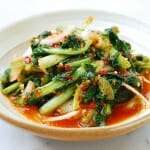
This kimchi recipe starts by preparing young radish greens and young Napa cabbages, trimming roots and washing thoroughly. Both vegetables are salted separately, soaking in saltwater to draw out moisture and develop texture. The time and salt amount varies depending on the salt coarseness. A spicy seasoning paste is made by blending roughly chopped red chili peppers, garlic cloves, ginger pieces, salted shrimp, fish sauce, gochugaru (Korean chili flakes), and sugar. A thin flour paste is prepared by cooking flour and water to help the kimchi adhere and ferment evenly.
The salted greens and cabbages are combined with the seasoning paste, sliced scallions, and onions then coated with the flour paste. The kimchi develops character and mild fermentation as it rests over time, offering a crunchy, slightly spicy, and refreshing flavor profile characteristic of young radish kimchi. It is commonly eaten as a side or paired with cold noodle dishes to balance richness.
Precision in salting each vegetable and using fresh ingredients in the seasoning paste influences the texture and depth of flavor. The inclusion of salted shrimp and fish sauce adds umami that defines traditional kimchi taste.
Ingredients
Young radish greens and cabbages
- 4 pounds young radish 열무 (young radish greens, yeolmu
- 6 tablespoons coarse salt use less if using finer salt, Korean
- 4 cups of water
- 2 pounds Napa cabbage 풋배추 (young napa cabbages, putbaechu
- 3 tablespoons coarse salt use less if using finer salt, Korean
- 2 cups water
Seasoning Ingredients
- 6 red chili peppers roughly chopped, fresh
- 10 garlic plump cloves
- 2 ginger roughly chopped, about 1 inch-long and 1 inch-round piece
- 1/4 cup salted shrimp saewujeot 새우젓
- 1/4 cup fish sauce myulchiaekjeot, 멸치액젓
- 3 to 4 tablespoons gochugaru Korean chili pepper flakes - use 1/2 cup or more if not using fresh peppers
- 1 tablespoon sugar
Flour Paste
- 2 tablespoons flour
- 2 cups of water
Other vegetables
- 5 scallion cut into 1-inch long pieces, 6 thin
- 1/2 onion thinly sliced, large
Instructions
- Cut off the root end of each radish if the root is thin and not usable. Otherwise, cut the thin end of the root and scrape off the impurities with a small knife. Trim off any bad leafy stems, and cut the greens into about 3-inch long pieces. Transfer to a large bowl.
- Trim off the root from each young cabbage. Cut the cabbages into about 3-inch long pieces, and transfer to another large bowl.
- Fill the bowl of greens with water. Let them sit in the water for about 10 minutes for the greens to release any dirt. Then, wash the greens a couple of times by gently shaking with your hands in the water. Drain. Do the same with the young cabbages.
- Dissolve 6 tablespoons of salt in 4 cups of water in a small bowl. Placing a handful of the greens back in the large bowl, sprinkle with some salt water. Repeat the process until all the radish greens are placed in the bowl. If you run out of salt water, pour some back out of the bowl with the greens and use again. Repeat the process for the young cabbages in another bowl with 3 tablespoons of salt and 2 cups of water.
- Let the vegetables sit for 40 minutes to an hour until they become slightly flexible. Flip them over once or twice while salting.
- Meanwhile, mix the flour well with water, and boil over medium heat, stirring, to make the flour paste. Cool.
- Coarsely blend the chili peppers, garlic, ginger and saewujeot together with 1/2 cup of water in a blender. Combine with the fish sauce, gochugaru, sugar and flour paste.
- Gently rinse the salted radish greens and cabbages separately in cold water, and drain well.
- Place the radish greens and cabbages in 3 to 4 batches in the same large bowl, pouring in some seasoning mix each time. Add the scallions and onions. Toss everything very lightly by hand (use kitchen gloves), until everything is evenly coated with the seasoning.
- Store in an airtight container or jar (about 1 gallon size). Leave it out at room temperature for a few hours before storing in the fridge. You can start eating kimchi any time, but it will taste best after a few days in the fridge.
User Reviews
Overall Rating
5
You'll Also Love