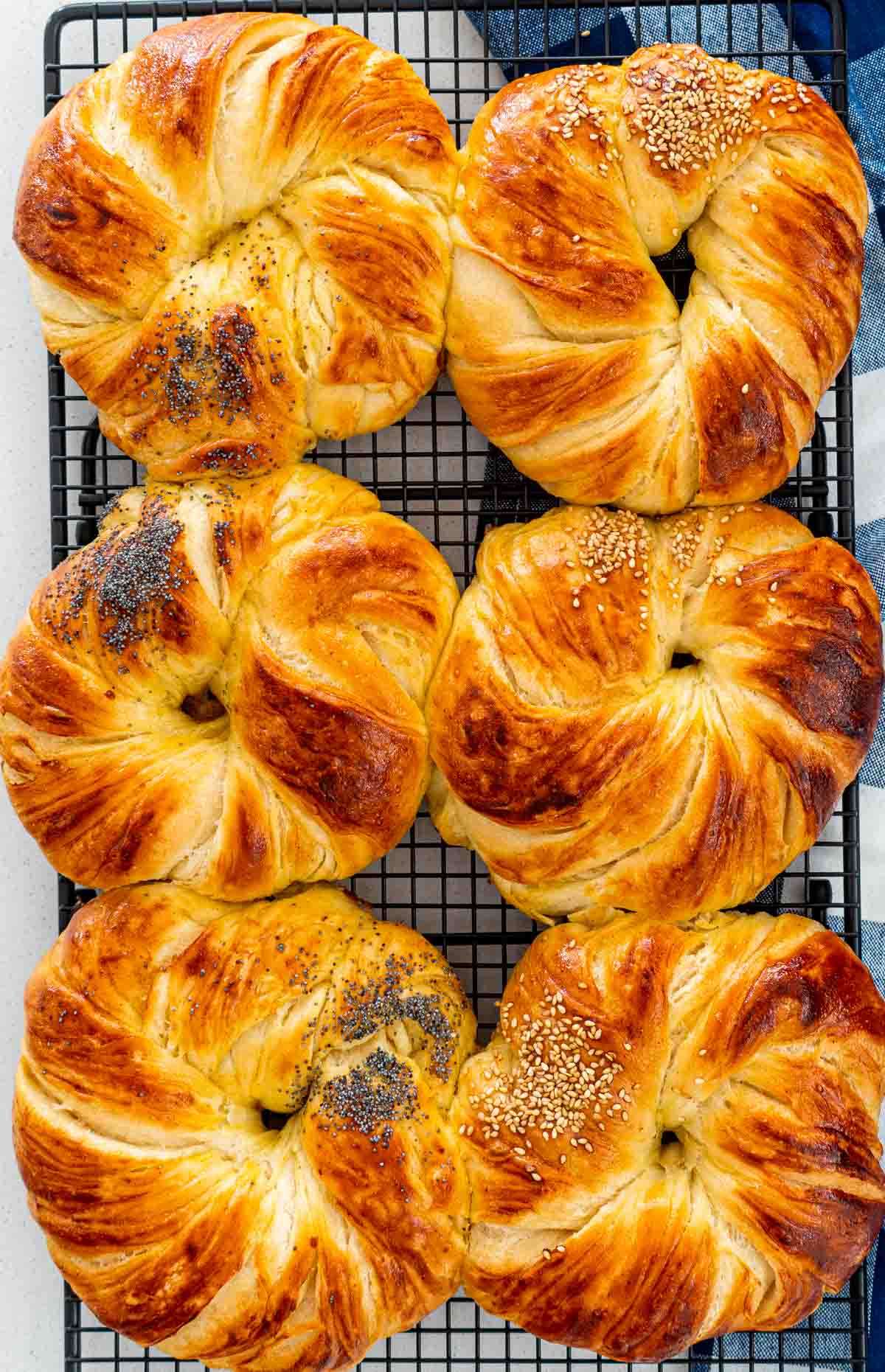
Brioche Buns
User Reviews
4.7
Brioche Buns
Description
Brioche Buns are prepared by activating yeast and combining it with lukewarm water, milk, sugar, eggs whites, oil, and salt, then gradually incorporating flour to form a soft but elastic dough. The dough is proofed in a warm, draft-free environment until doubled in size to develop the brioche’s signature light texture.
The dough is shaped into individual buns placed on baking sheets and baked to golden perfection with a tender crumb and soft bite. Optionally, vanilla paste can be added for flavor and seeds like sesame or poppy can be sprinkled on top for texture and appearance.
The buns are best enjoyed fresh but can be stored at room temperature for a few days or frozen for longer preservation. Adjusting flour amounts may be necessary depending on humidity levels and environment to achieve the ideal dough consistency.
Ingredients
- 1 cup water lukewarm
- 2 tablespoon sugar granulated
- 1 tablespoon active dry yeast
- 1 cup milk lukewarm
- ½ cup vegetable oil
- 2 large egg separated, at room temperature
- 1 teaspoon salt
- 4-6 cups all-purpose flour
- 6 tablespoon butter unsalted, softened
Optional
- 1 teaspoon vanilla paste
- 1 tablespoon sesame seeds
- 1 tablespoon poppy seeds
Instructions
Make Dough
- Activate yeast: In the bowl of your mixer add the warm water, a tbsp of the sugar and the active dry yeast. Stir and let it rest for 5 to 10 minutes until frothy.
- Add the rest of the wet ingredients: Add the rest of the sugar, milk, oil, salt, egg whites and roughly whisk everything together.
- Make the dough: Add 2 cups of the flour to the bowl and start mixing on low for a couple minutes. Add more flour, a cup at a time, until the dough comes together but is still a bit sticky and soft. I used 4 cups of flour, but you might need a bit more flour than I did. The dough should be a bit sticky, elastic and should spring back when poked with your finger. Using an oiled plastic bench scraper scrape the dough from the bowl and place it in a well oiled bowl. Cover the bowl with plastic wrap and let it rise in a warm, draft free environment until doubled in size, 1 to 2 hours.
Form The Buns
- Prep the oven and baking sheets: Preheat the oven to 375°F. Line 2 baking sheets with parchment paper.
- Roll out the dough: Punch down dough to release the air. Oil your work surface well, with a couple tablespoons of oil. Transfer the dough to the work surface and using your fingers spread the dough into a big rectangle, that's about 20 x 16 inches. The dough should be soft enough that you can easily spread it. Alternatively you can use a rolling pin.
- Create flaky layers: Spread about 3 tbsp of the butter over the surface of the dough. Fold in thirds, then use your fingers again to spread the dough a bit more. Spread another 2 tbsp of the butter over the new surface of the dough and fold it in thirds again, just like folding a letter. Spread the dough again a bit then spread the remaining butter over the top. Fold it in thirds one last time. Spread the dough so that it's about 12 inches by 8 inches. Basically we just created layers of dough with butter in between, similar to making croissants.
- Form buns: Using a pizza cutter cut the dough into 8 long strips, each strip about 1 1/2 inches wide. Fold each rope in two and twist it, then bring the ends together and pinch them to connect the rope. If your hands stick to the dough, just make sure to oil a bit. Place the buns on the prepared baking sheet, only 6 will fit on a baking sheet, so you'll have to bake the other 2 separately.
Finish And Bake
- Brush with yolks: Whisk the egg yolks wth the vanilla paste (optional), then generously brush the buns with this yolk mixture. If you wish, you can sprinkle the buns with some poppy seeds or sesame seeds.
- Bake: Transfer the baking sheet to the oven and bake 20 to 25 minutes or until golden brown. Let them cool for 5 minutes on the baking sheet then transfer to a cooling rack to cool completely.
Notes
- Refrigerate or freeze opened yeast in an airtight container and always check expiration dates for best results.
- Proof dough in a warm, draft-free place; using an oven's proof function or warmed oven speeds rising.
- Flour amount varies by environment; humid climates require more flour, dry climates less to maintain the soft dough texture.
- Dough is soft and elastic; it can be shaped by hand without rolling pin.
- Brioche buns are best enjoyed the day made but store well at room temperature for up to 3 days in a sealed bag.
- For freezing, cool buns completely, wrap individually tightly, then freeze up to 3 months.
Nutrition Information
Show DetailsNutrition Facts
Serving: 8Serving
Amount Per Serving
Calories 485 kcal
% Daily Value*
| Serving | 1bun | |
| Calories | 485kcal | 24% |
| Carbohydrates | 53g | 18% |
| Protein | 10g | 20% |
| Fat | 26g | 40% |
| Saturated Fat | 18g | 90% |
| Trans Fat | 1g | 50% |
| Cholesterol | 72mg | 24% |
| Sodium | 326mg | 14% |
| Potassium | 145mg | 3% |
| Fiber | 2g | 8% |
| Sugar | 5g | 10% |
| Vitamin A | 379IU | 8% |
| Vitamin C | 1mg | 1% |
| Calcium | 82mg | 8% |
| Iron | 3mg | 17% |
* Percent Daily Values are based on a 2,000 calorie diet.
User Reviews
Overall Rating
4.7
You'll Also Love