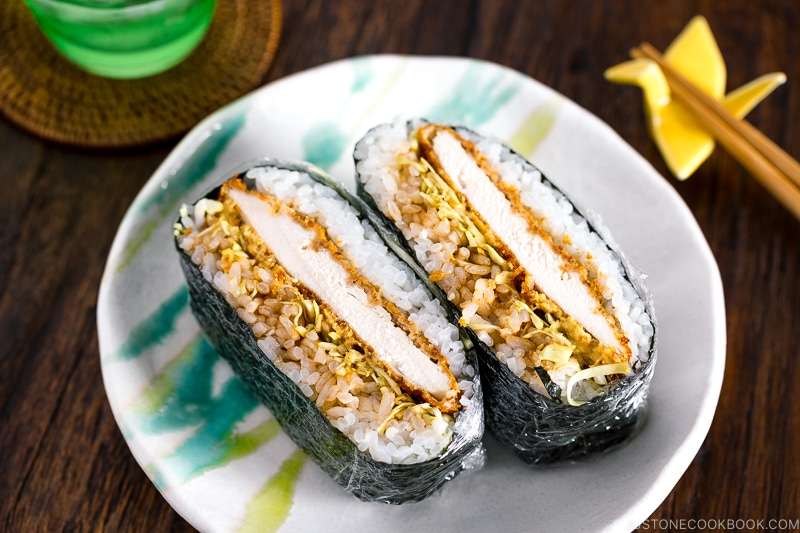
Chicken Katsu Onigirazu
User Reviews
4.7
-
Prep Time
15 mins
-
Total Time
15 mins
-
Servings
1 onigirazu
-
Calories
477 kcal
-
Course
Main Course
-
Cuisine
Japanese
Chicken Katsu Onigirazu
Description
This recipe assembles cooked Japanese short-grain rice into a thin, square layer on a nori sheet, sprinkled lightly with kosher salt for freshness. Julienned green cabbage and a baked chicken katsu cutlet provide layers of crunch and savory protein. Dijon mustard and tonkatsu sauce are spread to add acidity and sweet-savory notes. A second rice layer tops the fillings before the nori is carefully folded to create a neat square package.
The nori wrapping holds everything together while adding a subtle seaweed flavor. This method yields a compact and flavorful onigirazu, which contrasts tender rice with crispy chicken and fresh cabbage for a balanced bite.
These onigirazu are suitable for packed lunches or casual meals. They are best eaten soon after assembly to maintain crispness of the cabbage and chicken katsu texture.
Ingredients
- 1 chicken katsu baked
- 1–2 leaves green cabbage
- 1 heet nori dried laver seaweed
- 1 cup Japanese short-grain rice cooked
- ⅛ tsp kosher salt Diamond Crystal brand
- 1 tsp Dijon mustard
- 1–2 Tbsp tonkatsu sauce
Instructions
- Gather all the ingredients.
- Cut 1–2 leaves green cabbage into julienned slices.
- Place a plastic wrap on a working surface and put 1 sheet nori (dried laver seaweed) on top (shiny side facing down), with a corner pointing up.
- Evenly spread about ½ cup cooked Japanese short-grain rice in a thin layer and form into a square shape in the center of nori sheet. Sprinkle ⅛ tsp Diamond Crystal kosher salt. For Japanese rice ball (onigiri) that are enjoyed at room temperature, we add salt to the rice to keep the food fresh longer.
- Place the shredded cabbage evenly on top of rice and then 1 baked chicken katsu on top.
- Spread 1 tsp Dijon mustard and 1–2 Tbsp tonkatsu sauce.
- Flip over chicken katsu so the sauce is also on the cabbage.
- Place another ½ cup steamed rice on top. Try to keep the square shape as you spread the rice evenly in a thin layer. Bring left and right corners of nori sheet towards the center. Fold gently but tightly to wrap around the layers at the center.
- Then bring the bottom and top corners towards the center. Continue to fold gently but tightly around the layers. Make sure the rice is tucked in nicely.
- If you like the onigirazu to showcase the filling after cutting in half, mark with a piece of shredded cabbage perpendicular to the filling. Wrap with plastic wrap tightly and set aside for 5 minutes.
- Cut the onigirazu with a sharp knife (following the direction of the “cabbage” mark). Run your knife in cold water before cutting so that the cross-section will be clean.
To Store
- If you plan to make it ahead of time, wrap the onigirazu with a thick kitchen towel and keep it in the refrigerator overnight. The towel will prevent the rice from getting hard and dry from cold air (but it‘s impossible to keep it moist/fluffy). I strongly recommend making onigirazu on the same day you enjoy it.
Nutrition Information
Show DetailsNutrition Facts
Serving: 1onigirazu
Amount Per Serving
Calories 477 kcal
% Daily Value*
| Calories | 477kcal | 24% |
| Carbohydrates | 66g | 22% |
| Protein | 33g | 66% |
| Fat | 8g | 12% |
| Saturated Fat | 2g | 10% |
| Polyunsaturated Fat | 1g | 6% |
| Monounsaturated Fat | 3g | 15% |
| Trans Fat | 1g | 50% |
| Cholesterol | 119mg | 40% |
| Sodium | 298mg | 12% |
| Potassium | 529mg | 11% |
| Fiber | 1g | 4% |
| Sugar | 1g | 2% |
| Vitamin A | 237IU | 5% |
| Vitamin C | 2mg | 2% |
| Calcium | 41mg | 4% |
| Iron | 4mg | 22% |
* Percent Daily Values are based on a 2,000 calorie diet.
User Reviews
Overall Rating
4.7
You'll Also Love