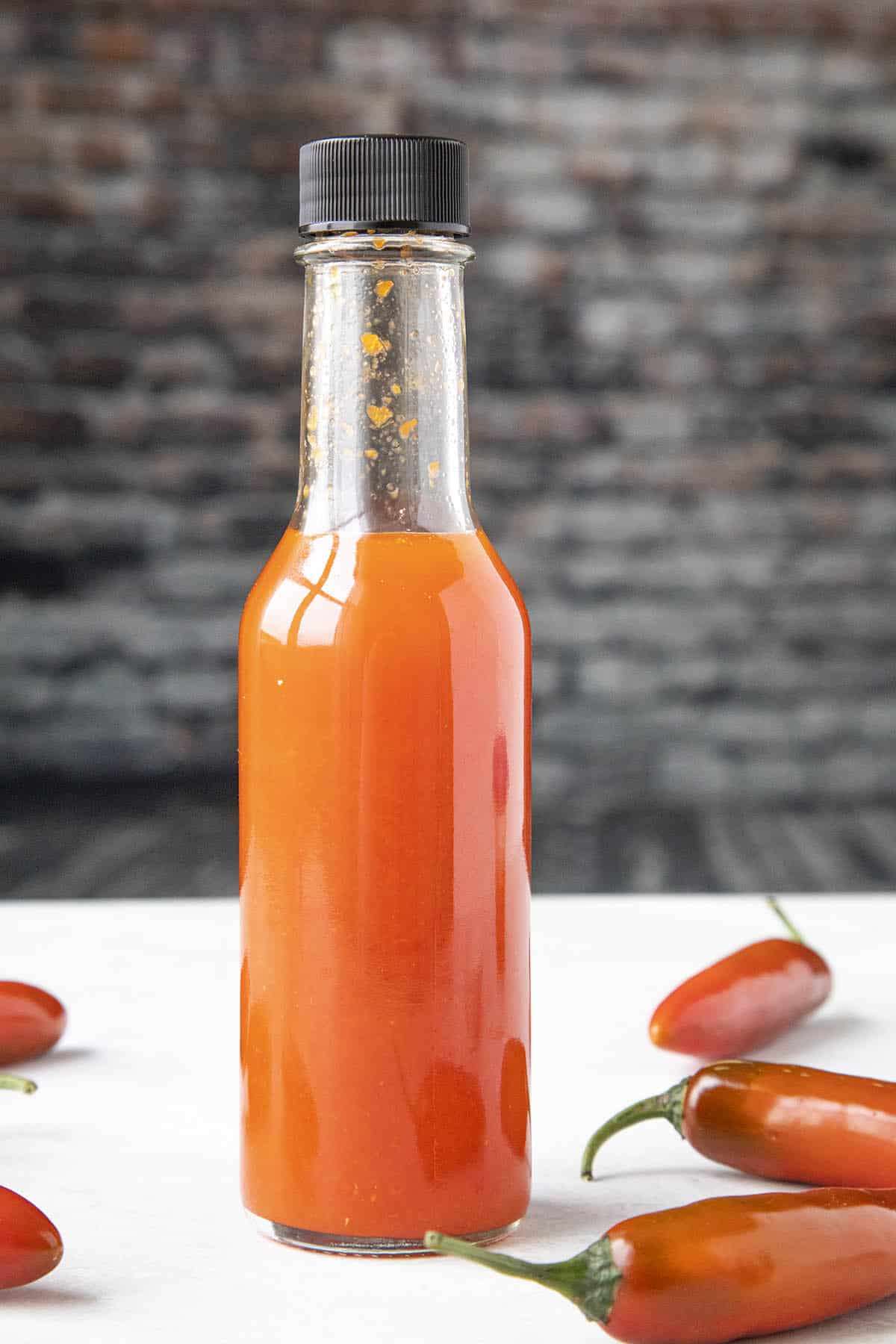
Fermented Hot Sauce Recipe
User Reviews
5
-
Prep Time
10 mins
-
Cook Time
15 mins
-
Fermentation
7 d
-
Servings
60 teaspoons
-
Calories
3 kcal
-
Course
Main Course, Condiments
-
Cuisine
American
Fermented Hot Sauce Recipe
Description
This recipe starts by roughly chopping serrano peppers and packing them into a jar with a salt brine made from unchlorinated water and sea salt. The jar is sealed and kept away from sunlight to ferment between 55-75°F. Regular burping of the jar releases gas buildup from fermentation. After one to two weeks, the peppers show reduced fermentation activity and the brine becomes cloudy and acidic-tasting.
The resulting fermented peppers are then blended with white wine vinegar of preferred strength and quality to balance acidity, producing a bright, sour, and spicy hot sauce. The fermentation develops depth of flavor that is difficult to replicate through other methods, while the vinegar preserves the sauce for longer storage.
To serve, use this hot sauce as a condiment to add heat and tang to dishes. Store it refrigerated for several months. If not cooked, fermentation may continue slowly in the fridge, and bottles may need occasional venting to release gas. For shelf-stable preservation, cooking and reaching a pH of 3.5 or below is recommended.
Ingredients
- 1 pound Serrano pepper or use any chili peppers, stems removed, red
- 1 quart water unchlorinated
- 3 tablespoons salt do not use iodized salt, sea salt
- ½-1 cup white wine vinegar use a good quality vinegar for better quality hot sauce, to your preference
Instructions
- First, ferment the serrano peppers. Roughly chop the peppers, then pack them into a ball jar, leaving at least 1 inch of head space. The peppers may rise a bit when fermenting.
- Next, mix 1 quart unchlorinated water with 3 tablespoons sea salt. Pour just enough brine over the peppers to cover them, pressing them down a bit as you go. It is important to keep the peppers covered with brine to avoid spoilage. Check this daily.
- Screw on the lid and set the jar away from direct sunlight to ferment for at least 1 week. Ideal temperatures are between 55-75 degrees F. The most active fermentation period is between 1-2 weeks, so be sure to monitor it during this time. “Burp” the jars often by unscrewing the lid a bit to let out some of the accumulating gases. Or, use an airlock or membrane for easier fermenting. See our page, “How to Ferment Peppers”, for more detailed instruction.
- After 1-2 weeks, the fermenting activity will diminish and the brine will turn cloudy and taste acidic.
- Drain the peppers, but reserve the brine.
- Add the fermented peppers to a food processor or blender, along with 1/2 cup of the brine and 1/2 cup vinegar. You can add more or less of each as desired to your preference. More brine will have more salty flavor, more vinegar will be more acidic.
- Process until smooth.
- Optional Step. Add the fermented hot sauce to a pot and bring to a quick boil. Reduce heat and simmer for 15 minutes. This will stop the fermentation process and meld the flavors, but will remove the probiotic benefits.
- Strain the mixture to remove the solids if desired, or use as-is for a thicker hot sauce. Pour into hot sauce bottles and enjoy.
- You can add more vinegar or water to thin out the hot sauce.
Notes
- Use sea salt or non-iodized salt for proper fermentation; iodized salt can inhibit fermentation.
- Maintain the temperature between 55-75°F for optimal fermentation activity.
- Burp jars daily or use airlocks to prevent pressure buildup during fermentation.
- pH of 3.5 or below is recommended if processing by water bath canning for shelf stability.
- Store fermented sauce refrigerated and burp the bottles occasionally to release gases if not cooked.
- Cooking fermented sauce will remove probiotics but extends shelf life and safety.
Nutrition Information
Show DetailsNutrition Facts
Serving: 60teaspoons
Amount Per Serving
Calories 3 kcal
% Daily Value*
| Calories | 3kcal | 0% |
| Carbohydrates | 1g | 0% |
| Protein | 1g | 2% |
| Fat | 1g | 2% |
| Saturated Fat | 1g | 5% |
| Sodium | 351mg | 15% |
| Potassium | 24mg | 1% |
| Fiber | 1g | 4% |
| Sugar | 1g | 2% |
| Vitamin A | 71IU | 1% |
| Vitamin C | 3mg | 3% |
| Calcium | 2mg | 0% |
| Iron | 1mg | 6% |
* Percent Daily Values are based on a 2,000 calorie diet.
User Reviews
Overall Rating
5
You'll Also Love