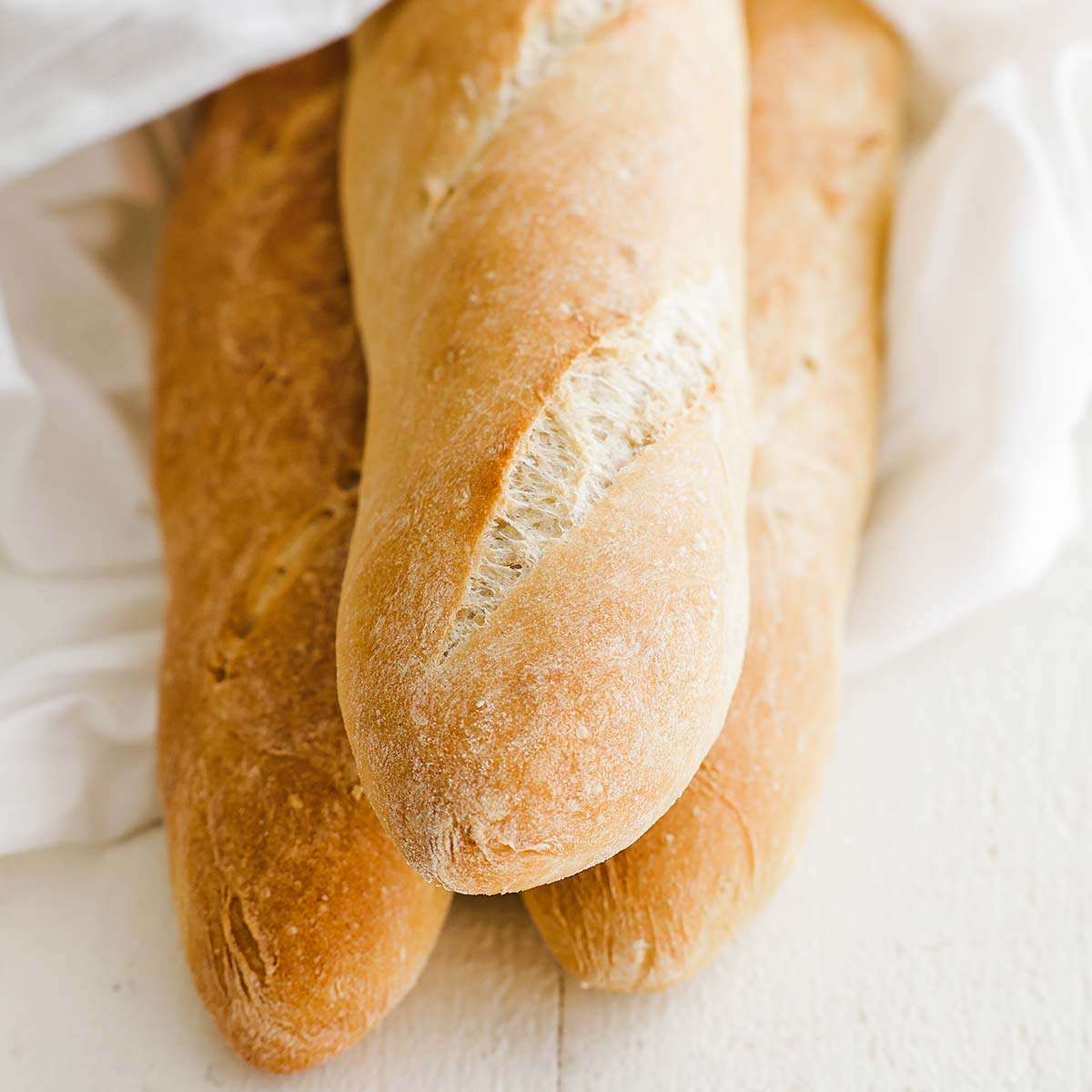
French Bread Recipe
User Reviews
5
French Bread Recipe
Description
This recipe starts by activating yeast in warm water with sugar, producing a foamy raft if using active yeast. The rest of the water, salt, softened butter, and bread flour are added before kneading thoroughly with a dough hook until slightly sticky. The dough is then covered and proofed in a warm environment, typically for 90 minutes until doubled in size.
After the first rise, the dough is punched down, gently kneaded again, and formed into evenly sized pieces depending on desired loaf thickness. The shaping into smooth balls or logs prepares them for a final proof and baking. The resulting bread features a crispy crust enhanced by baking with steam and a tender interior crumb.
Serving this French bread with butter, cheese, or as a sandwich base fits well with many meals. It can be stored for several days at room temperature or refrigerated, and it freezes well for months. Proofing in the oven with the light on provides an ideal warm environment. Scoring the dough with a sharp blade before baking helps expansion.
Ingredients
- 2 ¼ cup water 112° to 115°, warm
- 2 teaspoons sugar
- 1 active yeast packet
- 2 teaspoons salt sea salt
- 2 teaspoons unsalted butter softened
- 5 cups bread flour
Instructions
- Add ½ of the water to the bowl of a stand mixer along with the sugar and yeast.
- Whisk until combined, and then let it stand for 5 to 7 minutes.
- If you are using active yeast, a raft should form on the top. If you are using instant yeast, then there is no need to wait for the raft.
- Add in the rest of the water, salt, butter, and flour.
- Knead with a stand mixer using the dough hook for 8 to 10 minutes. It’s ok if the dough seems a little sticky.
- Remove the bowl, cover it with plastic wrap, and place it in a warm place for 90 minutes or until it’s doubled in size.
- Take off the plastic, and punch down the dough to its original size. If it’s stuck, dust it with some flour.
- Knead the dough on a clean, floured surface for 1 to 2 minutes.
- Form the dough into a large ball by cupping around the dough into the bottom.
- Cut the dough into 4 equal parts. If you want larger thicker French bread, cut it into 3 equal parts.
- Press down 1 of the doughs until it forms the shape of an oval.
- Fold the dough up by 1/3.
- Fold it up again by 1/3 meeting at the seam.
- Pinch the seams with your fingertips until they are shut.
- Roll the dough out until it is roughly 12 to 16 inches long and tapered at the ends.
- Place it on a sheet tray lined with parchment paper and cover it with plastic wrap.
- Proof for 60 minutes in a warm place.
- Preheat the oven to 425° and place a pan filled with water on the bottom rack
- Remove the plastic and cut 3 long slices on a bias using a sharp knife or razor. For an extra crisp crust, you can spray or brush the tops with water.
- Bake in the oven on the middle rack at 425° for 22 to 25 minutes or until browned on top and cooked through.
- Cool to room temperature. Slice and serve.
Notes
- Proof dough in a warm, humid environment like an oven with the light on for best rise.
- Adding a pan of water to oven while baking creates steam, promoting a golden crust.
- No rolling pin needed; shape dough by hand for even texture.
- Spray plastic wrap with non-stick spray to prevent sticking when covering dough.
- Use a sharp blade for scoring loaves to aid oven spring.
- The bread can be made up to one day ahead and kept covered at room temperature for three days or refrigerated up to five days.
- Freeze loaves for up to six months, thawing fully before slicing.
Nutrition Information
Show DetailsNutrition Facts
Serving: 8Serving
Amount Per Serving
Calories 286 kcal
% Daily Value*
| Calories | 286kcal | 14% |
| Carbohydrates | 58g | 19% |
| Protein | 9g | 18% |
| Fat | 1g | 2% |
| Saturated Fat | 0.2g | 1% |
| Polyunsaturated Fat | 1g | 6% |
| Monounsaturated Fat | 0.1g | 1% |
| Sodium | 586mg | 24% |
| Potassium | 79mg | 2% |
| Fiber | 2g | 8% |
| Sugar | 1g | 2% |
| Vitamin A | 2IU | 0% |
| Calcium | 14mg | 1% |
| Iron | 1mg | 6% |
* Percent Daily Values are based on a 2,000 calorie diet.
User Reviews
Overall Rating
5
You'll Also Love