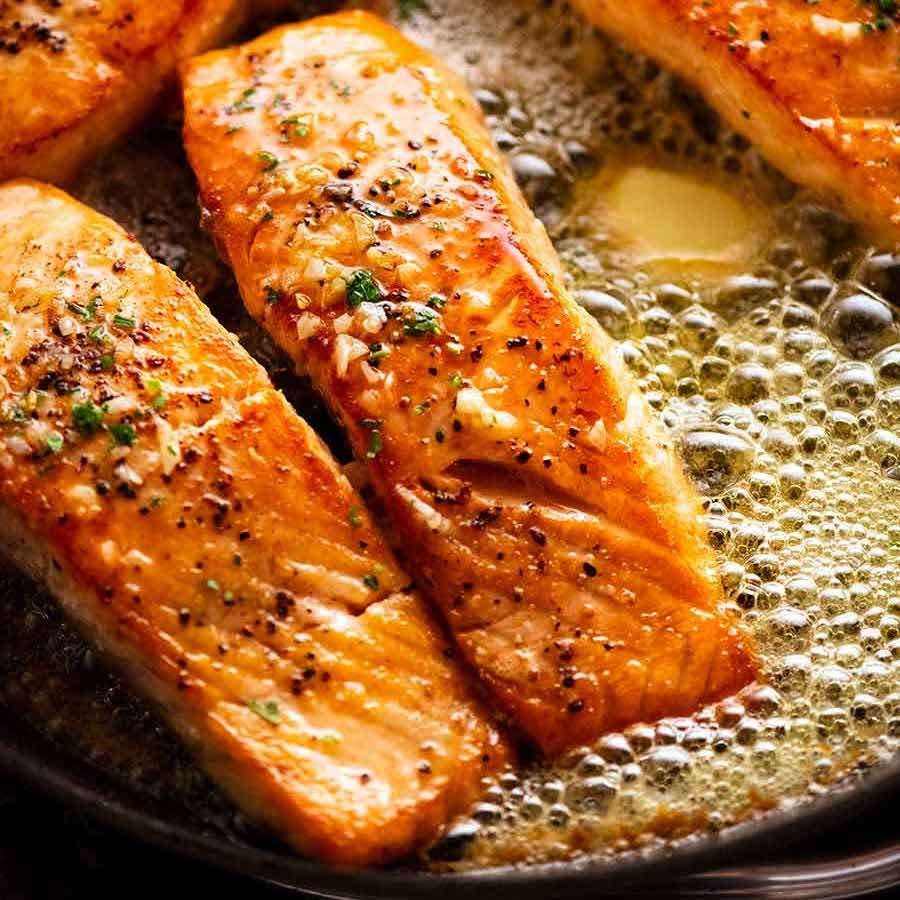
Garlic Butter Salmon recipe
User Reviews
5
-
Prep Time
5 mins
-
Cook Time
8 mins
-
Servings
4
-
Calories
464 kcal
-
Course
Main Course
-
Cuisine
American
Garlic Butter Salmon recipe
Description
This Garlic Butter Salmon recipe highlights salmon fillets cooked without skin for maximum flavor absorption. The fillets are seasoned simply with salt and pepper, then seared on one side until golden. After flipping, butter cubes and finely minced garlic are added and spooned repeatedly over the fish, creating a rich, buttery glaze that penetrates the flesh. A finishing touch of lemon juice brightens the flavor, balancing the buttery richness.
Cooking salmon to an internal temperature of about 50°C (122°F) ensures the fish remains moist and tender, slightly rare in the center, which is considered optimal for juiciness. Freshly chopped parsley scattered on top adds a subtle freshness to the dish. The gentle basting with garlic butter intensifies the flavor without overpowering the fish’s delicate taste.
This salmon pairs well with various side dishes and can be served immediately after resting for a few minutes to allow the juices to redistribute. The recipe’s instructions note that skin-on salmon can be used as well, adjusting cooking orientation accordingly. Leftover salmon keeps well in the refrigerator for several days and can be reheated gently or used cold in salads or sandwiches.
Overall, this recipe provides a straightforward method to enhance salmon with rich garlic butter flavors and a tender texture through careful cooking and basting techniques.
Ingredients
- 4 salmon 180g/6oz each), skinless and boneless, fillets
- 1/2 tsp salt , cooking / kosher
- 1/4 tsp black pepper
- 1 1/2 tbsp olive oil
- 1 tbsp garlic finely minced by hand (don't use a garlic press, about 2 cloves
- 90g / 6 tbsp butter cut into cubes (or unsalted + 1/4 tsp salt, salted
- 1 tsp lemon juice , plus more to taste
- 2 tsp parsley , finely chopped
Instructions
- Season salmon: Take salmon out of fridge 30 minutes prior to cooking. Sprinkle both sides with salt and pepper.
- Sear salmon 3 mins: Heat oil in large non stick skillet over medium-high heat. Add salmon, presentation side (ie. curved side) down, and cook for 3 minutes until golden.
- Turn, cook 1 min, then add butter: Turn salmon and cook the other side for 1 minute. THEN put the butter in.
- Baste 1 1/2 minutes: Once butter is melted and foaming, add garlic and immediately start spooning the bubbling butter continuously over the salmon for 1 1/2 minutes. To do this, tilt the pan slightly so the butter pools on one side. Use a large spoon to scoop the butter up and spoon it over the salmon.
- Remove salmon from stove: Check Internal temperature of salmon. It should be 50°C/122°F for medium-rare (optimum juiciness pull temp). Remove salmon to a plate. Rest for 3 minutes – it will rise to 53°C/127°F. (See Note 2 for internal temperatures)
- Add lemon juice to butter: Put pan back on unlit stove to keep butter hot. Add lemon juice.
- Serve: Place salmon on serving plates. Spoon over butter (be judicious, it's rich!), garnish with a sprinkle of parsley. Pictured in the post with Cauliflower Mash and leafy greens with French Vinaigrette.
Notes
- Slicing skinless salmon allows better absorption of the garlic butter sauce, but skin-on salmon can be used by adjusting cooking sides.
- Check internal temperature for doneness around 50°C (122°F) for medium-rare, ensuring juicy salmon.
- Leftover cooked salmon keeps 3 to 4 days in the refrigerator; reheat gently or use cold in salads and sandwiches.
Nutrition Information
Show DetailsNutrition Facts
Serving: 4Serving
Amount Per Serving
Calories 464 kcal
% Daily Value*
| Calories | 464cal | 23% |
| Carbohydrates | 1g | 0% |
| Protein | 36g | 72% |
| Fat | 35g | 54% |
| Saturated Fat | 14g | 70% |
| Trans Fat | 1g | 50% |
| Cholesterol | 147mg | 49% |
| Sodium | 531mg | 22% |
| Potassium | 891mg | 19% |
| Fiber | 1g | 4% |
| Sugar | 1g | 2% |
| Vitamin A | 639IU | 13% |
| Vitamin C | 1mg | 1% |
| Calcium | 28mg | 3% |
| Iron | 1mg | 6% |
* Percent Daily Values are based on a 2,000 calorie diet.
User Reviews
Overall Rating
5
You'll Also Love