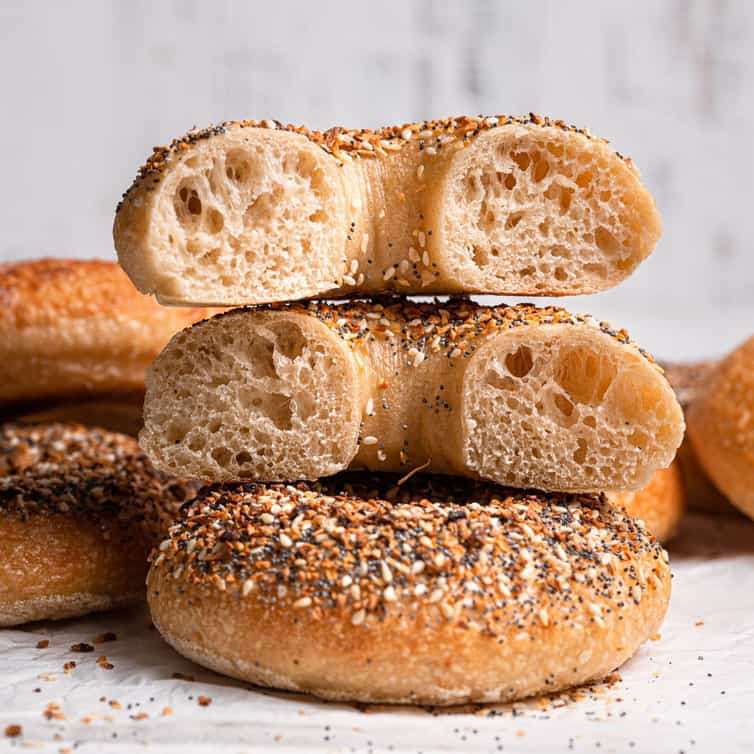
Homemade Bagels Recipe
User Reviews
4.7
Homemade Bagels Recipe
Description
This recipe begins by preparing a sponge with high-gluten unbleached flour, instant yeast, and water, left to ferment at room temperature for about two hours until foamy. The sponge is then combined with additional flour, salt, barley malt syrup, and yeast to form a firm dough. Kneading the dough by hand or machine until smooth ensures good gluten development for the characteristic bagel chewiness. The dough is shaped into bagels, then boiled briefly in a solution of sugar and malt powder, which helps form a shiny, chewy crust and proper oven spring. Baking follows to finish the crust and cook the interior fully.
The use of high-gluten flour supports a dense, chewy texture typical of bagels. Barley malt syrup or its substitutes like honey or light brown sugar contribute to the flavor and crust coloration. Prepared bagels can be stored at room temperature for a couple of days, refrigerated for up to five days, or frozen up to one month when wrapped properly. Bagels can be reheated by toasting or baking to refresh their texture. The dough can also be shaped and refrigerated before boiling and baking for up to two days.
Ingredients
For the Sponge
- 1 teaspoon instant yeast
- 4 cups high-gluten unbleached flour
- 2½ cups water at room temperature
For the Dough
- ½ teaspoon instant yeast
- 3¾ cups high-gluten unbleached flour
- 2¾ teaspoons salt
- 1 tablespoon barley malt syrup
For Boiling
- 1 tablespoon granulated sugar
- 2 tablespoons non-diastatic malt powder
- cornmeal for dusting baking sheets, or semolina flour
Instructions
- Make the Sponge: Stir the yeast into the flour in a 4-quart (or larger) mixing bowl. Add the water, whisking or stirring only until it forms a smooth, sticky batter (like pancake batter). Cover the bowl with plastic wrap and leave at room temperature for approximately 2 hours, or until the mixture becomes very foamy and bubbly. It should swell to nearly double in size and collapse when the bowl is tapped on the countertop.
- Make the Dough: In the same mixing bowl (or in the bowl of an electric mixer), add the additional yeast to the sponge and stir. Then add 3 cups of the flour and all of the salt and the barley malt syrup. Stir (or mix on low speed with the dough hook) until the ingredients form a ball, slowly working in the remaining ¾ cup flour to stiffen the dough.
- Transfer the dough to the counter and knead for at least 10 minutes (or for 6 minutes by machine). The dough should be firm, but still pliable and smooth. There should be no raw flour - all the ingredients should be hydrated. Break off a small piece of dough and gently stretch and pull it to see if it will hold a paper-thin, translucent membrane (called the "windowpane test"). If the dough seems dry and rips, add a few drops of water and continue kneading. If the dough seems tacky or sticky, add more flour to achieve the stiffness required. The kneaded dough should feels satiny and pliable but not be tacky.
- Shape the Bagels: Immediately divide the dough into 4½ ounce pieces for standard large bagels, or smaller if desired. Form the pieces into rolls. Cover the rolls with a damp kitchen towel and allow them to rest for 20 minutes.
- Line two baking sheets with silicone baking mats, or parchment paper sprayed lightly with non-stick cooking spray.
- To shape the bagels, use your thumb to poke a hold in a ball of bagel dough and gently stretch evenly until the hole is 1 to 2 inches in diameter. Alternatively, you can roll the dough into an 8-inch rope and wrap the dough around the palm and back of your hand, overlapping the ends by several inches. Press the overlapping ends together and gently roll back and forth to seal.
- Place each of the shaped bagels 2 inches apart on the pans. Mist the bagels very lightly with non-stick cooking spray and cover loosely with plastic wrap. Let the pans sit at room temperature for 20 minutes.
- Check to see if the bagels are ready to be retarded in the refrigerator by using the "float test". Fill a small bowl with cool or room-temperature water. The bagels are ready to be retarded when they float within 10 seconds of being dropped into the water. Take one bagel and test it. If it floats, immediately return the tester bagel to the pan, pat it dry, cover the pan with plastic wrap, and place it in the refrigerator overnight (it can stay in the refrigerator for up to 2 days). If the bagel does not float, return it to the pan and continue to proof the dough at room temperature, checking back every 10 to 20 minutes or so until a tester floats. The time needed to accomplish the float will vary, depending on the ambient temperature and the stiffness of the dough.
- Boil and Bake the Bagels: The following day (or when you are ready to bake the bagels), preheat the oven to 500 degrees F with the two racks set in the middle of the oven. Bring a large pot of water to a boil (the wider the pot the better - a Dutch oven is perfect!), and add the sugar and non-diastatic malt powder. Have a slotted spoon or skimmer nearby.
- Remove the bagels from the refrigerator and gently drop them into the water, boiling only as many comfortably fit (they should float within 10 seconds). After 1 minute flip them over and boil another minute. If you like very chewy bagels, you can extend the boiling to 2 minutes per side. While the bagels are boiling, sprinkle the same silicone baking mats or parchment-lined sheet pans with cornmeal or semolina flour. If you want to top the bagels with anything, do so as soon as they come out of the water.
- When all the bagels have been boiled, place the pans on the 2 middle shelves in the oven. Bake for approximately 5 minutes, then rotate the pans, switching shelves and giving the pans a 180-degree rotation. (If you are baking only 1 pan, keep it on the center shelf but still rotate 180 degrees.) After the rotation, lower the oven setting to 450 degrees F and continue baking for about 5 minutes, or until the bagels turn light golden brown. You may bake them darker if you prefer.
- Remove the pans from the oven, transfer the bagels to a wire cooling rack, and let cool for at least 15 minutes before serving. Fresh bagels are best, but these keep well in an airtight container or bag for up to 2 days. If you won't eat them within that time frame, I recommend wrapping them individually in plastic wrap and placing in a ziploc freezer bag, and storing them in the freezer for up to 1 month.
Notes
- Substitute bread flour for high-gluten flour, but avoid all-purpose flour to maintain bagel texture.
- Honey or light brown sugar can replace barley malt syrup in the dough.
- Store leftover bagels airtight at room temperature for 2 days or refrigerated for up to 5 days.
- Wrap and freeze bagels individually for up to 1 month; thaw wrapped before warming.
- Bagels can be shaped and refrigerated for up to 2 days before boiling and baking.
- Reheat by toasting, or for original texture, bake at 375°F for about 5 minutes.
Nutrition Information
Show DetailsNutrition Facts
Serving: 12large bagels
Amount Per Serving
Calories 301 kcal
% Daily Value*
| Calories | 301kcal | 15% |
| Carbohydrates | 57g | 19% |
| Protein | 11g | 22% |
| Sodium | 541mg | 23% |
| Potassium | 21mg | 0% |
| Fiber | 2g | 8% |
| Sugar | 2g | 4% |
| Calcium | 5mg | 1% |
| Iron | 1mg | 6% |
* Percent Daily Values are based on a 2,000 calorie diet.
User Reviews
Overall Rating
4.7
You'll Also Love