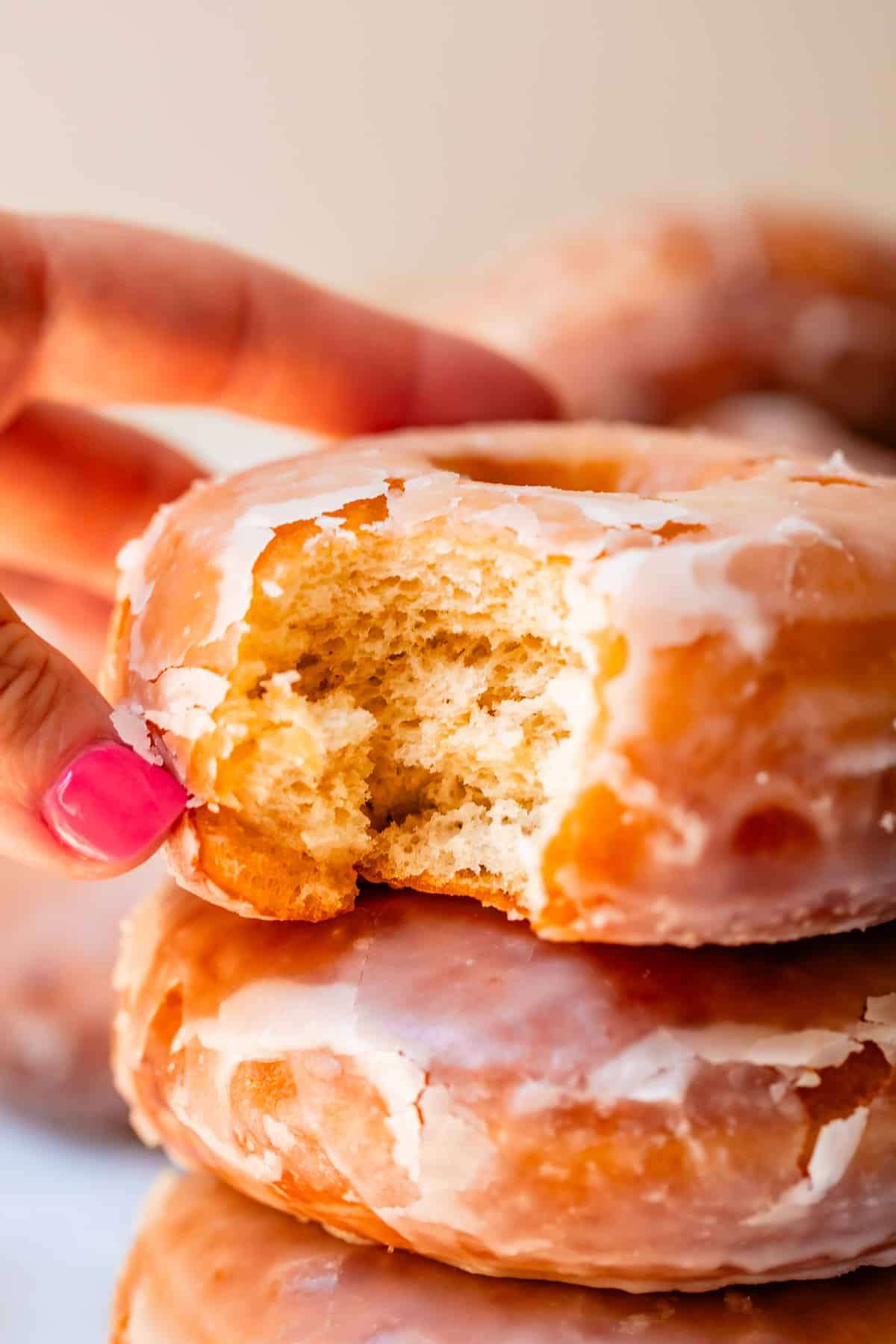
Homemade Donut Recipe
User Reviews
5
Homemade Donut Recipe
Description
The recipe begins by warming whole milk to about 105–110°F, activating a large quantity of active dry yeast with sugar to ensure good rise and airiness. The yeast mixture is combined with sugar, shortening, eggs, and vanilla extract, then mixed with bread flour, kosher salt, baking powder, and baking soda to create a well-developed dough. After mixing and kneading, the dough is allowed to rise until doubled.
Once risen, the dough is shaped into classic donut rings and left to proof again. The donuts are deep-fried in a generous amount of oil until golden brown, yielding a crisp exterior with a soft, airy interior. The glaze is prepared by melting butter with sugar, cornstarch, corn syrup, water, vanilla, and salt, then poured over warm donuts, providing a shiny and sweet finish.
This method results in donuts with a tender crumb and classic glazed appearance, suitable for serving fresh as a sweet breakfast or snack. The recipe includes options for overnight rises and advice on yeast types and temperatures for best results.
Ingredients
- 1 cup milk whole
- 3 tablespoons active dry yeast
- 1 tablespoon granulated sugar
- 1/2 cup granulated sugar
- 1/4 cup shortening
- 1 large egg
- 1 large egg yolk
- 1 and 1/2 teaspoons vanilla extract
- 3 and 1/4 cups bread flour plus 1/4 cup if necessary
- 2 and 1/2 teaspoons kosher salt or 2 teaspoons table salt
- 1/2 teaspoon baking powder
- 1/2 teaspoon baking soda
For frying
- 12 cups canola oil or peanut oil
For the glaze
- 1/2 cup water cold
- 1 tablespoon cornstarch
- 3 tablespoons granulated sugar
- 1/4 cup butter
- 1 tablespoon corn syrup
- 2 teaspoons vanilla
- 4 cups powdered sugar
- 1/2 teaspoon kosher salt use 1/4 teaspoon table salt
Instructions
- Make the dough. In a glass measuring cup, add 1 cup whole milk. Microwave it until it is warm but not hot. Stick your finger in it to make sure. If you wouldn't give a baby a bath in this milk, it's too hot. (I don't know why I can never think of a better temperature gauge than bathing children, but there you go.) Temp should be around 105-110 F.
- Add 3 tablespoons active dry yeast*. Yes! 3 tablespoons! We are not messing around! Add 1 tablespoon sugar so the yeast has something to eat.
- Wait a couple minutes until you see bubbles forming in your yeast mixture. (If it stays completely flat, you killed it, game over! Try again.)
- Add yeast mixture to a large bowl or the bowl of a stand mixer. Add 1/2 cup granulated sugar, 1/4 cup shortening, 1 egg, 1 egg yolk, and 1 and 1/2 teaspoons vanilla. Stir it all together with a rubber spatula.
- Carefully measure 3 and 1/4 cups bread flour (spoon the flour into the measuring cup, then level off the top.) Add the flour to your yeast mixture but don't stir yet.
- Add 2 and 1/2 teaspoons kosher salt, 1/2 teaspoon baking powder, and 1/2 teaspoon baking soda. Stir this into the flour.
- Knead the dough. Use the dough hook (or a wooden spoon) to stir the dough until it is thick enough to knead. Knead with the dough hook (or by hand on a lightly floured surface) for 5 full minutes. The dough should have come together and be stretchy and elastic. If you touch the dough and your fingers come away sticky, add the extra 1/4 cup of flour (or more as necessary), to get a workable dough.
- Grease a large bowl with oil or nonstick spray. Shape the dough into a ball, slap it in the bowl, and turn it over so the top side is greased. Cover with plastic wrap that has been sprayed generously with nonstick spray.
- Create a proofing box in your oven: Bring about 8-10 cups of water to a boil, either in a kettle or in a pot on the stove. Turn your oven on to 350 degrees F for about 30-60 seconds, then turn it off. The oven should be warm but not hot. You should be able to touch the oven racks with your fingers.
- Place the covered bowl of dough on the top rack in your oven. Place a 9x13 inch cake pan on the bottom rack of the oven. Pour the boiling water into the pan and shut the door right away to capture all the steam.
- Let the dough rise in this toasty, humid environment for 1 hour. The dough should have doubled in size.
- Prepare two half baking sheets with parchment paper. I love to use these 6x6 inch parchment paper squares (one rising donut per square.) If you don't have the fancy squares, I would take the time to cut 6x6 inch squares. Lay them out on the baking sheets.
- Pour the water from the 9x13 inch pan back into the pot or kettle and bring to a boil again. Heat your oven to 350 for 30-60 seconds, just like before, and turn it off. Warm, not hot.
- Shape the donuts. Scrape the dough onto a greased pastry mat or lightly floured work surface. Knead the dough a couple times, then divide the dough into 12-14 pieces, depending on how large you want your doughnuts to be. (If you want, make some tiny balls of dough and fry them as-is, for donut holes.)
- Pat each piece of dough into a 3 to 4 inch disc. Use a rolling pin if you want, I just used my hands. Use your thumb to press and eventually break through the center of the dough. Use your fingers to widen the hole to at least 1 and 1/2 inches, smoothing the dough along the edges as best you can. Stretch and mold your donut wider, and round out the ring of the donut. I found it helpful to place the donut on my finger and spin it a few times. Centrifugal force is real, folks #science. Shape your donut to be as round and puffy as you want it to look when you are eating it.
- Let the shaped donuts rise. Place each shaped donut on a square of parchment paper, with plenty of room to rise. Eight donuts is the max per pan I would say. Shape all the dough into donuts. Do not cover this time.
- Place the two pans of rising donuts in your oven, both pans on the top rack if you can squeeze them in. Place the 9x13 pan on the bottom rack. (If you can't squeeze, place one pan on each rack and place the 9x13 pan on the bottom of the oven, yes, directly on the element, but ONLY after you have shut off the oven. Make sure it's not hot to the touch. Do not turn the oven on!)
- Once all the shaped donuts are in the warm oven, pour the boiling water into the 9x13 inch pan. Shut the door right away. Let the shaped donuts rise for 30-45 minutes, until doubled in size.
- Make the glaze. Do this during the final rise, because you want to glaze the donuts when they are hot. In a small saucepan, add 1/2 cup cold water and 1 tablespoon cornstarch. Whisk together until smooth. Add 3 tablespoons granulated sugar and 1/4 cup butter. Turn the heat on to medium and whisk constantly. Cook for about 2 minutes, until the butter is melted and small bubbles are JUST beginning to form on the edges. Remove from the heat right away. (if you over cook this mixture, the cornstarch will get too thick.)
- Add 1 tablespoon corn syrup, 2 teaspoons vanilla, and 1/2 teaspoon kosher salt. Then add 4 cups SIFTED powdered sugar. (Add it through a strainer). Use a whisk to combine it all until there are no lumps. Keep the whisk handy; the glaze will start to harden on top, and you need to whisk it occasionally to keep it smooth. You may need to thin the glaze with a little more water, (or thicken with more powdered sugar), add it 1 tablespoon at a time.
- Heat the oil. Halfway through the rise time, start heating your oil. In a 12-inch high-sided skillet, add canola oil until it reaches about 2 inches up the side of the pan. Turn the heat to medium. Heat until the temperature reads 350 degrees F on a candy thermometer. Don't throw away the oil container.
- Prep your work station. Line a few paper grocery bags (or paper towels) on the counter and place 2 cooling racks on top. Have a pair of tongs handy. Keep your thermometer either clipped onto the side of the pan or nearby to recheck the temperature.
- Fry the donuts. When the doughnuts are doubled in size, remove the pans from the oven. Use two hands to lift the edges of a piece of parchment paper with one raised donut on it. Slowly lower the paper into the oil, dropping one side completely, and holding the paper up on the other side. The paper and the donut should be completely in the oil, except the corner you are holding with your fingers. Shimmy the paper back and forth until the donut slides off into the oil.
- Let the donut fry on the first side for about 30-60 seconds, until light brown. Use tongs or chopsticks to flip the donut and continue frying for another 30-60 seconds until light brown. (The donuts will continue to darken in color even after cooking.)
- Use a spider strainer (or slotted spoon or tongs) to gently lift the fried donut to the cooling rack set on top of the absorbent paper.
- Take the time to check the temperature of the oil before frying more. You might need to wait a couple minutes for the oil to climb back up to 350. Keeping the oil temperature steady is one of the reasons you need to use so much oil when deep frying.
- Continue frying the donuts, adding 3-4 donuts per batch, whatever you can fit. Check the temperature frequently and make sure it's near 350.
- When the donuts are all fried, turn off the heat and set the oil aside to cool.
- Glaze the donuts. When the donuts are cooled enough to touch but still warm, dip them in the glaze. Flip them over and make sure they get completely coated. Wait 20 minutes, then dip each donut again. One dip makes a good donut; double dipping makes a fantastic donut.
- Let the donuts cool completely. The glaze tastes better when it has had time to dry out and get crisp and crackly. But this of course means you don't get to eat a hot donut. Professional donut shops use a special ingredient (agar) to help the glaze set up faster. (If you want to try it, add 1/2 teaspoon agar to one batch of glaze.)
- Eat your donuts on day one. No, really. Find a neighbor to share with! Have a donut party! Calories don't count today! Day-old donuts are just not great.
- How to store donuts: Okay fine, no donut party.The first option is to store them in an airtight container. This keeps the donuts themselves fresh and moist, but can make the glaze soggy the longer they sit.Second, you can keep them in a loosely closed paper bag. This maintains the structure of the glaze, but they will dry out faster than those in an airtight container.
- What to do with the leftover oil: Hopefully you saved your oil container! If not, use mason jars. Place your container in the sink. Holler at your people for some help. Place a funnel on top of the container. Hold a strainer over the top of the funnel to catch any dough bits. Pour it in. Save it! Store in the cupboard. I use oil 2-3 times before funneling it back in the container a final time and tossing it in the trash.
Notes
- Using instant yeast can reduce rise times by about 20 minutes compared to active dry yeast.
- For overnight preparations, you can do the first rise in the refrigerator for 8-12 hours before shaping and continuing as usual.
- Alternatively, the second rise can be done overnight by shaping the donuts, covering well, and refrigerating before final proofing and frying.
- Ensure the milk temperature is warm but not hot (around 105-110°F) to keep yeast active without killing it.
Nutrition Information
Show DetailsNutrition Facts
Serving: 12Serving
Amount Per Serving
Calories 682 kcal
% Daily Value*
| Serving | 1donut | |
| Calories | 682kcal | 34% |
| Carbohydrates | 80g | 27% |
| Protein | 6g | 12% |
| Fat | 38g | 58% |
| Saturated Fat | 6g | 30% |
| Polyunsaturated Fat | 10g | 59% |
| Monounsaturated Fat | 21g | 105% |
| Trans Fat | 1g | 50% |
| Cholesterol | 43mg | 14% |
| Potassium | 85mg | 2% |
| Fiber | 1g | 4% |
| Sugar | 54g | 108% |
| Vitamin A | 195IU | 4% |
| Vitamin C | 0.003mg | 0% |
| Calcium | 47mg | 5% |
| Iron | 1mg | 6% |
* Percent Daily Values are based on a 2,000 calorie diet.
User Reviews
Overall Rating
5
You'll Also Love