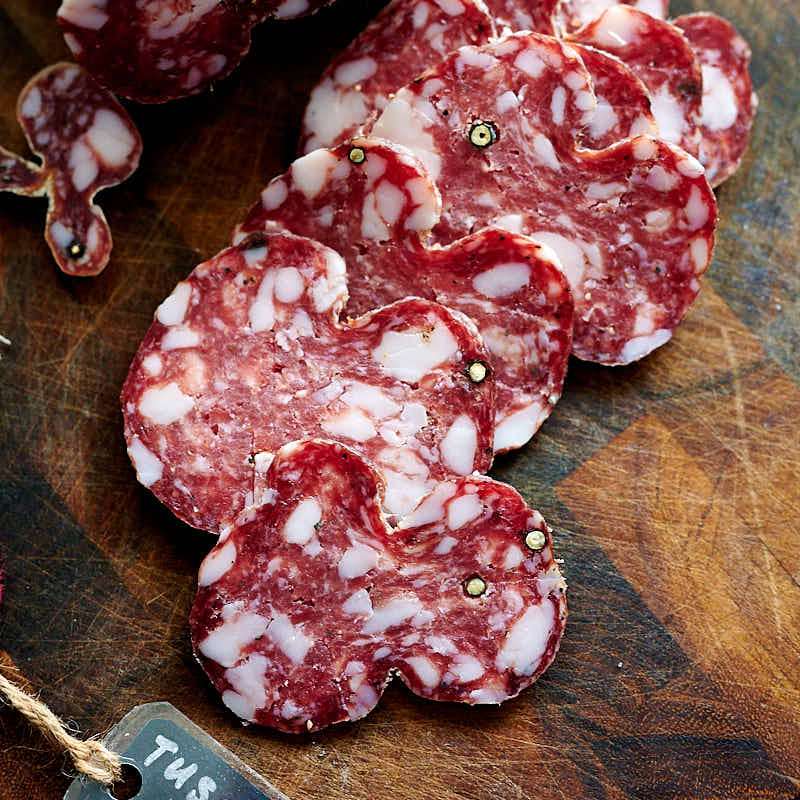
Homemade Salame Toscano
User Reviews
5
Homemade Salame Toscano
Description
Salame Toscano is prepared by selecting lean pork such as shoulder, neck (coppa), or loin, paired with pork back fat for moisture and texture. Salt, Cure #2 (a curing salt), dextrose, and a starter culture ensure safe fermentation and develop the salami's characteristic tang. The red wine, infused with crushed garlic and strained, contributes mild aromatic notes without garlic pieces in the final mix. Black pepper is used both whole and coarsely ground, adding pungency and texture.
The meat and fat are first cut, then combined with seasonings and cooled before grinding through a medium plate. The mixture is thoroughly mixed until sticky, ensuring an even distribution of ingredients which aids in fermentation and curing. This salami requires careful handling and timing for fermentation and drying to develop its flavor fully.
Scaling the recipe requires adjusting the starter culture proportionally, but the water used for culture rehydration remains consistent at 60 ml unless processing over 3 kg of meat, in which case it doubles to maintain appropriate moisture levels.
Ingredients
- 750 g pork shoulder, neck (coppa), or loin, lean, any or combination of ham
- 250 g pork back fat belly or back fat
- 25.5 g salt sea salt
- 2.5 g Cure #2
- 2.25 g dextrose
- 0.12 g T-SPX culture
- 60 ml distilled water
- 20 ml red wine good Tuscan red wine
- 1/4 clove garlic crushed, for infusing wine only, removed after infusion
- 3 g black pepper whole
- 3 g black pepper coarsley ground
Instructions
- Crush the garlic and place it in a small cup. Add the wine and let it infuse for about 30-60 minutes. Strain the wine before mixing it with the meat.
- Rehydrate the starter culture in 60 ml distilled water. (see notes)
- Weigh the lean meat and the back fat in grams. Calculate the rest of the ingredients, except the distilled water which will remain the same (see notes), weigh them out and set aside.
- In a small bowl, combine the salt, Cure #2 and dextrose.
- Cut the lean meat and about a 1/4 of the back fat into 1-inch pieces. Cut the rest of the back fat into small cubes, keeping separately. Sprinkle about 80% percent to the salt mixture over lean meat with large back fat pieces, and 20% over the finely chopped fat and mix each well.
- Freeze the meat and the fat for 20 minutes.
- Grind the lean pork and the larger fat pieces through a 3/16″ (4.5mm) grinder plate.
- Combine the ground pork with seasonings, dextrose, and starter culture. Mix well, until sticky, then mix in the groud and the cubed back fat. It helps to use a stand mixer with a paddle attachment for this.
- Stuff into 70-110 mm natural casings (beef bungs) and tie into 10"-12" links.
- Using a sterilized needle or sausage pricker, prick holes across the entire salami.
- Weigh the salami, write down its weight on a tag and attach the tag to the salami.
- If desired, inoculate with mold.
- Use the leftover meat from the stuffer/stuffing tube to make a small sample for measuring the initial pH and the pH at later stages. Make sure to record the readings.
- Dry at 59F - 77F (15C - 25C) and 65% - 86% RH for a period of 7 days as per the drying protocol above. Measure the pH, it should be below 5.3 at this point.
- Mature in the curing chamber at 55F - 57F (13C - 14C) and 80% - 84% for about 3 months.
Alternative curing method
- Ferment salami at 68F-70F for three days to get the pH below 5.3.
- Cure at the standard 55F-57F and 75% RH until 35% weight loss is obtained.
Notes
- When doubling or scaling up the recipe, increase the starter culture accordingly, but keep the distilled water at 60 ml or double it if using over 3 kg of meat.
Nutrition Information
Show DetailsNutrition Facts
Serving: 10servings
Amount Per Serving
Calories 289 kcal
% Daily Value*
| Calories | 289kcal | 14% |
| Carbohydrates | 1g | 0% |
| Protein | 17g | 34% |
| Fat | 24g | 37% |
| Saturated Fat | 9g | 45% |
| Cholesterol | 63mg | 21% |
| Sodium | 1128mg | 47% |
| Potassium | 323mg | 7% |
| Fiber | 1g | 4% |
| Sugar | 1g | 2% |
| Calcium | 6mg | 1% |
| Iron | 1mg | 6% |
* Percent Daily Values are based on a 2,000 calorie diet.
User Reviews
Overall Rating
5
You'll Also Love