How to Ferment Chili Peppers (Pepper Mash Recipe)
User Reviews
4.9
-
Prep Time
15 mins
-
Cook Time
7 d
-
Servings
1 cup
-
Calories
181 kcal
-
Course
Condiments
-
Cuisine
American
How to Ferment Chili Peppers (Pepper Mash Recipe)
Description
The basic pepper mash begins with finely chopped or blended chili peppers mixed with salt at about 2.3% of the mash weight, usually one teaspoon per pound of peppers. As the mixture is packed tightly into jars, moisture is released, creating a brine that naturally covers the peppers during fermentation. The jar should have at least one inch of headspace, and the peppers must remain submerged to prevent spoilage.
The brine pepper mash uses a saltwater solution ranging from 3% to 6% salt concentration, which allows for longer and more controlled fermentation. Both methods require keeping the jars away from direct sunlight and maintaining temperatures around 55-75°F (13-24°C). Active fermentation typically occurs within the first two weeks, so it's important to monitor the brine level and release any excess gas by loosening the lid periodically.
The resulting fermented mash develops acidity and complex flavors suitable for hot sauces, condiments, or cooking bases, with salt types excluding those with additives recommended to avoid off-flavors or fermentation issues.
Ingredients
FOR BASIC PEPPER MASH
- 1 pound chili peppers stemmed and roughly chopped (cored and seeded, if desired)
- 1 teaspoon salt
FOR BRINE PEPPER MASH
- 1 pound chili peppers stemmed and roughly chopped (cored and seeded, if desired)
- 1.5-3 tablespoons salt (1.5 tablespoon (27 g, for 3% brine) to 3 tablespoons (54 g, for 6% brine))
- 1 quart water unchlorinated
Instructions
FOR MAKING BASIC PEPPER MASH
- Finely chop your peppers. You can blend them to fit more into jars, but this can make it harder to keep below the brine.
- Next, mix in salt. You should use 1 teaspoon salt (5.69 g) per pound (.45 kg) of peppers. 1 pound of peppers should process down to about 1 cup of mash. So, use 1 teaspoon of salt per cup of mash, which is roughly 2.3% salt by weight.
- The peppers will begin to release their moisture right away.
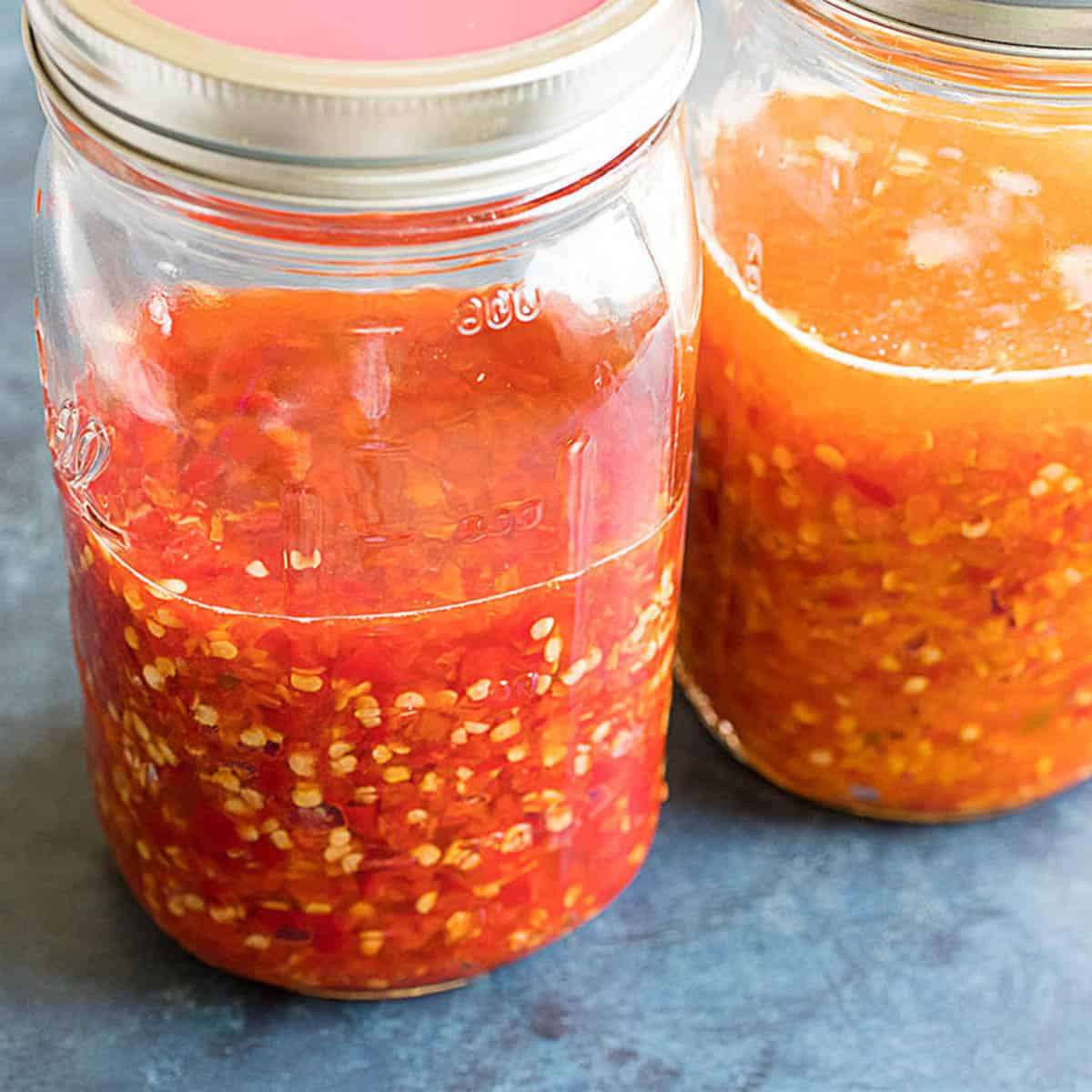
- Place your mash into a jar and press it down to remove any air pockets. Leave at least 1 inch (2.54 cm) of headspace. The peppers may rise a bit when fermenting. The brine will rise up and cover the peppers. It is important to keep the peppers covered with brine to avoid spoilage. Check this daily.
- Screw on the lid and set the jar away from direct sunlight to ferment for at least 1 week. Ideal temperatures are between 55-75 degrees F (12.78-23.89 C). The most active fermentation period is between 1-2 weeks, so be sure to monitor it during this time. “Burp” the jars often by unscrewing the lid a bit to let out some of the accumulating gases. Or, use an airlock or membrane for easier fermenting. See below for what I like to use.
- After 1-2 weeks, the fermenting activity will diminish. Move it to a pantry where you can let it ferment longer if you’d like, or use it right away. You can ferment for months or even longer to allow the flavors to more fully develop.
- Once it is ready, store it in the refrigerator where it will last for a year or longer.
FOR MAKING BRINE PEPPER MASH
- Finely chop your fresh peppers. You can blend them to fit more into jars, but this can make it harder to keep below the brine. Pack them into a jar, leaving at least 1 inch of head space. The peppers may rise a bit when fermenting.
- Next, mix 1 quart (.95 liter) unchlorinated water with sea salt. Pour just enough brine over the peppers to cover them, pressing them down a bit as you go. It is important to keep the peppers covered with brine to avoid spoilage. Use a glass weight or a baggie filled with water on top if needed to press the peppers down below the brine. Check this daily.
- Screw on the lid and set the jar away from direct sunlight to ferment for at least 1 week. Ideal temperatures are between 55-75 degrees F (12.78-23.89 C). The most active fermentation period is between 1-2 weeks, so be sure to monitor it during this time. “Burp” the jars often by unscrewing the lid a bit to let out some of the accumulating gases. Or, use an airlock or membrane for easier fermenting.
- After 1-2 weeks, the fermenting activity will diminish and the brine will turn cloudy and taste acidic. Move it to a pantry where you can let it ferment longer if you’d like, or use it right away. You can ferment for months or even longer to allow the flavors to more fully develop.
- Once it is ready, process it with a food processor. You can use it right away to make hot sauce or store it in the refrigerator where it will last for a year or longer.
- I personally like to add a bit of vinegar at this stage before storage.
Notes
- Use non-iodized salt such as sea salt, kosher salt, or pickling salt to avoid interfering with fermentation.
- Ensure peppers remain fully submerged under brine during fermentation to prevent spoilage.
- Keep fermentation jars in a cool, shaded spot with temperatures between 55-75°F (13-24°C) for best results.
- Allow at least one week for fermentation; monitor daily to release gas and maintain brine level.
Nutrition Information
Show DetailsNutrition Facts
Serving: 1cup
Amount Per Serving
Calories 181 kcal
% Daily Value*
| Calories | 181kcal | 9% |
| Carbohydrates | 40g | 13% |
| Protein | 8g | 16% |
| Fat | 2g | 3% |
| Saturated Fat | 0.2g | 1% |
| Polyunsaturated Fat | 1g | 6% |
| Monounsaturated Fat | 0.1g | 1% |
| Sodium | 2366mg | 99% |
| Potassium | 1461mg | 31% |
| Fiber | 7g | 28% |
| Sugar | 24g | 48% |
| Vitamin A | 4318IU | 86% |
| Vitamin C | 652mg | 724% |
| Calcium | 65mg | 7% |
| Iron | 5mg | 28% |
* Percent Daily Values are based on a 2,000 calorie diet.
User Reviews
Overall Rating
4.9
You'll Also Love