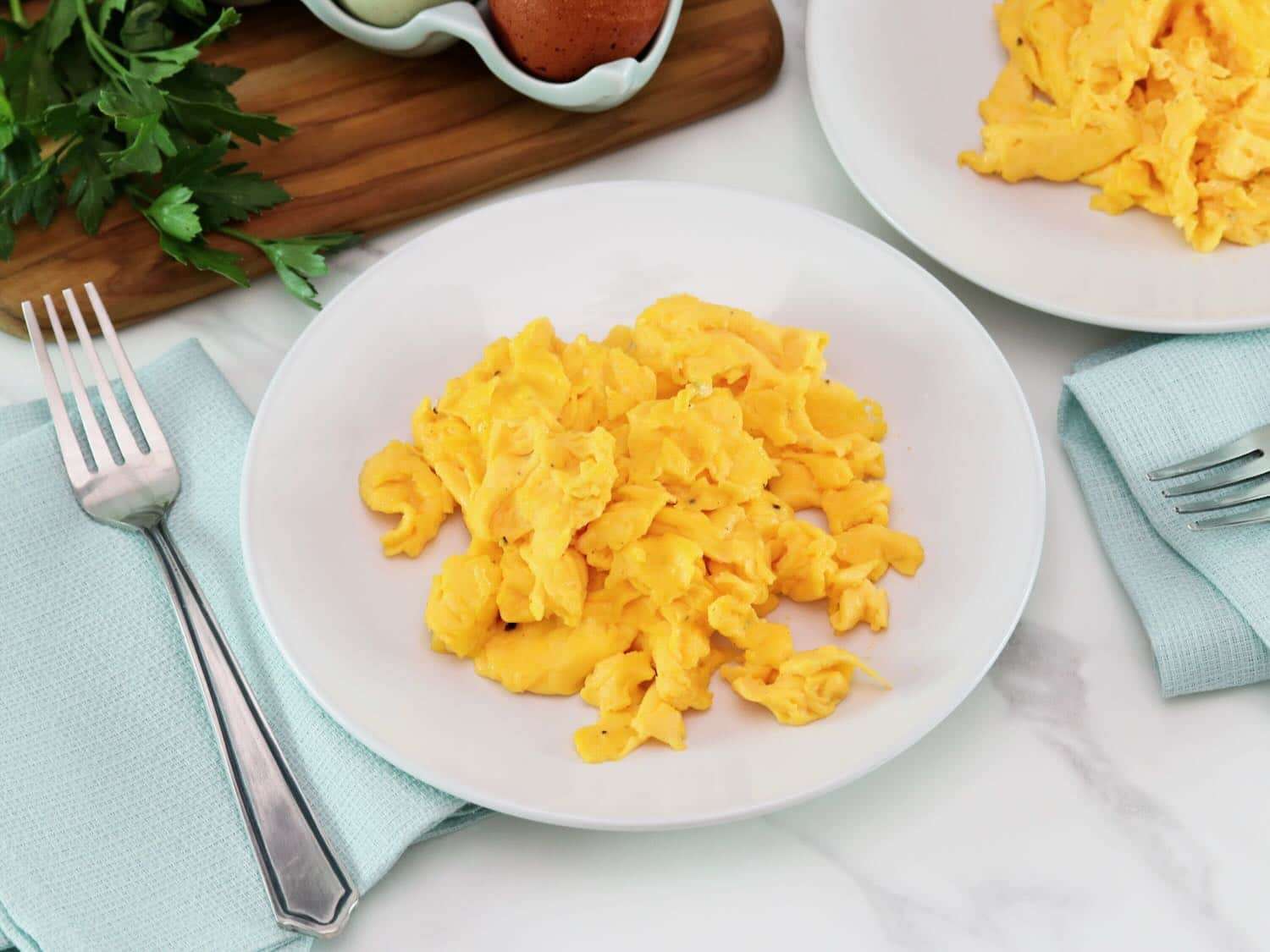
How to Make Scrambled Eggs
User Reviews
4.9
-
Prep Time
2 mins
-
Cook Time
8 mins
-
Total Time
10 mins
-
Servings
2 servings
-
Calories
147 kcal
-
Course
Main Course, Breakfast
-
Cuisine
American
How to Make Scrambled Eggs
Description
This method for scrambled eggs begins by whisking four large eggs with whole milk (or half and half or water), salt, and freshly ground black pepper until fully combined. The liquid helps incorporate air and adds moisture, contributing to a tender texture. Cheese can be prepared to add to the eggs if desired.
The eggs are cooked in a medium nonstick skillet over medium low to medium heat, using butter for fat. Moderate heat prevents overcooking and helps develop soft curds. The eggs are stirred or folded slowly as they cook until creamy and just set, then removed from heat to avoid dryness.
Scrambled eggs offer a flexible dish that can be served plain or with cheese. Using pasture-raised eggs can improve flavor and color. Cooking in a well-seasoned or nonstick pan aids even cooking and easy cleanup. Quantity recommendations help achieve even scrambling depending on pan size.
Ingredients
- 4 large egg
- 2 tablespoons whole milk half and half, heavy cream, or water
- cheese optional, shredded or crumbled
- salt I prefer sea salt and freshly ground black pepper
- black pepper I prefer sea salt and freshly ground black pepper
- butter (alternate oils include olive oil, ghee, avocado oil, or nonstick oil spray)
Instructions
- If you plan on adding cheese to your eggs, make sure that the cheese is shredded/prepared and set aside so you can add it to the non-stick skillet quickly. Place your skillet on the stovetop and turn on the heat. I leave the heat somewhere between medium low and medium, so it warms up but doesn't get too hot.
- Meanwhile, prepare your eggs. Break them into a bowl with a tablespoon of milk, half and half, or water (I prefer half and half or milk). Add some salt and pepper - I typically add about 1/8 teaspoon of sea salt and a few turns of black pepper. You might use more or less according to taste. If you're dairy intolerant or don't like the taste of milk, feel free to use water - but don't skip adding a little liquid, as it helps to add fluffiness to the scramble. I personally love the way creamy half and half enhances the flavor of the eggs.
- Use a fork or whisk to beat the eggs briskly for 30-60 seconds, making sure the eggs are fully broken up and mixed well with the milk and the seasonings. Use a little elbow grease here, the more you whip it the better.
- Lightly grease your hot skillet, coating the surface with a thin layer of oil or butter. I typically use butter, but only if the skillet isn't very hot - butter has a low smoke point, which means it burns easily. If the skillet has heated up a lot, try using ghee, avocado oil, or something with a higher smoke point. If using nonstick spray oil, use caution and keep it away from any open gas flames.Pour the eggs into the skillet. Keep the heat on medium/medium low, you don't want to rush it here-- if the skillet is too hot the eggs will cook too quickly and become rubbery. Once you pour the eggs in they will begin to cook immediately. Using a spatula (I use a wooden or silicone spatula so I won't damage my pan's nonstick coating), begin pulling the cooked outer edges in towards the center of the eggs. Uncooked eggs will flood the area you just pulled back. If you are adding cheese, now is the time to sprinkle it into the skillet. This will allow ample time for the cheese to melt and integrate into the eggs.
- Move the spatula around the edge of the skillet, pulling the cooked edges towards the center and re-flooding repeatedly. Cooked scrambled eggs will gather in the center of the skillet.
- At a certain point, the uncooked eggs will no longer flood and the scramble will all collect in the center of the skillet, but it will still be slightly runny in texture. Begin breaking up the scramble; quickly turn undercooked areas and keep the scramble moving to make sure that all surfaces cook evenly. Never leave a surface in contact too long with the skillet or it will become overcooked.
- Turn off the heat when the eggs are about 90% cooked. When the eggs are done, serve immediately. Perfectly cooked scrambled eggs are moist but not runny, with no crisp or brown edges. This technique may take a bit of practice, but it is quite simple. With time you too will be making and serving moist, fluffy scrambled eggs!
Notes
- This recipe yields two servings (four eggs total) using a medium-sized nonstick skillet for even cooking.
- Adapt egg quantity to skillet size: fewer eggs for small skillets, more for larger pans.
- If adding cheese, use about 1 tablespoon of shredded cheese per egg for balanced flavor.
- For best flavor, consider using pasture-raised eggs known for richer yolks and taste.
Nutrition Information
Show DetailsNutrition Facts
Serving: 2servings
Amount Per Serving
Calories 147 kcal
% Daily Value*
| Calories | 147kcal | 7% |
| Carbohydrates | 1g | 0% |
| Protein | 12g | 24% |
| Fat | 9g | 14% |
| Saturated Fat | 3g | 15% |
| Cholesterol | 372mg | 124% |
| Sodium | 145mg | 6% |
| Potassium | 138mg | 3% |
| Vitamin A | 540IU | 11% |
| Calcium | 64mg | 6% |
| Iron | 1.7mg | 9% |
* Percent Daily Values are based on a 2,000 calorie diet.
User Reviews
Overall Rating
4.9
You'll Also Love