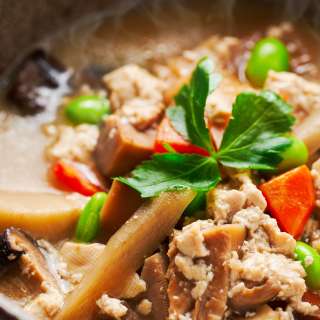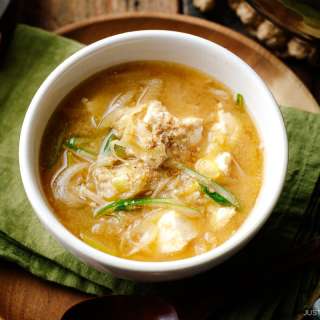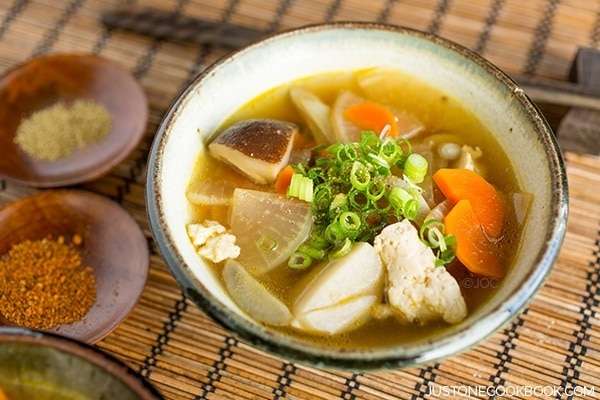
Kenchinjiru
User Reviews
4.7
135 reviews
Excellent
Kenchinjiru
Report
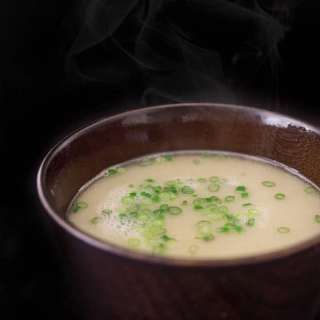
Originally created as Buddhist temple cuisine, Kenchinjiru (Japanese Vegetable Soup) is a clear soup cooked with root vegetables, tofu, shiitake, and kombu stock. It’s a well-balanced and flavorful soup for a meatless meal on a cold night. {Vegan}
Share:
Ingredients
For the Vegan Dashi
- 1 piece kombu (dried kelp) (4 x 4 inches, 10 x 10 cm per piece)
- 5 cups water (for the kombu)
- 3 dried shiitake mushrooms
- 1 cup water (for the shiitake)
For the Soup
- 7 oz firm tofu (½ 14-oz block)
- ½ package konnyaku (konjac) (4.6 oz, 130 g)
- 7 oz daikon radish (2 inches, 5 cm)
- 3.5 oz carrot (1 medium)
- 3 pieces taro (satoimo)
- 3.5 oz gobo (burdock root) (½ gobo)
For the Seasonings
- 1 Tbsp toasted sesame oil
- 3 Tbsp sake
- ½ tsp Diamond Crystal kosher salt
- 2 Tbsp soy sauce
For the Garnish
- 2 green onions/scallions
- shichimi togarashi (Japanese seven spice) (optional)
- Japanese sansho pepper (optional)
Instructions
- Gather all the ingredients.
To Prepare the Ingredients
- The Previous Night: Gently clean 1 piece kombu (dried kelp) with a damp towel. NEVER wash kombu and do not remove the white powder (that’s where the umami flavor is). These days, kombu is pretty clean. Soak the kombu in 5 cups water overnight. If you don’t have time, skip soaking and go to the next step.
- The Next Day: Slowly bring the kombu and water to a boil. Right before the water boils, remove and discard the kombu. Turn off the heat and set it aside.
- Put 3 dried shiitake mushrooms in a small bowl and cover with 1 cup water. Place a smaller bowl on top to keep the mushrooms submerged.
- Wrap 7 oz firm tofu with a paper towel and place it on a plate. Put another plate on top to press the tofu. Drain for 30 minutes.
- Meanwhile, cut ½ package konnyaku (konjac) into bite-size pieces. You can use a spoon to cut the konnyaku. By giving the konnyaku an uneven texture, the surface will absorb more flavor. Then, boil for 2–3 minutes to get rid of the odor. Drain the water and set it aside.
- Peel 7 oz daikon radish, 3.5 oz carrot, and 3 pieces taro (satoimo). Cut the daikon in quarters lengthwise and the carrot in half lengthwise. Slice them thinly crosswise so they will cook faster. Cut the satoimo into about ¼-inch (6-mm) slices and soak in water to get rid of the slimy texture.
- Scrape the skin off 3.5 oz gobo (burdock root) with the back of a knife under running water. Cut in half lengthwise and thinly slice diagonally. Soak in water for 5 minutes and drain.
- When the shiitake mushrooms are soft and hydrated, squeeze out the liquid and set aside the mushrooms. Strain the soaking liquid through a fine-mesh sieve to get rid of any particles. You now have shiitake dashi. Set it aside.
- Remove and discard the stems of the shiitake mushrooms and cut the caps into quarters.
To Cook the Kenchinjiru
- Heat a large pot and add 1 Tbsp toasted sesame oil. Sauté the daikon, carrot, taro (satoimo), gobo (burdock root), and konnyaku until the oil coats the ingredients.
- Then, add the shiitake mushrooms. Tear the tofu with your fingers and add to the pot. (If you are using silken tofu, use a knife to cut and add it right before serving.) Tofu will absorb more flavor when it is torn by hand. Sauté until all the ingredients are coated with the oil.
- Add the shiitake dashi and kombu dashi. Bring it to a boil.
- Turn down the heat to simmer. Cook for 10 minutes, skimming occasionally. Use a fine-mesh strainer to skim the foam and scum on the surface. Tip: Fill a measuring cup with water and clean the strainer in it. Change the water when it gets dirty.
- After 10 minutes, add 3 Tbsp sake and ½ tsp Diamond Crystal kosher salt and continue to cook until the vegetables are all tender. Finally, add 2 Tbsp soy sauce.
To Serve
- Right before serving, thinly slice 2 green onions/scallions. Serve the soup and garnish with scallion. Sprinkle with optional shichimi togarashi (Japanese seven spice) and Japanese sansho pepper, if you like it spicy.
To Store
- You can keep the leftovers in an airtight container or the pot and store in the refrigerator for 2–3 days.
Nutrition Information
Show Details
Calories
138kcal
(7%)
Carbohydrates
13g
(4%)
Protein
6g
(12%)
Fat
6g
(9%)
Saturated Fat
1g
(5%)
Sodium
663mg
(28%)
Potassium
312mg
(9%)
Fiber
3g
(12%)
Sugar
4g
(8%)
Vitamin A
4204IU
(84%)
Vitamin C
14mg
(16%)
Calcium
150mg
(15%)
Iron
1mg
(6%)
Nutrition Facts
Serving: 4Serving
Amount Per Serving
Calories 138 kcal
% Daily Value*
| Calories | 138kcal | 7% |
| Carbohydrates | 13g | 4% |
| Protein | 6g | 12% |
| Fat | 6g | 9% |
| Saturated Fat | 1g | 5% |
| Sodium | 663mg | 28% |
| Potassium | 312mg | 7% |
| Fiber | 3g | 12% |
| Sugar | 4g | 8% |
| Vitamin A | 4204IU | 84% |
| Vitamin C | 14mg | 16% |
| Calcium | 150mg | 15% |
| Iron | 1mg | 6% |
* Percent Daily Values are based on a 2,000 calorie diet.
Genuine Reviews
User Reviews
Overall Rating
4.7
135 reviews
Excellent
Other Recipes
You'll Also Love