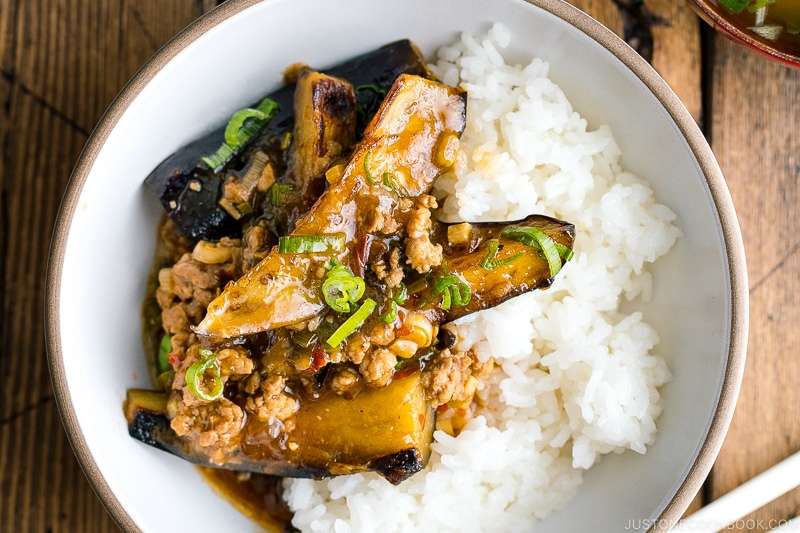
Mapo Eggplant (Mabo Nasu)
User Reviews
4.8
-
Prep Time
10 mins
-
Cook Time
20 mins
-
Total Time
30 mins
-
Servings
3 (3
-
Calories
304 kcal
-
Course
Main Course
-
Cuisine
Japanese
Mapo Eggplant (Mabo Nasu)
Description
Mapo Eggplant (Mabo Nasu) blends Japanese eggplant with ground pork and a sauce composed of doubanjiang, miso, and soy sauce for a savory, umami-rich flavor. The eggplant pieces are soaked to reduce bitterness, lightly coated in potato starch for a tender but intact texture after frying, then cooked together with garlic, ginger, and ground pork. The sauce is thickened with a starch slurry, creating a glossy coating that clings to the eggplant. Sesame oil adds a toasted aroma, and sliced green onions garnish the dish, bringing a fresh contrast.
This dish serves well as part of a Japanese or Chinese-inspired meal, pairing nicely with steamed rice to balance the sauce and spices. The approach keeps the eggplant pieces intact and flavorful without becoming mushy.
Ingredients
- 10 oz Japanese eggplant 2-3 eggplants, each usually 5 oz, 142 g; see the instructions to use a globe eggplant
- 2 green onion or scallions
- 1 heaping tsp ginger (minced; from a 1-inch, 2.5-cm knob)
- 1 clove garlic
- 1 Tbsp potato starch for coating the eggplant, or cornstarch
- ⅓ cup neutral oil (for frying the eggplant)
- 1 Tbsp sesame oil for stir-frying, toasted
- 3.5 oz ground pork
For the Slurry Mixture
- 1 Tbsp potato starch or cornstarch
- 2 Tbsp water
For the Seasonings
- 1 Tbsp sake
- 1 Tbsp doubanjiang use either the spicy or non-spicy type, or use gluten-free doubanjiang; increase the amount if you like it spicy, spicy chili bean paste
- 1 tsp sweet bean paste or substitute 1 tsp doubanjiang, tienmienjiang
- 1 cup chicken stock or broth
- 1 tsp miso paste
- 1 tsp sugar
- 1 Tbsp soy sauce
- 2 tsp rice vinegar unseasoned
Instructions
- Gather all the ingredients.
- Discard the ends of 10 oz Japanese eggplants. Cut them in half widthwise and then cut into wedges. Tip: If you are using a globe eggplant (please know that its peel is tougher than Japanese or Chinese eggplant skins), cut it into pieces with peel attached so it holds the flesh. Without peel, the eggplant will lose its shape and get mushy.
- Cut the wedges the same size for even cooking. Soak them in water for 5 minutes to remove the astringency.
- Cut 2 green onions/scallions to separate the white and green parts. Cut each part into thin rounds and keep them in separate piles.
- Cut 1 knob ginger into thin slices. Cut the slices into julienne strips, then mince them. You will need 1 heaping tsp ginger (minced). You can use more or less, depending on your preference.
- Mince 1 clove garlic (or use a garlic press).
- Transfer the eggplant to a tray/plate, and pat dry with a paper towel. Sprinkle with 1 Tbsp potato starch or cornstarch and coat well. You don‘t want to see any moisture on the eggplant because it will splash in the oil.
- To make the slurry mixture, combine 1 Tbsp potato starch or cornstarch and 2 Tbsp water in a measuring cup. Mix well and set aside. You will need to stir the mixture again right before pouring.
To Cook the Mapo Eggplant
- In a large frying pan, heat ⅓ cup neutral oil on medium-high heat (or medium heat on a professional stove). Add the eggplant in a single layer. If the eggplant overlaps, fry it in batches.
- Pan-fry the eggplant until golden brown. Transfer to a plate.
- All the oil you used for frying should be absorbed by the eggplant now. Heat 1 Tbsp toasted sesame oil in the frying pan on medium heat (medium-low on the professional stove). Add the minced garlic and minced ginger.
- Stir-fry until they are fragrant. Then, add 3.5 oz ground pork and increase the heat to medium-high (or medium on the professional stove).
- When the pork is 80% cooked, add 1 Tbsp sake and stir.
- Add the white part of the green onions, 1 Tbsp doubanjiang (spicy chili bean paste), and 1 tsp tienmienjiang (sweet bean paste). Stir well to combine. Be careful not to let the sauce burn. If the heat is too strong, lower it a bit.
- Add 1 cup chicken stock/broth.
- Add 1 tsp miso, 1 tsp sugar, and 1 Tbsp soy sauce.
- Bring it to simmer. Then, add the eggplant.
- Coat the eggplant with the sauce. Stir the slurry mixture one last time and slowly drizzle it into the pan. Stir to combine with the sauce.
- Bring it to simmer and check the consistency of the sauce. If it‘s too loose, let the moisture evaporate. If the sauce is too thick, you can drizzle in a small amount of water to loosen it up. When the consistency is good, drizzle 2 tsp rice vinegar (unseasoned) over the sauce as a finishing touch.
To Serve
- Right before serving, sprinkle with the green part of the green onions. Serve over steamed rice in a bowl or on a plate by itself. Enjoy!
To Store
- You can store Mabo Eggplant in an airtight container and keep it in the refrigerator for up to 3 days and in the freezer for up to 3–4 weeks.
Nutrition Information
Show DetailsNutrition Facts
Serving: 3(3
Amount Per Serving
Calories 304 kcal
% Daily Value*
| Calories | 304kcal | 15% |
| Carbohydrates | 11g | 4% |
| Protein | 7g | 14% |
| Fat | 26g | 40% |
| Saturated Fat | 4g | 20% |
| Trans Fat | 1g | 50% |
| Cholesterol | 19mg | 6% |
| Sodium | 641mg | 27% |
| Potassium | 297mg | 6% |
| Fiber | 3g | 12% |
| Sugar | 4g | 8% |
| Vitamin A | 139IU | 3% |
| Vitamin C | 3mg | 3% |
| Calcium | 20mg | 2% |
| Iron | 1mg | 6% |
* Percent Daily Values are based on a 2,000 calorie diet.
User Reviews
Overall Rating
4.8
You'll Also Love