Mille-Feuille Nabe
User Reviews
4.8
-
Prep Time
15 mins
-
Cook Time
15 mins
-
Total Time
30 mins
-
Servings
4
-
Calories
967 kcal
-
Course
Main Course
-
Cuisine
Japanese
Mille-Feuille Nabe
Description
Mille-Feuille Nabe features Napa cabbage and thinly sliced pork belly arranged in alternating layers and cooked gently in a broth made from dashi stock, sake, soy sauce, sliced ginger, and kosher salt. The dashi broth provides a subtle umami that complements the fat from the pork and the tender cabbage. Ginger slices add a warm aroma and mild spiciness to the broth. The pork belly used is specifically not bacon, to avoid excessive saltiness. This hot pot is typically served accompanied by a dipping sauce of ponzu, green onion, and optionally, Japanese seven spice, offering a bright and zesty contrast to the warm layers in the pot.
The dish suits a communal meal where diners can pick their portions from the pot and dip in the tangy sauce. It balances the richness of pork belly with the freshness of cabbage and the lightness of the broth. The layered presentation adds an elegant visual to the dining experience.
To ensure the best results, use pork belly slices without skin or rind, which can be requested from the butcher. The recipe notes suggest that Asian markets often have suitable pork belly, and if unavailable, one can ask the butcher to remove the skin if present.
Ingredients
- 1 head Napa cabbage (4 lbs, 1.8 kg)
- 1½ lb pork belly or slice your own pork belly; see Notes for where to buy; do not use bacon, since it‘s too salty for this dish, sliced
For the Broth
- 8-10 lices ginger (peeled and thinly sliced from a 1-inch, 2.5-cm knob)
- 5 cups dashi use standard Awase Dashi, dashi packet or powder, or Vegan Dashi, Japanese soup stock
- 2 Tbsp sake
- 1 Tbsp soy sauce
- ½ tsp kosher salt Diamond Crystal brand
For the Dipping Sauce
- 1 green onion or scallion
- ponzu
- Japanese seven spice optional, for a spicy kick, aka shichimi togarashi
Instructions
- Before You Start: If you haven‘t made 5 cups dashi (Japanese soup stock) yet, here‘s a quick version using my favorite dashi packet. First, add 2 dashi packets to 5 cups water in a saucepan. Start cooking over medium heat. When it reaches a boil, reduce the heat to medium low and simmer for 2–3 minutes. Turn off the heat. Remove the packets from the saucepan, shake them a few times to release more flavor, then discard them. The dashi is now ready to use.
- Gather all the ingredients.
To Prepare the Ingredients
- To make the soup broth, combine 5 cups dashi (Japanese soup stock), 2 Tbsp sake, 1 Tbsp soy sauce, and ½ tsp Diamond Crystal kosher salt in a measuring cup or mixing bowl. Don’t reduce the salt since the napa cabbage will release liquid during cooking and dilute the soup.
- Peel and thinly slice the ginger knob into 8-10 slices ginger and set it aside.
- Thinly cut 1 green onion/scallion. Put the green onion in a small serving bowl to add later to the dipping sauce.
- Cut 1 head napa cabbage lengthwise into quarters. I like to cut just the white bottom half of the napa cabbage head with a sharp knife, then pull apart the leafy top half with my hands. By tearing the leaves naturally, you lose fewer leaves compared to slicing. DO NOT cut off the core from the 4 wedges yet. The core keeps the leaves attached at the root end and makes layering the pork belly much easier.
- Carefully wash the leaves without detaching them from the core. Drain well. Don’t throw away any leaves that naturally come off while rinsing. We’ll use them later on.
To Make the Layers
- Layer 1½ lb sliced pork belly into the napa cabbage wedges by placing one pork belly slice between each of the leaves. If the pork belly is longer than the cabbage wedge, trim the pork with kitchen shears and layer it in other parts of the cabbage. If you have extra pork belly, put an additional slice in the outer layers that have wide leaves.
- Once you‘ve tucked in the pork belly slices, carefully cut off the hard cabbage cores without disturbing the layers. Cut each wedge into 4 pieces that are each about 2 to 2½ inches (5–6 cm) long, keeping the layers of cabbage and pork neatly stacked as you slice.
To Pack the Pot
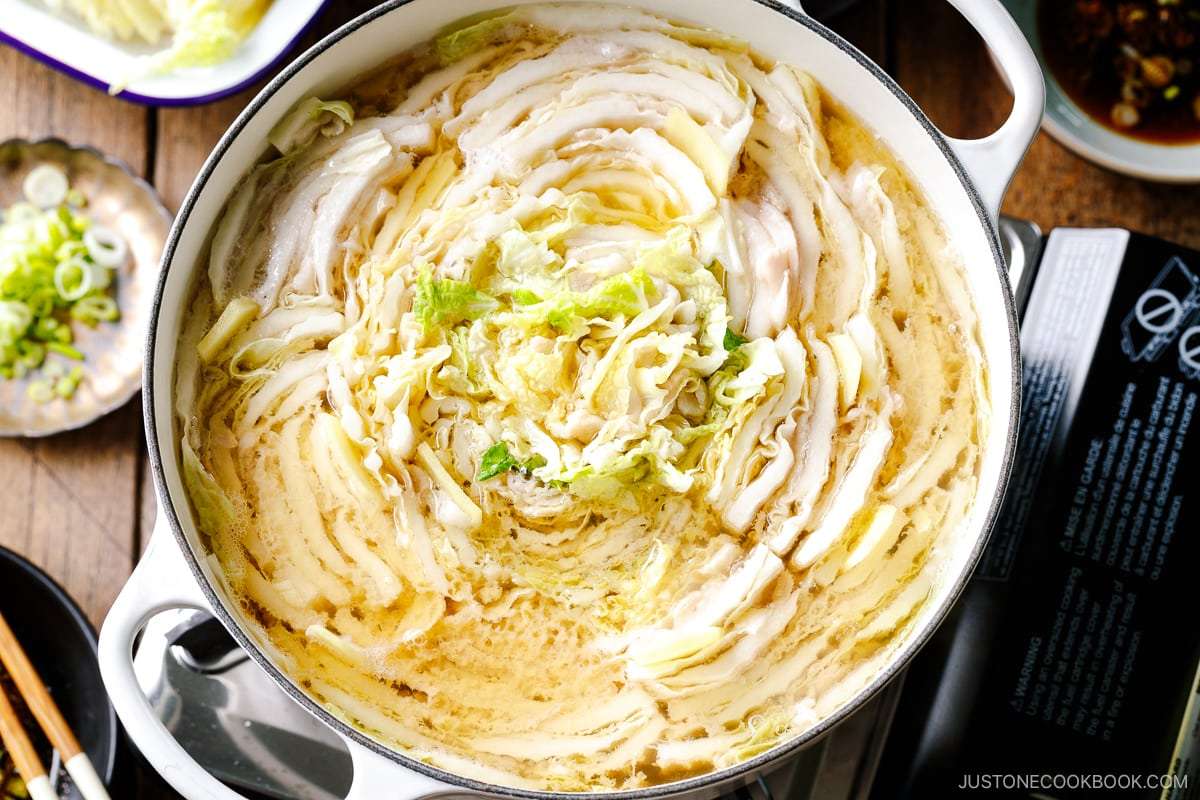
- Next, start packing the ingredients in a donabe or regular 10-inch pot (I used a 4.5 QT Le Creuset pot; if you‘re doubling the recipe, use two 10-inch pots or one larger pot). Start from the edge of the pot and work your way toward the center. Turn the stacks on their side so the pink and green layers are visible. Position the layers parallel to the pot‘s side so they eventually form concentric circles once the pot is packed.
- I usually place the thicker cabbage leaves near the edge of the pot and the tender leaves in the center. Make sure to pack the pot tightly as the layers will become loose during cooking.
- If you don’t have enough layers to pack the pot tightly, consider using a smaller pot or place other ingredients in the center. Here, I stuffed the center with the napa cabbage leaves that came off when I cut and rinsed the cabbage. You can also put enoki mushrooms or shimeji mushrooms in the center.
- If you have extra layers, hold them in a deep baking dish or a container with a tall rim. You can add them to the pot later after you‘ve remove most of the cooked layers.
- Insert the thinly sliced ginger between the layers.
- Pour the soup broth into the pot with the cabbage and pork layers. If you are cooking at the table, bring the pot to the table. Otherwise, you can start cooking on the stove.
To Set up the Table
- At each place setting, prepare a medium bowl and a small bowl for each person. To cook at the table, set it up a portable gas stove and place the pot on it.For the dipping sauce, add ponzu, the chopped green onion/scallion, and optional shichimi togarashi (Japanese seven spice) to the small individual bowls.
To Cook and Serve
- Start cooking, covered, on medium-high heat. Once boiling, skim off the foam and fat on the surface using a fine-mesh skimmer. Then, reduce the heat to medium low and cook covered until the napa cabbage is tender and the pork belly is cooked through, roughly 8–10 minutes. When the Mille-Feuille Nabe is cooked through, serve it hot. Dip in the ponzu sauce and enjoy!
To Store
- You can keep the leftovers in an airtight container and store in the refrigerator for up to 3 days or in the freezer for a month.
Notes
- Pork belly slices or blocks can be found at Asian grocery stores, especially Japanese, Korean, and Chinese markets, and some American grocers behind the meat counter.
- If your pork belly has skin or rind, ask the butcher to remove it before purchasing.
Nutrition Information
Show DetailsNutrition Facts
Serving: 4Serving
Amount Per Serving
Calories 967 kcal
% Daily Value*
| Calories | 967kcal | 48% |
| Carbohydrates | 16g | 5% |
| Protein | 22g | 44% |
| Fat | 91g | 140% |
| Saturated Fat | 33g | 165% |
| Polyunsaturated Fat | 10g | 59% |
| Monounsaturated Fat | 42g | 210% |
| Cholesterol | 122mg | 41% |
| Sodium | 372mg | 16% |
| Potassium | 1414mg | 30% |
| Fiber | 6g | 24% |
| Sugar | 7g | 14% |
| Vitamin A | 1450IU | 29% |
| Vitamin C | 122mg | 136% |
| Calcium | 358mg | 36% |
| Iron | 2mg | 11% |
* Percent Daily Values are based on a 2,000 calorie diet.
User Reviews
Overall Rating
4.8
You'll Also Love