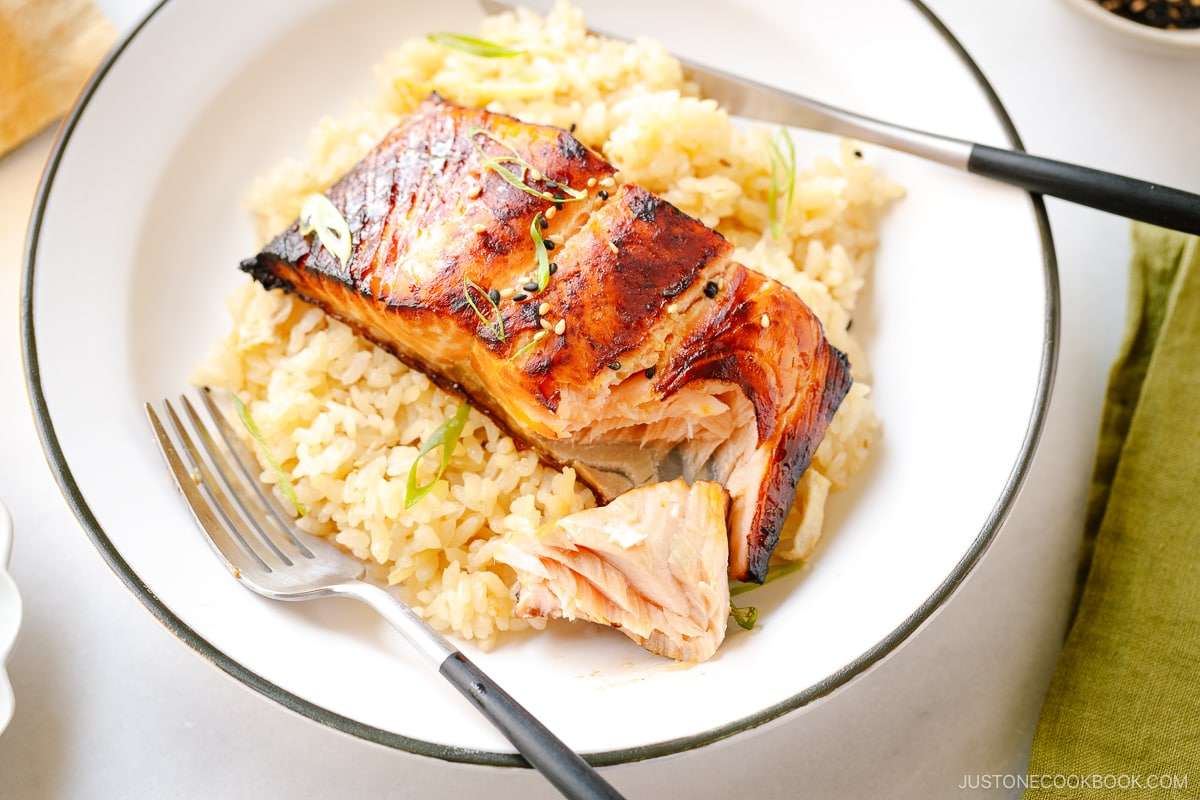
Miso Salmon
User Reviews
4.8
-
Prep Time
5 mins
-
Cook Time
10 mins
-
Additional Time
1 hr
-
Total Time
1 hr 15 mins
-
Servings
2
-
Calories
308 kcal
-
Course
Main Course
-
Cuisine
Japanese
Miso Salmon
Description
This recipe begins with skin-on salmon fillets that are checked for scales and bones to ensure optimal eating quality. A marinade combining miso paste, sake, mirin, soy sauce, and toasted sesame oil coats the salmon, infusing it with savory and slightly sweet flavors. The marinating time ranges from one to two hours to allow the flavors to penetrate without overpowering the fish’s delicate profile.
Cooking the marinated salmon results in a tender fish with a lightly caramelized glaze from the miso mixture. The marinade’s ingredients balance sweetness, saltiness, and a hint of acidity that complements the fatty salmon. Toasted sesame oil adds a subtle nutty aroma to the final dish.
Salmon prepared this way is suitable for serving as a simple protein course accompanied by steamed vegetables or rice. Removing bones and scales before marinating ensures a pleasant texture. Chilling during the marination step helps the flavors meld and keeps the fish firm.
Ingredients
- 2 salmon fillets ¾ lb, 340 g; ideally, less than 1 inch or 2.5 cm thick; 4-6 oz or 113-170 g per fillet, skin-on
For the Marinade
- 2 Tbsp miso paste use any type of miso; I used Hikari Miso Organic White Miso
- 1 Tbsp sake
- 1 Tbsp mirin
- 1 Tbsp soy sauce
- ¼ tsp sesame oil toasted
For the Garnish (optional)
- ½ tsp sesame seeds toasted, white and black
- 1 green onion chopped, or scallion
Instructions
- Before You Start: Please note that this recipe requires a marination time of 1–2 hours.
- Gather all the ingredients. Check your 2 skin-on salmon fillets for scales and tiny bones. For bones, run your fingers along the flesh surface and sides to feel for the hard tips of any bones and pull them out with fish boning tweezers. For scales, run your fingers back and forth across the skin to find any scales and scrape them off with the flat edge of a knife.
To Lightly Marinate
- In a large bowl or flat tray, mix the marinade ingredients: 2 Tbsp miso, 1 Tbsp sake, 1 Tbsp mirin, 1 Tbsp soy sauce, and ¼ tsp toasted sesame oil.
- If your salmon is not cut into fillets yet, cut it into individual portions so that they cook faster and evenly. The typical American serving size is 6 oz (170 g). Then, place the salmon in the bowl with the marinade, skin side up.
- Spoon the marinade on top of the salmon, making sure to coat the sides and skin. Cover and keep it in the refrigerator for 1–2 hours for fillets up to 1 inch (2.5 cm) at the thickest part. Marinate for 3 hours for a thicker cut. Tip: This fish is marinated for a short time, unlike Black Cod with Miso. I don’t recommend marinating the salmon overnight, as it will get quite salty.
To Broil (for thin fillets less than 1 inch or 2.5 cm thick)
- Turn on the broiler to High (550ºF/288ºC) with a rack placed in the center position, 9 inches (23 cm) away from the top heating element. Preheat for 5 minutes. Tip: When broiling, you don‘t adjust the oven temperature; instead, you control the distance between the heating element and the surface of the food. It‘s similar to using hotter and cooler zones on your grill. Meanwhile, cut the green onions diagonally into thin slices. Line a baking sheet with aluminum foil (since parchment paper will burn) and spray or brush the oil so the salmon skin won‘t stick.
- Next, take the salmon out of the refrigerator and remove any excess marinade completely; otherwise, the miso may burn during broiling.
- I take the additional step of scraping off the excess marinade with an offset spatula or butter knife (optional). Next, place the salmon pieces skin side down on the prepared baking sheet.
- Broil the salmon until the thickest part of the fillet registers an internal temperature of 125–130°F* (52–54ºC), for roughly 10–13 minutes. You do not need to flip the salmon during broiling. If you prefer it medium rare, you can stop cooking at 120ºF (49ºC). *Please note that the USDA recommends cooking fish to an internal temperature of 145°F (63ºC); however, the residual heat will continue to cook the salmon, resulting in overcooked fish.
To Bake (for thick fillets)
- Preheat the oven to 425°F (218ºC) with a rack placed in the center position. For a convection oven, reduce the cooking temperature by 25ºF (15ºC). Next, take the marinated salmon out of the refrigerator and remove any excess marinade completely from the fish; otherwise, the miso may burn during baking. You can scrape off the marinade with an offset spatula or butter knife if you‘d like.
- Place the salmon pieces skin side down on a baking sheet lined with parchment paper. If you‘re using an oven probe, insert it into the thickest part of the flesh. Tip: If you don‘t have a probe, I highly recommend getting a Thermapen instant-read thermometer.
- Transfer the baking sheet to the oven and attach the probe (if using) to the oven. Bake the salmon until the thickest part of the fillet registers an internal temperature of 125–130°F* (52–54ºC), for roughly 18–20 minutes. You do not need to flip the salmon during baking. If you prefer medium rare, you can stop cooking at 120ºF (49ºC). Tip: My recommended baking time is 5 minutes per ½-inch (1.3-cm) thickness of salmon measured at the thickest part. *Please note that the USDA recommends cooking fish to an internal temperature of 145°F (63ºC); however, the residual heat will continue to cook the salmon, resulting in overcooked fish.
- Take it out from the oven. Test if the salmon is cooking by flaking the flesh. If it flakes easily, it’s cooked through. To char (optional): You can broil the salmon to give it a nice char, if desired. When the salmon is getting close to the desired internal temperature, remove the probe from the salmon and oven. Then, change the oven setting to Broil on High (550ºF/288ºC). Keep the oven rack placed in the center position, 9 inches (23 cm) away from the top heating element. Then, broil the salmon for 3 minutes or until the surface is blistered and browned a bit. Note that the salmon will continue to cook while broiling; therefore, don't wait too long to switch to broil.
To Serve
- Serve the Miso Salmon and top with ½ tsp toasted white and black sesame seeds and 1 green onion/scallion thinly sliced (both toppings are optional). I like to serve this salmon with Ginger Rice. Enjoy!
- Optional: I always discard the marinade (that‘s why I try to use the least amount of marinade), but if you don‘t want to waste it or make too much, you can dilute the marinade with water and cook it for a few minutes. Serve it with the salmon or use it for other dishes.
To Store
- You can store the leftovers in an airtight container and store in the refrigerator for up to 3 days and in the freezer for a month.
Nutrition Information
Show DetailsNutrition Facts
Serving: 2Serving
Amount Per Serving
Calories 308 kcal
% Daily Value*
| Calories | 308kcal | 15% |
| Carbohydrates | 3g | 1% |
| Protein | 40g | 80% |
| Fat | 13g | 20% |
| Saturated Fat | 2g | 10% |
| Polyunsaturated Fat | 5g | 29% |
| Monounsaturated Fat | 4g | 20% |
| Cholesterol | 109mg | 36% |
| Sodium | 423mg | 18% |
| Potassium | 1003mg | 21% |
| Fiber | 1g | 4% |
| Sugar | 1g | 2% |
| Vitamin A | 144IU | 3% |
| Vitamin C | 1mg | 1% |
| Calcium | 36mg | 4% |
| Iron | 2mg | 11% |
* Percent Daily Values are based on a 2,000 calorie diet.
User Reviews
Overall Rating
4.8
You'll Also Love