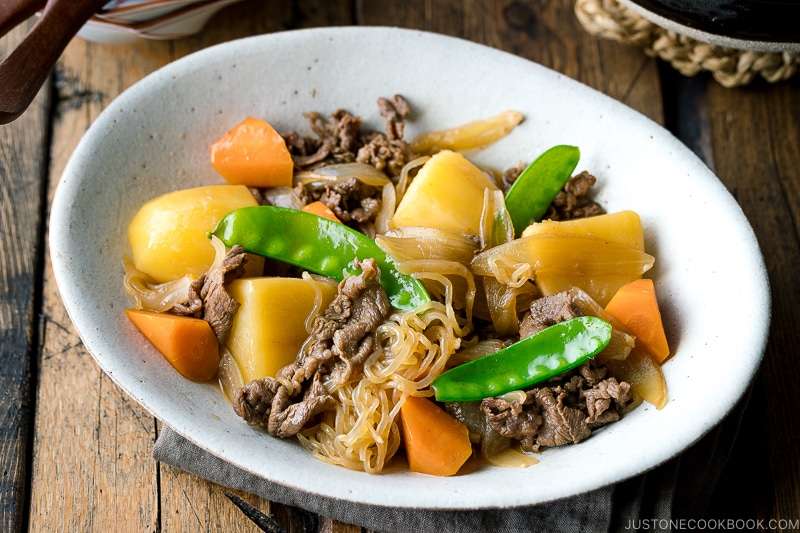
Nikujaga (Japanese Meat and Potato Stew)
User Reviews
4.7
-
Prep Time
15 mins
-
Cook Time
15 mins
-
Additional Time
30 mins
-
Total Time
1 hr
-
Servings
4
-
Calories
338 kcal
-
Course
Main Course
-
Cuisine
Japanese
Nikujaga (Japanese Meat and Potato Stew)
Description
This recipe starts with preparing all vegetables using Japanese techniques such as diagonal cuts for carrots and smoothing potato edges, which help even cooking and maintain the potatoes' shape. Thinly sliced beef chuck or pork is used, but mushrooms can substitute for vegetarian versions. Shirataki noodles provide a low-calorie, chewy contrast, while snow peas add color and crispness.
The broth blends classic Japanese seasonings—dashi stock, mirin, soy sauce, sake, and sugar—offering a balanced umami and sweetness. Ingredients are simmered together until flavors meld and the potatoes become tender without falling apart. This slow cooking produces a stew with tender meat and vegetables infused with the savory-sweet broth.
Nikujaga is often enjoyed as a home-style dish and can be served with steamed rice. The recipe’s careful preparation of ingredients emphasizes texture and the proper melding of flavors common in Japanese comfort food.
Ingredients
- 1 onion (8.8 oz, 250 g)
- 1 carrot (4.5 oz, 127 g)
- 3 potato 1.2 lb, 546 g, Yukon gold variety
- 8 pieces snow peas (or use green beans or green peas)
- 1 package shirataki noodles (7 oz, 200 g)
- ½ lb beef chuck or slice your own meat; you can use thinly sliced pork; substitute with shiitake, king oyster, or portobello mushrooms for vegan/vegetarian, thinly sliced, or ribeye as alternative
- 1 Tbsp neutral oil
For the Seasonings
- 2 cups dashi use standard Awase Dashi, dashi packet or powder, or Vegan Dashi, Japanese soup stock
- 4 Tbsp mirin
- 4 Tbsp soy sauce
- 2 Tbsp sake
- 1 Tbsp sugar
Instructions
- Gather all the ingredients.
To Prepare the Ingredients
- Cut 1 onion in half, and cut each half into ½-inch (1.3 cm) wedges.
- Peel 1 carrot and cut it into 1-inch (2.5 cm) pieces. Here, I use a Japanese cutting technique called rangiri where we cut the carrot diagonally while rotating it a quarter turn between cuts. This helps to create more surface area so it will cook faster and absorb more flavor.
- Cut each of the 3 Yukon gold potatoes into quarters. Tip: Yukon golds keep their shape better during simmering, but I sometimes use russet potatoes, which tend to break easily but absorb flavors nicely.
- Remove the sharp edges of the potatoes with a knife to create smooth corners. Then, soak the potatoes in water to remove the starch. Tip: We call this Japanese cutting technique mentori. This prevents the potatoes from breaking into pieces. If the potatoes have sharp edges, they are likely to bump into each other and break while simmering.
- Remove the strings from 8 pieces snow peas.
- Bring a small pot of water to a boil and add a pinch of salt. Add the snow peas.
- Blanch them in the boiling water for 1 minute and take them out. Keep the water boiling.
- Drain 1 package shirataki noodles and cut them roughly in half. Blanch the noodles in the pot of boiling water for 1 minute to remove any odor.
- Drain well and set aside. Cut the thinly-sliced beef in half or thirds (depending on the size) so that the pieces are about 3 inches (7.6 cm) wide.
To Cook the Nikujaga
- Preheat a large pot or Dutch oven (I used a 4-QT Staub cocotte) on medium heat. Then, add 1 Tbsp neutral oil and sauté the onion wedges.
- When the onion wedges are coated with oil, add ½ lb thinly sliced beef (chuck or ribeye) and cook until no longer pink.
- Add the potatoes and coat them well with the cooking liquid. Tip: This coating will help keep the potatoes from breaking.
- Add the carrot pieces and shirataki noodles and mix everything together.
- Add 2 cups dashi (Japanese soup stock), making sure there‘s enough liquid to almost cover the ingredients (it doesn‘t have to fully cover the ingredients). If there‘s not enough liquid, add water.
- Cover with a lid and continue to cook. Once boiling, skim the scum and foam from the surface with a fine-mesh skimmer.
- Add 1 Tbsp sugar, 2 Tbsp sake, 4 Tbsp soy sauce, and 4 Tbsp mirin.
- Mix it all together and place an otoshibuta (drop lid) on top of the ingredients.
- Simmer on low heat for 12–14 minutes, or until a skewer pierces a potato easily. Tip: The otoshibuta holds the ingredients in place and is necessary to maintain the shape of the vegetables. They bump into each other and break easily when they are loose. Do not mix the ingredients while cooking; the otoshibuta will help distribute the cooking liquid and its flavors.
- Turn off the heat and remove the otoshibuta. Ideally, let the Nikujaga rest (uncovered) for 30–60 minutes before serving. The flavors will soak into the ingredients while cooling down.
To Serve
- When you are ready to serve the Nikujaga, add the blanched snow peas to the pot and cover to reheat on medium heat. When simmering, reduce the heat and let it simmer for a few minutes. Tip: Add the snow peas right before serving to keep their bright color.
- Turn off the heat and serve the Nikujaga with some cooking liquid in a large serving bowl or individual bowls.
To Store
- You can keep the leftovers in an airtight container or in the pot and store in the refrigerator for up to 3–4 days. Nikujaga tastes even better on the second day! To freeze, remove the potatoes as their texture changes when frozen. You can keep it in the freezer for up to a month.
Nutrition Information
Show DetailsNutrition Facts
Serving: 4Serving
Amount Per Serving
Calories 338 kcal
% Daily Value*
| Calories | 338kcal | 17% |
| Carbohydrates | 39g | 13% |
| Protein | 17g | 34% |
| Fat | 11g | 17% |
| Saturated Fat | 6g | 30% |
| Polyunsaturated Fat | 1g | 6% |
| Monounsaturated Fat | 4g | 20% |
| Cholesterol | 35mg | 12% |
| Sodium | 737mg | 31% |
| Potassium | 937mg | 20% |
| Fiber | 5g | 20% |
| Sugar | 10g | 20% |
| Vitamin A | 5391IU | 108% |
| Vitamin C | 37mg | 41% |
| Calcium | 49mg | 5% |
| Iron | 2mg | 11% |
* Percent Daily Values are based on a 2,000 calorie diet.
User Reviews
Overall Rating
4.7
You'll Also Love