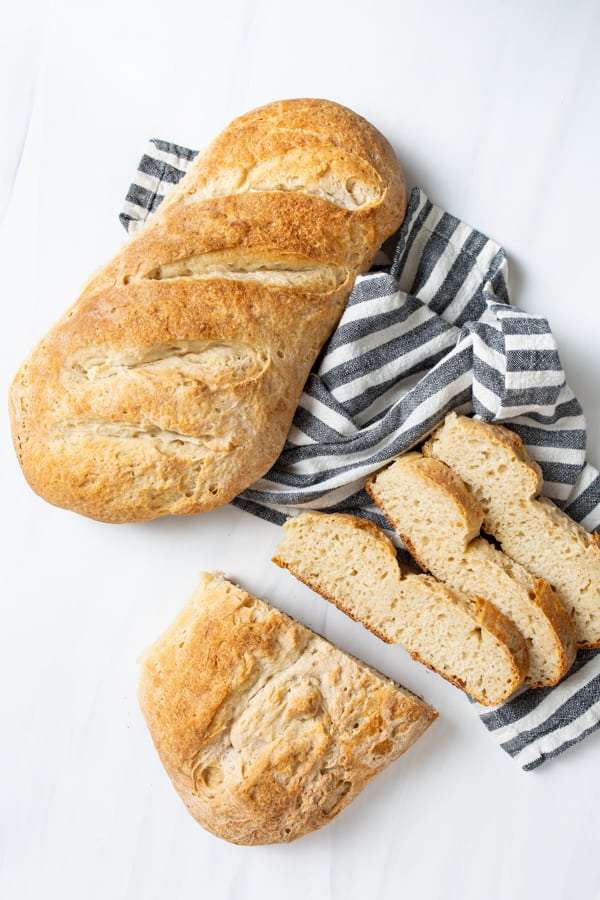
No Yeast Sourdough Bread
User Reviews
4.4
No Yeast Sourdough Bread
Description
This bread recipe relies on a mature sourdough starter combined with lukewarm water and part of the flour to create an active dough base. After vigorous mixing, the dough rests at room temperature for 4 hours, then ferments overnight in the fridge, allowing natural yeast development and flavor enhancement.
Following refrigeration, additional flour, sugar, and kosher salt are incorporated, and the dough is kneaded until smooth. The final rise occurs in a covered bowl until the dough becomes light and bubbly with visible gas pockets, which may take up to 5 hours or more depending on conditions.
This method results in a hearty bread with characteristic sourdough tang, achieved without commercial yeast. Regular gentle folding during rising encourages an even crumb structure. The process demands patience but rewards with rich flavor and texture from natural fermentation.
Ingredients
- 1 cup sourdough starter 227 grams, "fed"
- 1-1/2 cups water 340 grams, lukewarm
- 5 cups all-purpose flour 602 grams, divided
- 1 tablespoon granulated sugar
- 2-1/4 teaspoons kosher salt
Instructions
- In a large bowl combine the starter, water, and 3 cups of flour. Beat vigorously for 1 minute.
- Cover, and let rest at room temperature for 4 hours.
- Refrigerate overnight, for about 12 hours. The dough will have expanded in size and become more relaxed after its overnight rest.
- After refrigeration, add the remaining 2 cups of flour, sugar, and kosher salt.
- Knead to form a smooth dough. Knead either by hand or with a dough hook attached to a mixer. This may take some work, but the flour will be incorporated into the dough. You're looking for a smooth dough after kneading.
- Allow the dough to rise in a covered bowl until it's light and airy, with visible gas bubbles. Depending on the vigor of your starter and the temperature of your kitchen, this may take up to 5 hours (or even longer). For best results, gently deflate the dough once an hour by turning it out onto a lightly floured or lightly greased work surface; stretching and folding the edges into the center; turning it over, then returning it to the bowl. Adding these folds will help strengthen the dough’s structure, and allow you to feel how it’s progressing over time.
- Note: sourdough bread (especially sourdough without added yeast) can be finicky and may not go exactly to the written plan. Please allow yourself to go with the flow, and not treat this as an exact to-the-minute process.
- When the dough is ready, transfer the dough to a lightly floured or lightly greased work surface and gently divide the dough in half.
- Gently pat the dough to deflate it slightly and remove any large air bubbles. To make a loose round, stretch the outside edge of the dough away from itself and then fold it back toward the center, pressing it down to seal. Repeat this process five or six times, working your way around the dough until all the edges are gathered in the center. Turn the dough over so the seam is facing down, cover, and repeat with the other piece of dough. Let the dough rest, covered, for about 10 minutes.
- To shape into bâtards: Place the preshaped dough on a lightly floured surface and stretch it gently from the top and bottom, elongating it into an oval. Gently pat the dough to remove any lingering bubbles.
- Fold the top third of the dough down toward the center, as if folding a letter. Press with the heel of your hand to seal. Then fold the left and right top corners toward the center at 45 degree angles, pressing to seal. Repeat this process a second time. Then fold the dough in half, bringing the top edge to meet the bottom. Seal the seam with the heel of your hand, pressing firmly where the two edges meet.
- Turn the dough over so the seam is facing down. With cupped hands, gently roll the dough back and forth; your fingertips should be lightly touching its surface as you roll. Move your hands from the center out toward the edges, rounding the dough and tapering the ends very slightly by using more pressure.
- Place the bâtards on a lightly greased or parchment-lined baking sheet.
- Cover and let rise until very puffy, about 2 to 4 hours (or longer; give them sufficient time to become noticeably puffy). Don't worry if the loaves spread more than they rise; they'll pick up once they hit the oven's heat.
- Towards the end of the rising time, preheat the oven to 425 degrees F.
- Spray the loaves with lukewarm water. This will help them rise in the oven by keeping their crust soft and pliable initially.
- Slash the bâtards. Try one slash down the length of the loaf, two diagonal slashes, or another symmetrical pattern of your choice. Make the slashes fairly deep; a serrated bread knife or lame wielded firmly, works well here.
- Bake the bread for 25 to 30 minutes, until it's a very deep golden brown.
- Remove it from the oven, and cool on a rack.
- Store bread, loosely wrapped in plastic, for several days at room temperature or freeze for longer storage.
Notes
- This recipe requires a fed sourdough starter and involves long resting and fermentation periods for best results.
- Gentle periodic folding during the final rise helps develop the dough’s structure.
- Temperatures and starter activity influence rise times, which can take up to 5 hours or longer.
- The recipe originates from King Arthur Flour, ensuring tested sourdough techniques.
Nutrition Information
Show DetailsNutrition Facts
Serving: 2loaves
Amount Per Serving
Calories 1220 kcal
% Daily Value*
| Serving | 1g | |
| Calories | 1220kcal | 61% |
| Carbohydrates | 256g | 85% |
| Protein | 35g | 70% |
| Fat | 4g | 6% |
| Saturated Fat | 1g | 5% |
| Polyunsaturated Fat | 2g | 12% |
| Sodium | 4374mg | 182% |
| Fiber | 9g | 36% |
| Sugar | 8g | 16% |
* Percent Daily Values are based on a 2,000 calorie diet.
User Reviews
Overall Rating
4.4
You'll Also Love