Oden (Japanese Fish Cake Stew)
User Reviews
4.8
-
Prep Time
30 mins
-
Cook Time
1 hr 40 mins
-
Additional Time
1 hr
-
Total Time
3 hrs 10 mins
-
Servings
4
-
Calories
569 kcal
-
Course
Main Course
-
Cuisine
Japanese
Oden (Japanese Fish Cake Stew)
Description
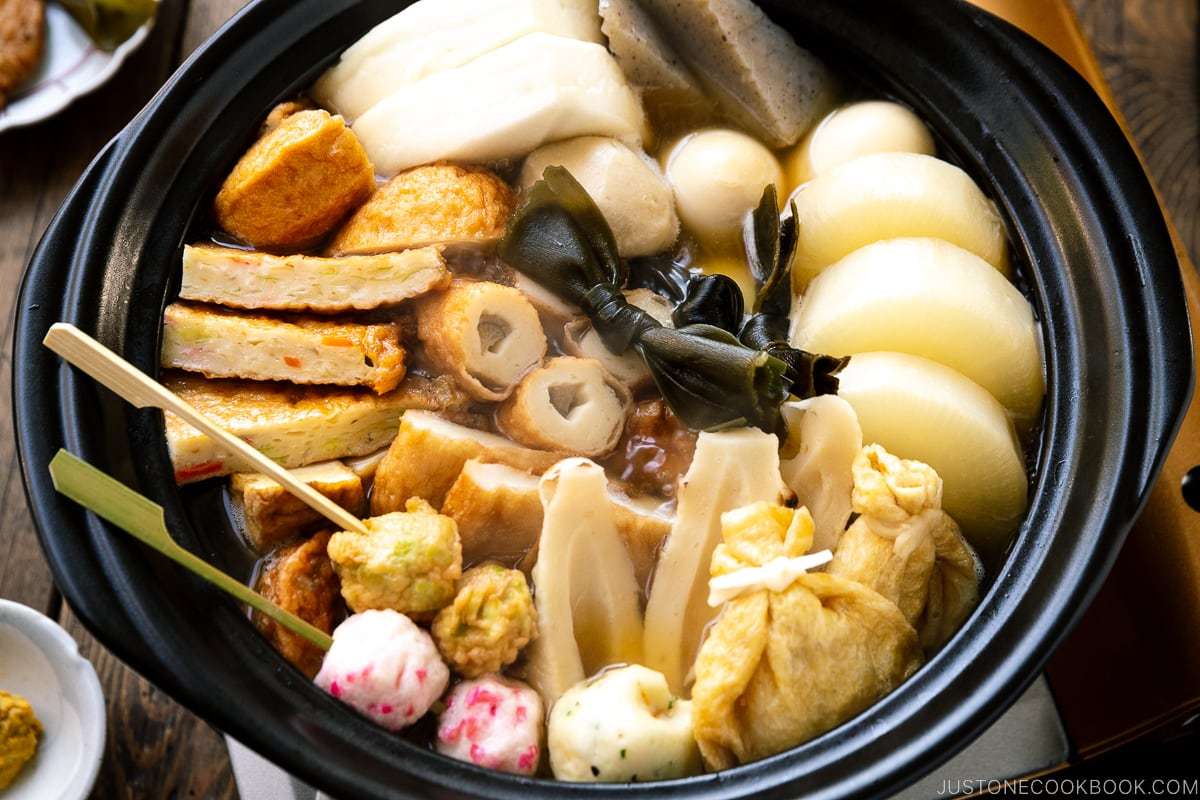
This Oden recipe assembles a selection of traditional ingredients including sliced daikon radish, konnyaku, assorted fish cakes and fish balls, deep-fried firm tofu (atsuage), optional mochi rice cakes wrapped in tofu pouches (mochi kinchaku), hard-boiled eggs, and dried knotted kombu to enhance broth flavor. The broth base uses a strong dashi stock complemented by soy sauce, sake, mirin, and kosher salt for balanced umami and mild sweetness.
The daikon is peeled, sliced into thick rounds with softened edges to maintain shape, and scored to help absorb broth flavors. Kombu strips add depth to the broth while the assortment of fish cakes and tofu provide varied mouthfeel ranging from chewy to soft. Slow simmering allows all components to soak in the broth, melding flavors and tenderizing ingredients without overcooking.
Oden is typically served hot in bowls with some of the flavorful broth. It pairs well with steamed rice and is traditionally accompanied by karashi mustard for an added pungent kick. This dish is a winter staple and comfort food in Japan.
Ingredients
For the Ingredients
- 4 inches daikon radish
- 1 package konnyaku 9 oz, 255 g, aka konjac
- 1 package fish cake about 27 oz, 750 g, assorted (oden set
- 1 package Fish ball about 27 oz, 750 g, assorted (oden set
- 1 package deep-fried firm tofu 6.5 oz, 184 g, cutlet, atsuage
- 2 pieces tofu pouch optional; for the mochi kinchaku, deep-fried, aka aburaage
- 2 pieces mochi optional; for the mochi kinchaku, Japanese rice cake
- 4 egg boiled for 8 minutes, cooled, and peeled, hard-boiled
- 1 package fish cake 4.6 oz, 130 g, hanpen
- 4 pieces kombu or hydrate a large piece of kombu, cut strips, and tie a knot in each, dried, knotted
For the Broth
- 6 cups dashi use standard Awase Dashi, dashi packet or powder, or Vegan Dashi; I highly recommend a strong dashi flavor for this recipe, Japanese soup stock
- 2 Tbsp soy sauce you can use regular soy sauce, but the broth will be darker, usukuchi (light-colored
- 1 Tbsp sake
- 2 Tbsp mirin
- ½ tsp kosher salt Diamond Crystal brand
For Serving
- karashi mustard optional, Japanese hot mustard
Instructions
- Gather all the ingredients. If you can‘t find dried knotted kombu, hydrate a large piece of kombu, cut it into individual strips, and tie a knot in each. If the hydrated kombu is very thick and not pliable, skip tying the knots and instead cut it into smaller strips or squares.
To Prepare the Daikon
- Using a vegetable peeler, remove the outer skin from 4 inches daikon radish. Then, slice the daikon into round pieces 1 inch (2.5 cm) thick.
- With the knife, remove the sharp edges of the daikon slices to smooth them out. This technique is called mentori. The rounded corners and edges will prevent the daikon from breaking and protect its shape. Next, score a cross on one flat side of the daikon slices, about ¼ inch deep, so they will absorb more flavors.
- If you are going to serve rice with the Oden, reserve the cloudy water from rinsing the rice. Fill a medium pot with this cold, cloudy water.
- Add the daikon to the pot. Turn on the stove to medium heat and cook, uncovered, for about 20 minutes. Drain and rinse the daikon in running water. Set aside. Tip: This method helps get rid of the daikon‘s bitterness and odor and makes the daikon a beautiful white color. Make sure to cook the daikon starting with cold water. This allows the center of the daikon to cook slowly before the water reaches a boil and that will help cook the daikon evenly.
To Prepare the Konnyaku
- Bring a small saucepan of water to a boil. Meanwhile, score one side of 1 package konnyaku (konjac) in a crisscross pattern: Make diagonal cuts in one direction about ⅛ inch (3 mm) deep and ⅛ inch (3 mm) apart, then repeat the diagonal cuts in the other direction. Tip: This will help the konnyaku absorb more flavors.
- Next, cut the konnyaku into thirds crosswise. Then, cut each third in half diagonally, creating a triangle shape.
- Place the konnyaku in the boiling water, cook for 3 minutes, and drain. Tip: This helps to remove the odor from the konnyaku.
To Remove the Excess Oil from the Oden Set
- Put water in a donabe (Japanese clay pot) or a large, shallow pot and bring it to a boil. Add 1 package oden set (assorted Japanese fish cakes and fish balls)—we call them nerimono—to the boiling water for 15–30 seconds. Tip: This recommended step removes the excess deep-frying oil from factory processing.
- Remove the fish cakes and fish balls from the boiling water and transfer them to a plate or tray. Let cool. Keep the boiling water in the pot, if you are going to make mochi kinchaku (optional). Otherwise, drain the water and rinse the pot.
To Make the Mochi Kinchaku (optional)
- Blanch 2 pieces aburaage (deep-fried tofu pouch) in the reserved boiling water for 15–30 seconds to remove the excess oil. Remove them from the water and set aside. Drain the water and rinse the pot.
- Cut the aburaage in half crosswise to make two square pockets. Cut 2 pieces Japanese rice cake (mochi)—also called kirimochi—in half or small enough to fit into the tofu pocket.
- Open one aburaage pocket and put a piece of kirimochi inside. Use a toothpick to close the aburaage pouch so the mochi doesn‘t fall out during cooking. Repeat to make the remaining pouches.
To Prepare the Broth
- To the rinsed donabe or large pot, add 6 cups dashi (Japanese soup stock), 2 Tbsp usukuchi (light-colored) soy sauce, 1 Tbsp sake, 2 Tbsp mirin, and ½ tsp Diamond Crystal kosher salt. Mix well together.
To Cook the Oden
- Put the daikon, konnyaku, and 4 hard-boiled eggs (peeled) in the donabe or pot. Bring it to a boil.
- Once boiling, reduce the heat to low or medium low to maintain a simmer. Cook, uncovered, for 20 minutes.
- Meanwhile, cut the big pieces of fish cakes in the oden set in half or quarters so they are a convenient size to pick up with chopsticks. Here, I cut the larger Satsuma age (round fried fish cakes) into quarters and the chikuwa (baked fish cakes) diagonally in half.
- I cut the gobo-maki (burdock fish cake rolls) and fish balls in half.
- I cut the medium-sized Satsuma age in half. I cut the pieces of 1 package deep-fried firm tofu cutlet (atsuage) in half crosswise and then cut each piece in half again diagonally.
- For the small fish balls, you can thread two pieces onto a skewer to keep them together. Diagonally cut 1 package hanpen (fish cake) in quarters.
- After 20 minutes, check your oden pot. If there‘s so much broth that your oden pot will overflow when you add the oden set and other fish cakes, transfer some broth to a measuring cup (or bowl) and set aside. You can add this reserved broth to the pot later, as needed.
- Now, add the oden set, other fish cakes (except for the hanpen), atsuage, and 4 pieces dried knotted kombu to the pot. Cook for 10 minutes.
- After 10 minutes, add the hanpen and the mochi kinchaku (optional). Cook for 3 minutes. Now, your oden is ready to serve. Alternatively, you can turn off the heat and let it cool on the countertop. Tip: Just like other Japanese simmered foods (nimono), letting oden cool in the broth allows the flavors of the savory dashi to soak into the ingredients.
To Serve
- Serve hot. Reheat oden if you let it cool in the previous step, but make sure not to overcook it.
- Oden is usually served with a little bit of karashi (hot mustard) on the side. To make karashi, combine 2 tsp Japanese karashi hot mustard with 3 tsp (1 Tbsp) of hot water in a small bowl.
- Mix together, cover the bowl with plastic wrap, and flip upside down to let it steam under the bowl for 5 minutes to get a good taste and aroma. Unwrap the bowl and the karashi is ready to use.
To Keep
- You can keep the leftovers in an airtight container and keep them for 3 days in the refrigerator or for up to a month in the freezer (do not freeze eggs and konnyaku). Reheat before serving, but do not overcook it.
Nutrition Information
Show DetailsNutrition Facts
Serving: 4Serving
Amount Per Serving
Calories 569 kcal
% Daily Value*
| Calories | 569kcal | 28% |
| Carbohydrates | 63g | 21% |
| Protein | 31g | 62% |
| Fat | 17g | 26% |
| Saturated Fat | 4g | 20% |
| Polyunsaturated Fat | 2g | 12% |
| Monounsaturated Fat | 3g | 15% |
| Cholesterol | 209mg | 70% |
| Sodium | 1249mg | 52% |
| Potassium | 401mg | 9% |
| Fiber | 6g | 24% |
| Sugar | 33g | 66% |
| Vitamin A | 260IU | 5% |
| Vitamin C | 15mg | 17% |
| Calcium | 238mg | 24% |
| Iron | 3mg | 17% |
* Percent Daily Values are based on a 2,000 calorie diet.
User Reviews
Overall Rating
4.8
You'll Also Love