Pork Belly Confit
User Reviews
5
-
Prep Time
45 mins
-
Cook Time
1 d 15 hrs 15 mins
-
Total Time
1 d 16 hrs
-
Servings
6 servings
-
Calories
2667 kcal
-
Course
Main Course
-
Cuisine
American
Pork Belly Confit
Description
This recipe begins by making a complex brine from water, kosher salt, honey, bay leaves, rosemary, thyme, flat-leaf parsley, crushed garlic, and black peppercorns. The brine is boiled briefly to dissolve the salt and release aromatics, then cooled completely. The pork belly is submerged and refrigerated for about 10 hours to absorb the flavors without becoming overly salty.
After brining, the pork belly is rinsed and dried, then placed in an ovenproof pot with enough lard to cover it by half to three-quarters of an inch. The lard is slowly heated on the stove until it reaches 190°F (87°C), then the pot is covered and transferred to a low oven set at 200°F (93°C) to cook gently for several hours. This low-temperature confit method breaks down connective tissue while preserving moisture.
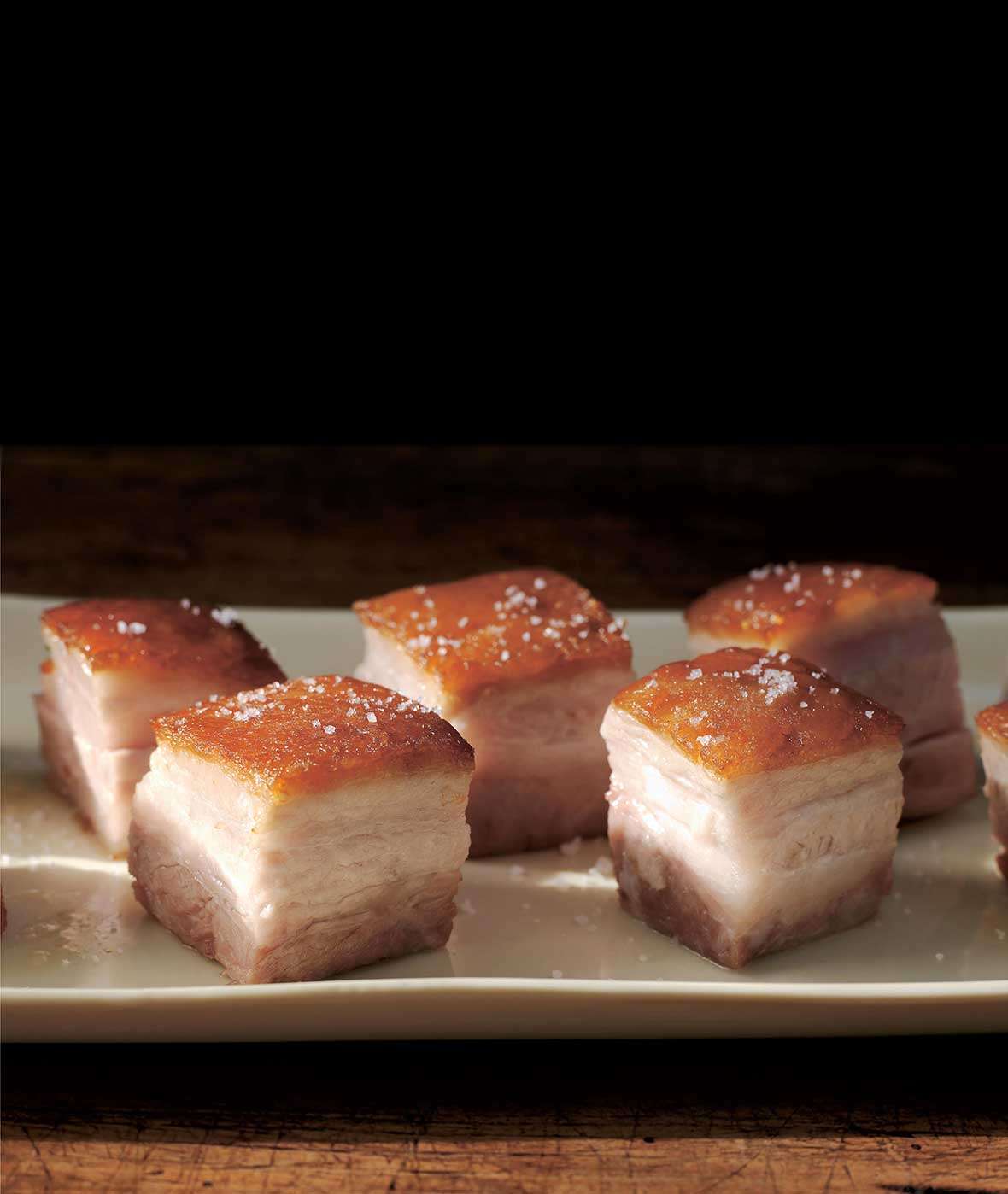
The result is meat that is tender and enriched with the subtle flavors of the herbs, garlic, and honey from the brine. The lard also imparts a silky texture and can be saved for further cooking use. The dish can be finished with a light drizzle of canola oil and coarse sea salt for presentation and added texture contrast.
Ingredients
For the brine
- 1/4 cup plus 2 tablespoons honey
- 12 bay leaves
- 3 large rosemary sprigs
- 1/2 bunch thyme
- 1/2 bunch flat-leaf parsley
- 1/2 cup garlic crushed, papery skin left on, cloves
- 2 tablespoons black peppercorns
- 1 cup kosher salt
- 8 cups water
For the confit
- 1 batch pork brine
- One lab pork belly
- About 6 cups lard at room temperature
For the assembly
- canola oil
- sea salt coarse
Instructions
Make the brine
- Combine all of the ingredients in a large pot, cover, and bring to a boil. Heat for 1 minute, stirring to dissolve the salt, then remove from the heat and let cool completely. Cover and refrigerate for at least 8 hours and up to 3 days.
- Pour the brine into a container large enough to hold the pork. Add the pork, cover, and refrigerate for 10 hours (but no longer as the pork may become salty).
Make the confit
- Remove the pork from the brine, discarding the liquid. Rinse the pork under cold water and pat it dry with paper towels or let it air dry.
- Preheat the oven to 200°F (93°C). Reach for an ovenproof pot that's only slightly larger than the porkand has a lid, such as a 12-quart Dutch oven. Place the pork in the pot and add enough lard to cover it by 1/2 to 3/4 inch. Attach a thermometer to the side of the pot.
- Place the pot over low heat until the lard registers 190°F (87°C). This could take as long as an hour. Cover the pot, transfer it to the oven, and heat until the pork is meltingly tender. This will probably take 5 1/2 to 6 hours, but start checking after 4 hours.
- Remove the pot from the oven and let the pork cool to room temperature. The pork can be refrigerated as-is, enveloped by lard in the pot, for up to 1 week. (We prefer to first gently press the confit to compress the internal layers and force out some of the excess fat. This results in a better texture and appearance. To press the confit, transfer it to a baking dish and pour just enough lard into the dish to barely cover it. Cover the belly loosely with plastic wrap, place a smaller baking dish on top of it and weight it with a brick, a large can, a cast-iron skillet, or something of similar weight. Refrigerate for at least 12 hours. Cover and refrigerate the reserved lard. After it’s been pressed, the pork can be covered with some of the reserved lard and refrigerated for up to 1 week.)
Serve the confit
- Remove the pot from the refrigerator and let it sit in a warm spot for 1 to 3 hours. You want the lard to soften enough so you can scrape it from the pork, yet you want the pork to remain as cold as possible so it will be relatively easy to slice.
- Remove the pork from the pot and wipe off any lard that clings to the meat. (The lard can be reused to confit additional pork as long as it doesn't taste too salty. To reserve the lard, pour it into a pot and heat gently to liquefy, then strain through a fine-mesh conical strainer into a storage container. Refrigerate for up to 2 months or freeze for up to 6 months.)
- Using a sharp knife, remove the skin from the pork. Score the fat on the pork belly in a crosshatch pattern. Slice the pork or cut it into squares (actually, the belly can be cut into any shape) and let it rest at room temperature for 20 to 30 minutes.
- Preheat the oven to 350°F (175°C).
- Heat some canola oil in a large ovenproof skillet over medium heat. Carefully place the pieces of confited pork, fat-side-down, in the skillet, being careful not to crowd the pan and also being careful of spatters. (You may need to work in batches.) Immediately reduce the heat to medium-low and cook until the excess fat is rendered and the fatty side is browned, 8 to 18 minutes, depending on the exact temperature of your oil. You may need to pour off any excess fat about halfway through cooking. When the pork is browned, transfer the skillet to the oven until the belly is heated through, about 10 minutes. Remove from the oven, sprinkle with the salt, and serve.
Notes
- Keep the pork belly submerged in the brine for about 10 hours to infuse flavor without excess saltiness.
- Slow cooking in lard at low oven temperature ensures tender, moist meat with rich flavor.
- Save the rendered lard after cooking for use in other dishes or future confits.
- Use a pot just slightly larger than the pork belly to minimize the amount of lard needed.
- After cooking, seasoning with coarse sea salt and a small amount of canola oil enhances the texture and flavor before serving.
Nutrition Information
Show DetailsNutrition Facts
Serving: 6servings
Amount Per Serving
Calories 2667 kcal
% Daily Value*
| Serving | 1serving | |
| Calories | 2667kcal | 133% |
| Carbohydrates | 18g | 6% |
| Protein | 15g | 30% |
| Fat | 285g | 438% |
| Saturated Fat | 81g | 405% |
| Monounsaturated Fat | 122g | 610% |
| Trans Fat | 27g | 1350% |
| Cholesterol | 109mg | 36% |
| Sodium | 18945mg | 789% |
| Fiber | 1g | 4% |
| Sugar | 12g | 24% |
* Percent Daily Values are based on a 2,000 calorie diet.
User Reviews
Overall Rating
5
You'll Also Love