Preserved Lemons
User Reviews
4.8
Preserved Lemons
Description
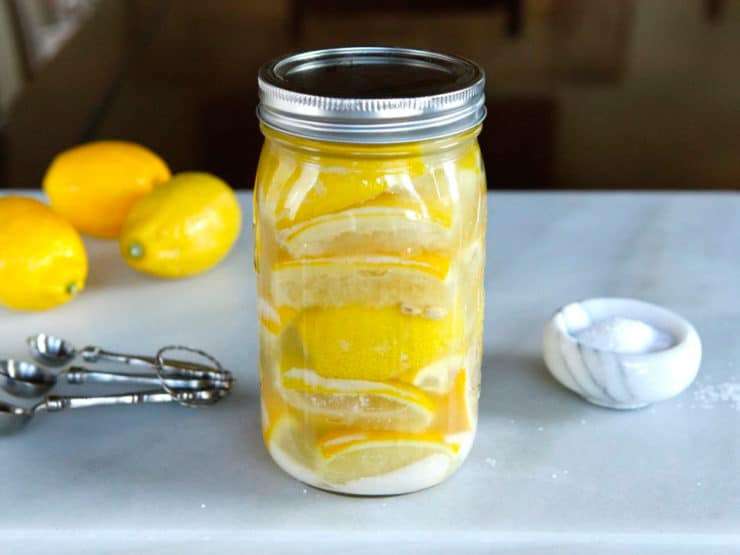
Preserved Lemons start with whole lemons that are cleaned and trimmed on both ends to create stable flat surfaces. Each lemon is partially sliced into quarters, stopping short of cutting all the way through, allowing the quarters to remain attached. Salt is packed inside these slits and on the outside to coat the lemons. The salted lemons are then tightly packed into a clean quart jar. Pressure is applied to extract their juices, helping cover the lemons fully. If needed, fresh lemon juice tops off the jar to submerge them. The lemons ferment in their own juices and salt, softening their peel and mellowing their acidity while intensifying flavor.
This preservation technique yields a robust, salty lemon flavor that enhances savory dishes by adding complexity and brightness. Preserved Lemons are used in Middle Eastern and North African cuisines to enrich tagines, sauces, salads, and marinades. The soft rind and flesh offer a tart and salty accent that can transform simple recipes.
It is important to use enough salt and a clean jar to ensure proper preservation. The lemons should be kept refrigerated after initial fermentation and can be stored for several months. The preserved lemon juice and pulp can also be incorporated into dressings or cooked dishes for a distinct citrus note.
Ingredients
- 6-8 lemon whole
- 4-5 tablespoons salt
Instructions
- Start by cleaning your quart jar in hot soapy water. Dry with a clean towel. Clean the outsides of the lemons, rinse and pat dry. Slice the ends from the lemons to create a flat top and bottom.
- Stand the lemon on one of the flat ends. To preserve the lemons whole, cut an "x" in the lemon and stop when you are about 1/2 inch from cutting all the way through.
- The quarters of the lemon remain attached at the base.
- Open the lemon and pour in 1/2 tbsp of salt. Don't worry if some of the salt spills out.
- Once you salt the lemons, pack them into the jar as tightly as possible. You can use a pestle or a wooden spoon to push them in.Once all of the lemons are in the jar, add an additional 1 tbsp of salt. Press on the lemons one more time to extract as much juice as possible.If the lemons are submerged in juice you can secure the lid, if not you may need to add additional fresh lemon juice to top them off.
- Alternatively, after slicing off the ends from the lemons, you can simply quarter them into four separate pieces; the quarters do not need to remain attached at the base. If you use this method, pour 1/2 tbsp salt into the bottom of the jar, place four lemon quarters in the jar, and sprinkle 1/2 tbsp salt evenly on top of the for slices. Repeat with each quartered lemon, alternating layers of 4 slices and 1/2 salt, till the jar is tightly packed with lemon slices. Sprinkle 1 tbsp on top of the final layer of slices.
- Use a pestle to press on the lemons and extract as much juice as possible. Top off the jar with fresh lemon juice if needed.Seal the jar and store the lemons in a cool dry place for at least 1 week. Give them a shake every once in a while to disperse the juice and salt.
- After 1 week, move your lemons to refrigerator. When the peels become translucent, you will know they are soft and ready for use.
- When you are ready to use a lemon, remove it from the jar and rinse to remove excess salt.
- Cut all of the remaining lemon flesh and pith away from the rind and discard.
- Chop the preserved lemon peel according to your recipe, or whichever way you prefer.
- You can store the lemons in the refrigerator for up to 6 months.
Notes
- Use a clean quart jar and fresh lemons for best results.
- Press lemons tightly in the jar to extract juices and ensure coverage.
- If lemons are not fully submerged in juice, add fresh lemon juice to cover completely before sealing.
- Allow lemons to ferment for several weeks before use; they can be stored refrigerated after fermentation.
Nutrition Information
Show DetailsNutrition Facts
Serving: 24Serving
Amount Per Serving
Calories 8 kcal
% Daily Value*
| Calories | 8kcal | 0% |
| Carbohydrates | 3g | 1% |
| Protein | 1g | 2% |
| Fat | 1g | 2% |
| Saturated Fat | 1g | 5% |
| Sodium | 1163mg | 48% |
| Potassium | 37mg | 1% |
| Fiber | 1g | 4% |
| Sugar | 1g | 2% |
| Vitamin A | 6IU | 0% |
| Vitamin C | 14mg | 16% |
| Calcium | 8mg | 1% |
| Iron | 1mg | 6% |
* Percent Daily Values are based on a 2,000 calorie diet.
User Reviews
Overall Rating
4.8
You'll Also Love