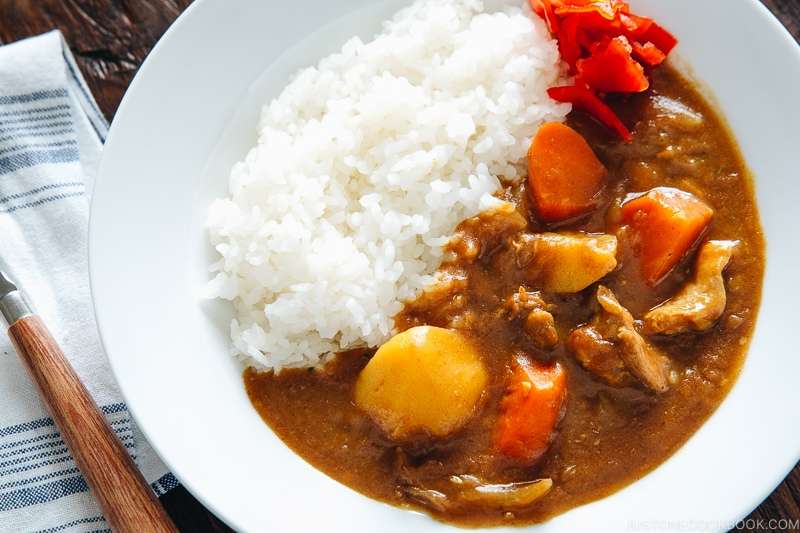
Pressure Cooker Japanese Curry
User Reviews
4.8
-
Prep Time
20 mins
-
Cook Time
20 mins
-
Additional Time
30 mins
-
Total Time
1 hr 10 mins
-
Servings
6
-
Calories
320 kcal
-
Course
Main Course
-
Cuisine
Japanese
Pressure Cooker Japanese Curry
Description
The recipe starts by preparing the vegetables: onions cut into wedges, carrots cut using a rangiri technique to increase surface area for faster cooking and better flavor absorption, and quartered Yukon gold potatoes soaked to remove excess starch for a firmer texture. Garlic and freshly grated ginger add aromatic depth. Boneless, skinless chicken thighs are cut into bite-sized pieces for even cooking.
The curry sauce is made by sautéing ingredients with chicken stock and adding a Japanese curry roux block, along with ketchup and soy sauce to deepen the flavor. Cooking under pressure reduces cooking time and tenderness is achieved for both meat and vegetables without mushiness, thanks in part to the chosen potato variety and cut sizes.
Served with steamed Japanese short-grain rice, the curry can be accompanied by pickled vegetables for contrast. The meal provides a comforting, rich flavor with mild spices, suitable for home cooking.
Substitution notes advise using pork or beef chuck roast instead of chicken, but warn against beef stew meat that does not become tender with this method. Preparation techniques like rangiri for carrots and sogigiri for chicken optimize texture and absorption of flavors.
Ingredients
- 3 onion large; 2¼ lb, 1, 005 g
- 1½ carrot 5 oz, 143 g
- 3 potato 15 oz, 432 g, Yukon gold variety
- 2 cloves garlic
- 1 tsp ginger (grated, with juice)
- 1½ lb chicken thighs see Notes for substitutions, boneless, skinless
- ⅛ tsp kosher salt Diamond Crystal brand
- ⅛ tsp black pepper freshly ground
For the Curry Sauce
- 1 Tbsp neutral oil (for cooking)
- 3 cups chicken stock for lower sodium, use water only or half stock and half water, or broth
- 1 package curry roux 7-8 oz or 200-230 g; or make my Japanese Curry Roux, Japanese style
- 1 Tbsp ketchup
- 1 Tbsp soy sauce
For Serving
- 6 ervings Japanese short-grain rice cooked
- pickled vegetables optional; or make my Homemade Fukujinzuke, Japanese fukujinzuke red style
Instructions
- Gather all the ingredients. Please read my blog post about options for add-on condiments to season the curry sauce.
To Prepare the Ingredients
- Cut 3 onions in half and cut each half into 5 wedges.
- Peel 1½ carrots and cut into bite-sized pieces. I use a Japanese cutting technique called rangiri. This cut creates more surface area, which helps the carrots absorb more flavor and cook faster. Tip: You can cut the vegetables slightly bigger to avoid a mushy texture.
- Peel 3 Yukon gold potatoes and cut them into quarters. Soak them in water for 15 minutes to remove the excess starch. Tip: Do not use russet potatoes since they would break down too easily.
- Mince 2 cloves garlic (I like this garlic press). Then, grate the ginger with a microplane zester or ceramic grater and reserve 1 tsp ginger (grated, with juice).
- Cut 1½ lb boneless, skinless chicken thighs into bite-sized pieces. I use the sogigiri Japanese cutting technique to create more surface area and flatten each piece so it cooks faster. Season with ⅛ tsp Diamond Crystal kosher salt and ⅛ tsp freshly ground black pepper.
To Cook the Curry
- Press the Sauté button on your Instant Pot (I use a 6 QT Instant Pot) or preheat a stovetop pressure cooker over medium heat. When the inner pot is hot, add 1 Tbsp neutral oil.
- Then, add the onion wedges, minced garlic, and grated ginger with juice.
- Add the chicken pieces to the pot and mix until just coated with the oil.
- Add the carrots and potatoes to the pot and mix well.
- Add 3 cups chicken stock/broth and use a spatula to press down the meat and vegetables into the liquid. Then, place the cubes from 1 package Japanese curry roux (I combine half mild and half medium spicy packaged roux) on top of the other ingredients. DO NOT MIX! Otherwise, the roux may sink to the bottom of the pot and burn while cooking. For solidified homemade roux, place the cubes on top of the ingredients and do not mix. For non-solidified homemade roux (that you just made), add it after pressure cooking is done.
- Cover and lock the lid. Make sure the Instant Pot‘s steam release handle points to Sealing and not Venting. Press the Keep Warm/Cancel button on the Instant Pot to stop sautéing. Then, press the Meat/Stew button to switch to pressure cooking. Press the “minus“ button to change the cooking time to 15 minutes.
- For a Stovetop Pressure Cooker: Close and lock the lid. Set the pressure level to high. Heat the pot on the stovetop over medium-high heat until you‘ve reached high pressure. Then, reduce the heat to medium low to maintain high pressure, and cook for 15 minutes.
- When it is finished cooking, the Instant Pot will switch automatically to the Keep Warm mode. Slide the steam release handle to Venting to let out steam until the float valve drops down, OR let the pressure release naturally (this takes about 15 minutes).
- Unlock the lid. (If you‘re using homemade curry roux, add it to the pot now and heat on Sauté mode for an additional 5 minutes until well blended into the stew.) Add 1 Tbsp ketchup and 1 Tbsp soy sauce now. Mix well, stirring to dissolve the curry roux and checking one last time that there are no undissolved chunks left. Tip: If you use my unsalted homemade curry roux, taste the curry sauce now and add salt to your liking. I recommend adding 2–4 tsp Diamond Crystal kosher salt, but this will vary based on the brand of the chicken broth and condiments you added.
To Serve
- Portion 6 servings cooked Japanese short-grain rice on individual plates and serve the curry on top. Serve with optional fukujinzuke (Japanese red pickled vegetables) on the side.
To Store
- Keep the leftovers in a glass airtight container and store it in the refrigerator for up to 3 days and in the freezer for a month. The texture of the potatoes will change in the freezer, so remove them before freezing. Defrost the frozen curry in the refrigerator for 24 hours before you want to reheat it.
To Reheat
- Leftover curry sauce will thicken into a paste as it cools, so it tends to burn while reheating. To avoid this, stir ½ cup (120 ml) water or more into the leftover sauce until loosened. Then, gently reheat it on low heat. If the sauce seems thin, continue heating with the lid off to reduce the sauce.
Notes
- Chicken thighs can be substituted with pork or beef chuck roast for this curry; avoid using beef stew meat as it won't become tender enough.
- Use Yukon gold potatoes quartered and soaked to maintain texture; russet potatoes tend to break down too much.
- Cut carrots using rangiri style to increase surface area for better flavor absorption and faster cooking.
- The recipe uses a curry roux block and includes ketchup and soy sauce to create depth in the curry sauce.
Nutrition Information
Show DetailsNutrition Facts
Serving: 6Serving
Amount Per Serving
Calories 320 kcal
% Daily Value*
| Calories | 320kcal | 16% |
| Carbohydrates | 28g | 9% |
| Protein | 26g | 52% |
| Fat | 8g | 12% |
| Saturated Fat | 5g | 25% |
| Polyunsaturated Fat | 1g | 6% |
| Monounsaturated Fat | 2g | 10% |
| Trans Fat | 1g | 50% |
| Cholesterol | 108mg | 36% |
| Sodium | 1052mg | 44% |
| Potassium | 786mg | 17% |
| Fiber | 4g | 16% |
| Sugar | 7g | 14% |
| Vitamin A | 2606IU | 52% |
| Vitamin C | 23mg | 26% |
| Calcium | 67mg | 7% |
| Iron | 2mg | 11% |
* Percent Daily Values are based on a 2,000 calorie diet.
User Reviews
Overall Rating
4.8
You'll Also Love