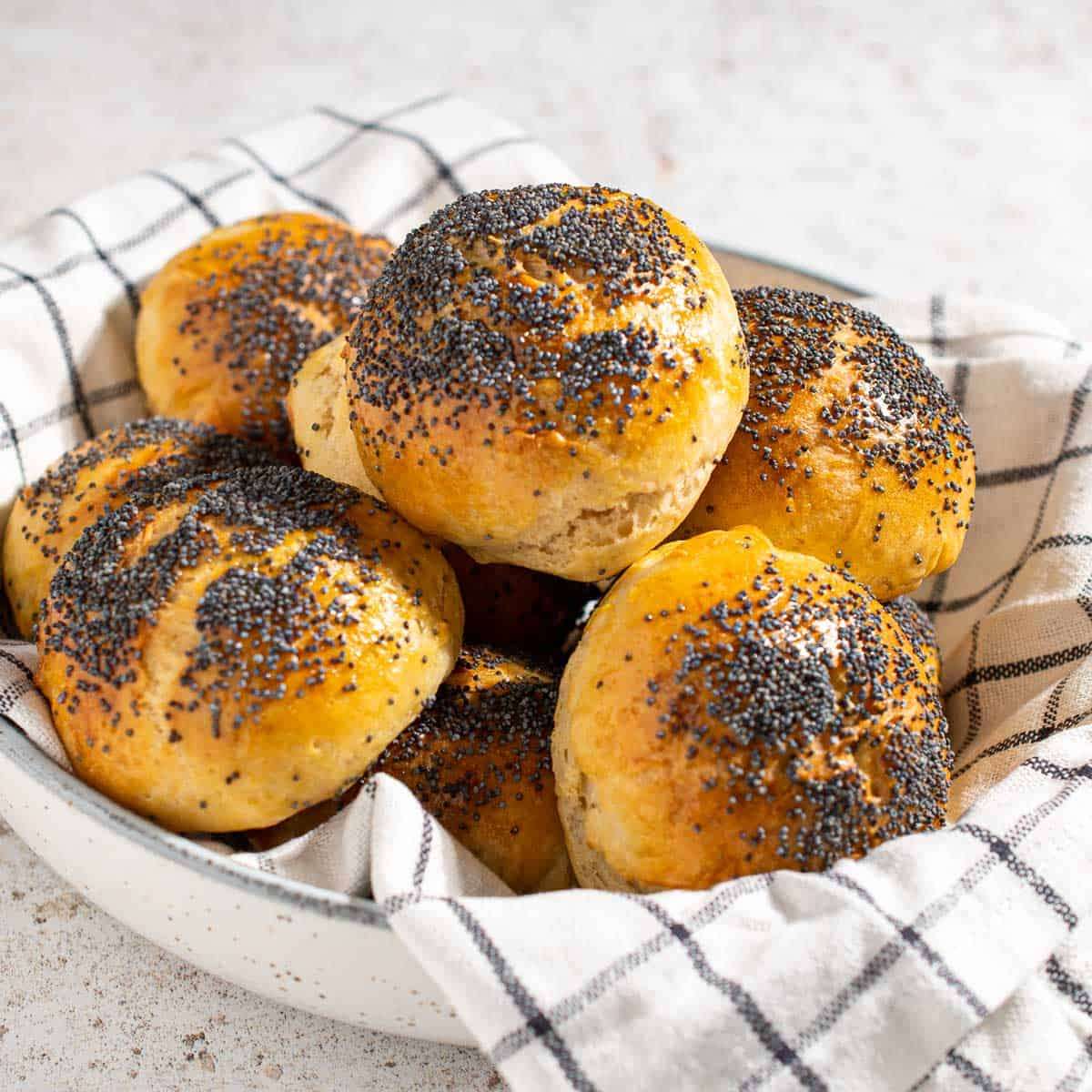
Rundstykker - Danish breakfast rolls
User Reviews
5
Rundstykker - Danish breakfast rolls
Description
These Danish breakfast rolls begin by activating active dry yeast in warm milk with sugar, creating a frothy starter for the dough. Flour, salt, melted butter, and the yeast mixture are combined and kneaded until a smooth, elastic dough forms. After resting, the dough is divided and shaped into rolls. A beaten egg brushed on top helps develop a shiny crust, and poppy seeds add characteristic flavor and texture.
The baking process yields rolls with a soft interior crumb and a slightly crisp golden crust. The dough's medium softness allows shaping while maintaining enough structure for a tender texture. These rolls are well suited to breakfast, served with butter or jam, or as sandwich rolls for lighter meals.
Using quality ingredients, especially fresh yeast and all-purpose flour, is important to achieve good rise and flavor. Proper kneading activates gluten development for structure, and adequate resting allows the dough to rise fully. Making shallow cuts on the tops before baking helps control expansion and gives a traditional look.
It's advised to let the rolls cool briefly post-baking to set the crumb and prevent them from falling apart when handled or sliced.
Ingredients
- 300 millilitres milk warm
- 1½ teaspoon active dried yeast 7.5ml. Make sure the yeast is still fresh and within date.
- 1½ teaspoon sugar
- 400 grams all-purpose flour and extra for handling the dough
- 1 teaspoon salt
- 30 grams butter melted, unsalted
- 1 egg lightly beaten for brushing
- 3-4 tablespoons poppy seeds for sprinkling
Instructions
- Line a large baking tray with parchment paper.
- In a bowl, add the warm milk, yeast and sugar. Give it a quick stir. Note: The milk should not be boiling, just warm, slightly above room temperature. We heat ours in the microwave for about 1 minute in a tall measuring jug.
- Leave the yeast mixture to develop for 10-15 minutes. Note: You can tell that a yeast mixture has developed when it becomes frothy and bubbly on the surface. This indicates that the yeast is active and has started to feed on the sugar in the mixture, producing carbon dioxide gas as a by-product.
- In the meantime, add the flour and salt to the bowl of a stand mixer. Give it a stir to combine.
- Add the melted butter.
- Once the yeast is ready, add the yeast mixture and give the dough a quick stir with a fork.
- Using the dough hook on the stand mixer, knead for 10-12 minutes.At first the dough will look very sticky. After kneading, it will look much more uniform, smooth and elastic.
- Transfer the dough into a large, lightly oiled mixing bowl. Cover with a kitchen towel and allow it to rise in a warm spot for 60-90 minutes until it's doubled in volume. Tip: During the winter in the UK we like to put the oven on a low heat for about 5 minutes to heat up. Switch the oven off and put the dough inside with the door slightly ajar. It's important that the oven is not at all hot, but just warm.
- When the dough has risen, cover your hands in flour and divide it into 10 equally sized pieces. Roll each piece into a ball and place on a parchment lined baking tray. Allow enough space between each roll to allow for rising.
- Cover the tray loosely with a clean kitchen towel and allow to rest for a further 30 minutes in a warm spot.
- Preheat the oven to 200℃/390℉/gas mark 6.
- When the dough has rested, brush the rolls with the lightly beaten egg and a pastry brush.
- Sprinkle over the poppy seeds. With the tip of a very sharp knife, or a scalpel, cut a small cross in the top of each roll.
- Bake for 20-25 minutes until the rolls are golden brown, well risen and baked through. Allow to cool for 5 minutes before transferring to a cooling rack.
Notes
- Use fresh yeast and good-quality flour for optimal rise and flavor.
- Knead dough thoroughly to develop gluten for texture and elasticity.
- Allow sufficient time for dough to rise and rest for flavor development.
- Keep flour on hand while shaping to manage a medium-soft dough.
- Score tops with a sharp blade before baking to aid expansion and appearance.
- Let rolls cool slightly after baking to set the crumb before serving.
Nutrition Information
Show DetailsNutrition Facts
Serving: 10rolls
Amount Per Serving
Calories 211 kcal
% Daily Value*
| Calories | 211kcal | 11% |
| Carbohydrates | 35g | 12% |
| Protein | 8g | 16% |
| Fat | 5g | 8% |
| Saturated Fat | 1g | 5% |
| Polyunsaturated Fat | 1g | 6% |
| Monounsaturated Fat | 1g | 5% |
| Trans Fat | 0.002g | 0% |
| Cholesterol | 20mg | 7% |
| Sodium | 257mg | 11% |
| Potassium | 149mg | 3% |
| Fiber | 2g | 8% |
| Sugar | 3g | 6% |
| Vitamin A | 74IU | 1% |
| Vitamin C | 0.03mg | 0% |
| Calcium | 88mg | 9% |
| Iron | 2mg | 11% |
* Percent Daily Values are based on a 2,000 calorie diet.
User Reviews
Overall Rating
5
You'll Also Love