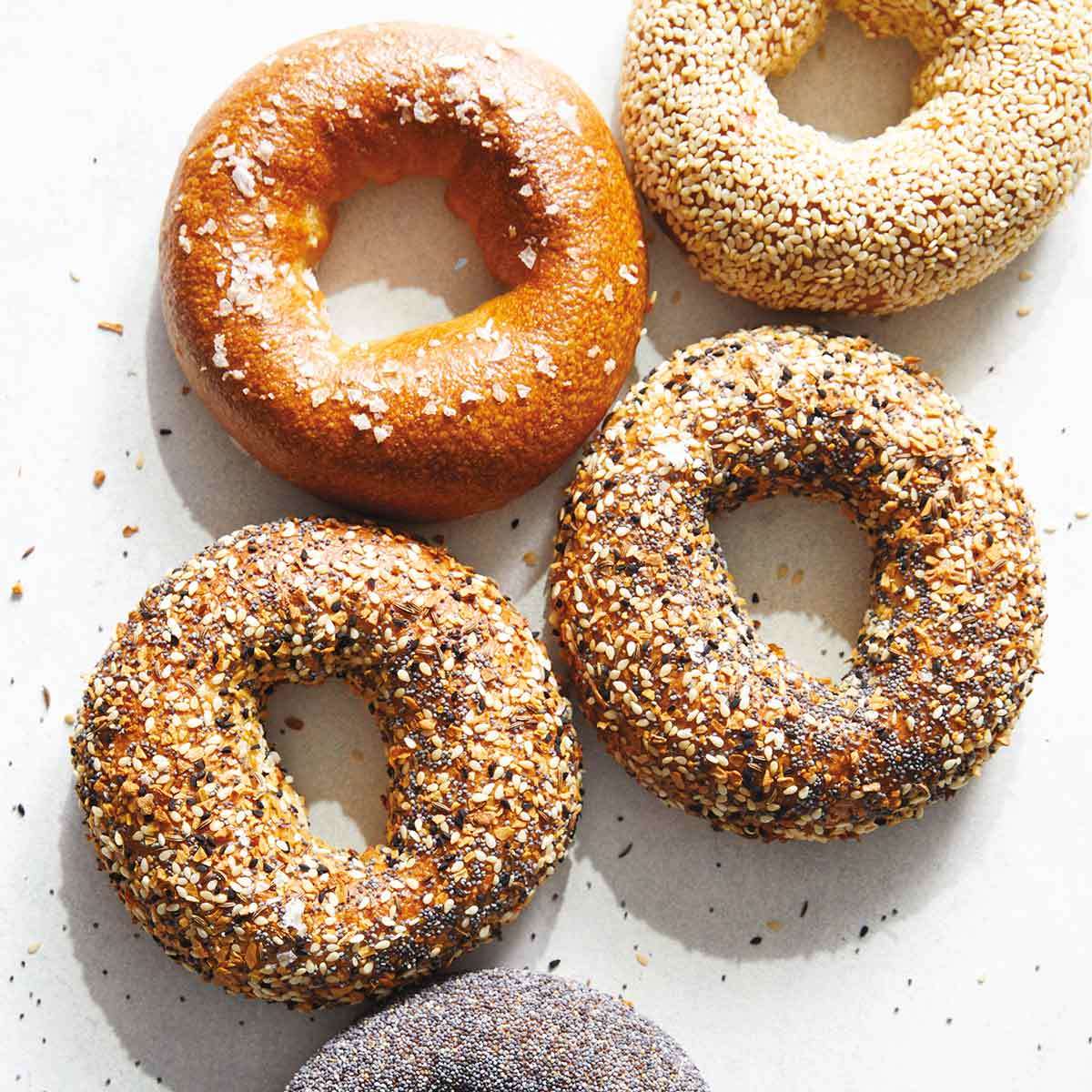
Rye Bagels
User Reviews
5
Rye Bagels
Description
This recipe for Rye Bagels begins with a rye sponge made from dark rye flour, salt, yeast, and cold water, which ferments slowly to develop flavor. The sponge is then mixed into a dough with bread flour, whole wheat flour, milk, sugar, salt, barley malt syrup, water, and activated yeast. The dough is kneaded to a firm consistency before shaping.
The use of barley malt syrup is key for achieving the characteristic shine and malty taste associated with traditional bagels. A blend of seeds—caraway, nigella, poppy, sesame—along with onion flakes tops the bagels before baking, contributing a complex aroma and textured crust.
This recipe requires attention to water temperature and fermentation for optimal rise and flavor. The finished bagels have a chewy texture and a rich, slightly sweet flavor from the malt syrup, making them suitable for breakfast or sandwiches.
Barley malt syrup can be substituted with honey or molasses, though this changes the flavor profile. The recipe notes emphasize the importance of temperature control for both the sponge and yeast activation steps to ensure proper fermentation and texture.
Ingredients
For the rye sponge
- 1/2 cup dark rye flour
- 1/4 teaspoon salt fine sea salt
- 1/8 teaspoon instant yeast
- 1/3 cup water cold (65° to 70°F | 18° to 21°C
For the dough
- 2/3 cup water lukewarm (98º to 105ºF | 37° to 41°C
- 1 teaspoon instant yeast
- 2 cups bread flour plus extra for dusting
- 3/4 cup whole wheat flour
- 3 tablespoons milk whole
- 1 tablespoon plus 1 1/2 teaspoons granulated sugar
- 1 1/2 teaspoons salt fine sea salt
- 1 teaspoon barley malt syrup
- baking spray nonstick
For the topping
- 1 1/2 teaspoons caraway seeds
- 1 1/2 teaspoons nigella seeds
- 1 1/2 teaspoons poppy seeds
- 1 tablespoon plus 1 1/2 teaspoons sesame seeds
- 3 tablespoons onion flakes
- 1/4 cup barley malt syrup
Instructions
Prep Day
Make the rye sponge
- In a small bowl, stir the flour, salt, yeast, and cold water together and mix with a wooden spoon or rubber spatula until well combined, about 30 seconds. The water temperature is important to ensure that the sponge rises at a slower rate; warmer water can cause the sponge to ferment too quickly, impacting the flavor of the bagels. Cover tightly with plastic wrap or a kitchen towel and ferment at room temperature for 4 hours.
Make the dough
- When the sponge is ready, you can make the dough. Into a bowl, pour the lukewarm water and sprinkle the yeast over it. Stir and set aside to activate for 5 minutes. Be sure to use the correct temperature water; any hotter and the yeast can deteriorate.
- In a stand mixer fitted with the dough hook attachment, combine the dissolved yeast mixture, rye sponge, flours, milk, sugar, salt, and barley malt syrup. Mix on low speed for 2 minutes just to combine. Increase the speed to medium and mix until the dough feels firm and bouncy, about 2 minutes.
- Place the dough on a lightly floured surface and knead briefly to shape into a smooth ball. Place the dough in a bowl lightly coated with nonstick spray, cover tightly with plastic wrap, and let rest at room temperature for 20 minutes so the gluten can relax.
- Coat a rimmed baking sheet with nonstick spray. Cut the dough into six equal pieces, about 4 1/2 ounces (125 g) each. Shape each piece into a tight ball. With your index finger, poke a hole in the middle of the ball to create a hollow center. Stretch the hole until it measures 1 to 1 1/2 inches (25 to 38 mm) in diameter.
- Move the shaped bagels to the prepared sheet, making sure they’re spaced at least 2 inches (5 cm) apart. Cover with plastic wrap and refrigerate overnight. The bagels will be ready to poach the next day.
Baking Day
- Remove the bagels from the refrigerator and let them sit, uncovered, at room temperature for 1 hour.
- Place an oven rack in the middle position and preheat the oven to 400ºF (204°C). Coat a rimmed baking sheet with nonstick spray.
Make the topping
- In a small bowl, combine the caraway seeds, nigella seeds, poppy seeds, sesame seeds, and onion flakes.
- To poach the bagels, bring a medium saucepan of water to a boil. Lower the heat until the water is at a simmer and stir in the barley malt syrup. The barley malt will help the exterior of the bagels brown while giving them an attractive sheen.
- Working in batches of 2 or 3 bagels at a time, use a spider or slotted spoon to carefully lower each bagel into the water. Poach for 30 seconds, flip with the spider or slotted spoon, and poach for 30 seconds more. Use the spider or slotted spoon to transfer the poached bagels to the prepared baking sheet, placing them 2 inches (5 cm) apart, with the “prettier” side up. Sprinkle each bagel immediately with 1 tablespoon topping. Repeat with the remaining bagels.
- Bake the bagels for 15 minutes. Then rotate the baking sheet and bake until the bagels are golden brown, 5 to 10 minutes more. Rotating the sheet halfway through the baking process will ensure that the bagels color evenly. Cool on a wire rack for 1 hour before serving.
Notes
- Barley malt syrup provides the classic shiny crust and malty flavor; substitute honey or molasses if unavailable but expect a different taste.
- Use cold water (65° to 70°F) for the rye sponge to ensure slow fermentation and better flavor development.
- Maintain the correct water temperature (98° to 105°F) when activating yeast to avoid killing it.
Nutrition Information
Show DetailsNutrition Facts
Serving: 6bagels
Amount Per Serving
Calories 314 kcal
% Daily Value*
| Serving | 1bagel | |
| Calories | 314kcal | 16% |
| Carbohydrates | 65g | 22% |
| Protein | 10g | 20% |
| Fat | 3g | 5% |
| Saturated Fat | 1g | 5% |
| Cholesterol | 1mg | 0% |
| Sodium | 698mg | 29% |
| Fiber | 5g | 20% |
| Sugar | 13g | 26% |
* Percent Daily Values are based on a 2,000 calorie diet.
User Reviews
Overall Rating
5
You'll Also Love