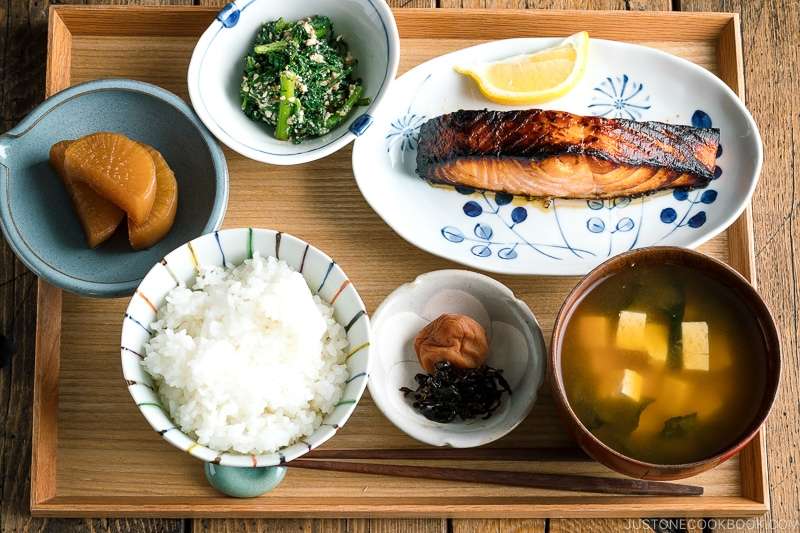
Shio Koji Salmon
User Reviews
4.7
-
Prep Time
5 mins
-
Cook Time
20 mins
-
Additional Time
8 hrs
-
Total Time
8 hrs 25 mins
-
Servings
4
-
Calories
254 kcal
-
Course
Main Course
-
Cuisine
Japanese
Shio Koji Salmon
Description
This recipe uses shio koji to marinate salmon fillets, imparting a subtle savory depth and aiding in tenderizing the fish. After patting the skin-on salmon dry, a generous coating of shio koji is applied to all surfaces, including the skin. Refrigeration overnight promotes a gentle enzymatic breakdown, resulting in a succulent, enhanced-flavor fillet.
Broiling the marinated salmon under high heat produces a nicely crisped skin and browned top without overcooking the flesh. The process requires proper timing and oven rack placement to achieve optimal texture. Variations can include other types of firm fish, and marination time may be adjusted for thinner cuts.
The marinade also allows for freezing the salmon before cooking, extending its storage life up to a month. This versatility makes shio koji salmon suitable for meal prep or special occasions where flavorful fish with minimal seasoning is desired.
Ingredients
- 4 salmon fillets 1½ lb, 700 g; you can use yellowtail, cod, and other types of fish fillet; for more shio koji recipes, please read the post, skin-on
- 4 Tbsp shio koji (I use shio koji from Hikari Miso)
Instructions
- Gather all the ingredients.
To Marinate the Salmon
- Pat dry 4 skin-on salmon fillets with a paper towel to remove any moisture. Put 4 Tbsp shio koji on salmon fillets. It doesn‘t have to be precise amount, just enough to coat the salmon.
- Distribute shio koji to all sides of salmon, including the skin. Cover with plastic and refrigerate overnight. Depending on the thickness of the salmon, the marinate time may vary. If you have a thin piece, you can marinate it for a few hours. For thick pieces like mine, I recommend overnight. If you want to freeze the uncooked salmon, you must store the marinated salmon in an airtight freezer bag and store in the freezer for up to a month.
To Broil the Salmon
- Line a baking sheet with foil. Set the broiler on High with a rack placed about 8 inches (20 cm) from the top heating element (I use the middle rack of my oven) and preheat for 5 minutes. When broiling, you don‘t control the temperature in the oven; instead, you control the distance between the broiler and the surface of the food. It‘s similar to using hotter and cooler zones on your grill. My broiler setting is Low (450ºF/232ºC), Medium (500ºF/260ºC), and High (550ºF/288ºC). I usually use the medium (6 inches away) or high (8 inches away).
- Using your hands, wipe off shio koji from the salmon fillet. Shio koji gets burn easily, so it’s best to remove it completely from the salmon. Place the salmon on the prepared baking sheet, 1–2 inches apart from each other.
- Broil the salmon for 10 minutes. NOTE: The cooking time varies depending on the thickness of the fish and the distance between the broiler and the food. When the top is nicely charred, take it out from the oven.
- Flip so the side of the salmon is now up. Place the salmon back in the oven, and broil again for another 5–8 minutes until the thickest part of the fillet reaches an internal temperature of 145°F (63ºC) using an instant-read cooking thermometer. Serve warm or at room temperature.
To Bake the Salmon
- Preheat the oven to 425°F (218ºC) with a rack placed in the center of the oven. For a convection oven, reduce cooking temperature by 25ºF (15ºC). Bake the salmon for 15 minutes, or until the surface is blistered and brown a bit. You do not need to flip the fish. Note: 5 minutes per ½-inch thickness of salmon (measure at the thickest).
To Store
- You can keep the leftovers in an airtight container and store in the refrigerator for up to 3 days and in the freezer for 1 month.
Nutrition Information
Show DetailsNutrition Facts
Serving: 4Serving
Amount Per Serving
Calories 254 kcal
% Daily Value*
| Calories | 254kcal | 13% |
| Carbohydrates | 1g | 0% |
| Protein | 34g | 68% |
| Fat | 11g | 17% |
| Saturated Fat | 2g | 10% |
| Cholesterol | 94mg | 31% |
| Sodium | 330mg | 14% |
| Potassium | 833mg | 18% |
| Sugar | 2g | 4% |
| Vitamin A | 68IU | 1% |
| Calcium | 20mg | 2% |
| Iron | 1mg | 6% |
* Percent Daily Values are based on a 2,000 calorie diet.
User Reviews
Overall Rating
4.7
You'll Also Love