Single-Quart Sauerkraut
User Reviews
5
Single-Quart Sauerkraut
Description
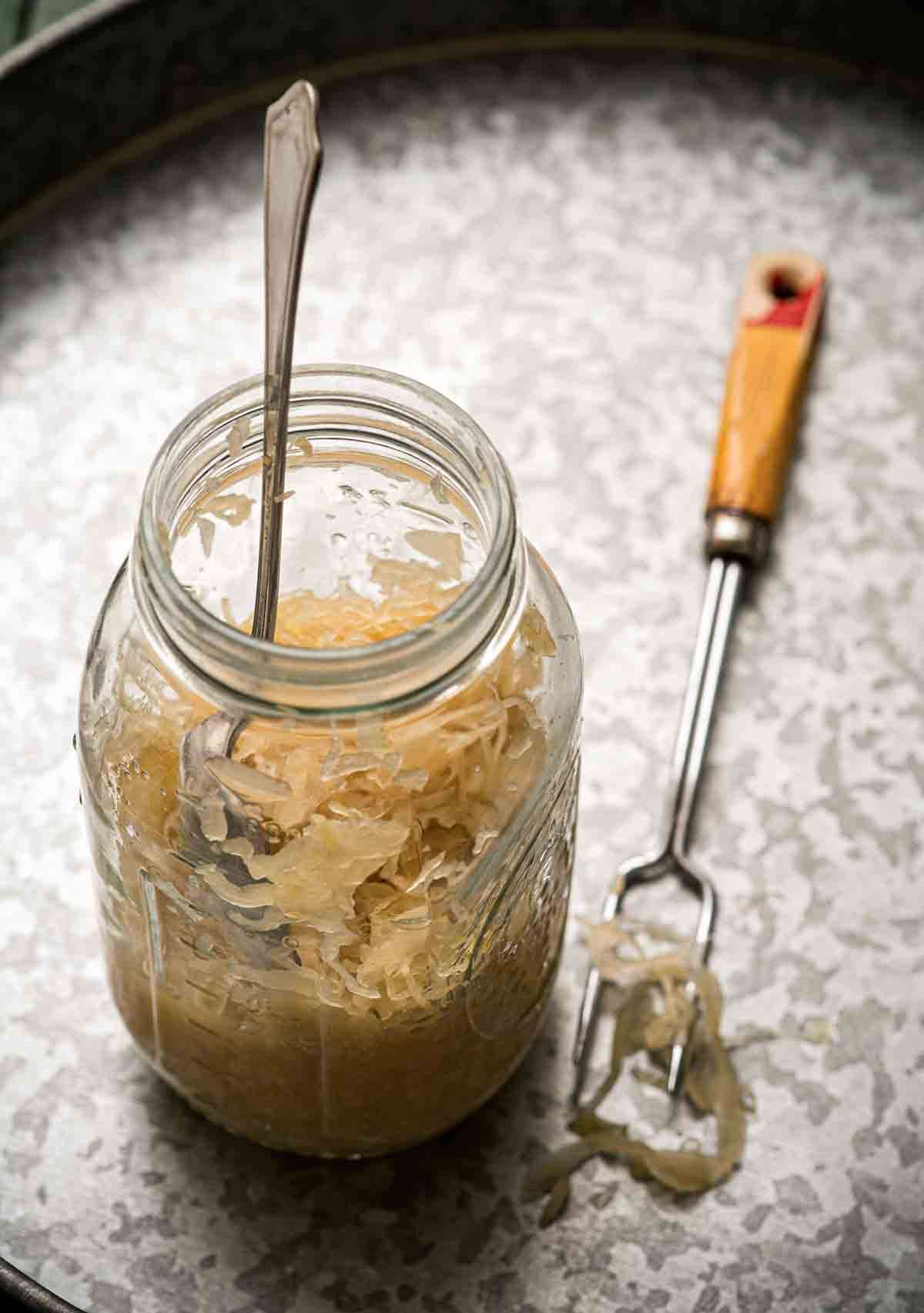
The recipe begins by sterilizing a wide-mouthed 1-quart jar and a smaller jar to be used as a weight. Finely shredded cabbage is mixed with fine sea salt and optionally caraway seeds before being kneaded thoroughly to release liquid, reducing its volume by half. The salted cabbage and brine are tightly packed into the jar so the cabbage stays submerged under its liquid. The smaller jar filled with water is set in the mouth of the larger jar to weigh down the cabbage, ensuring it remains below the brine to prevent mold.
Left to ferment at room temperature, natural lactic acid bacteria convert sugars into acids, lending the sauerkraut its characteristic tangy flavor and tender texture. This method yields a traditional fermented cabbage ideal for adding acidity and crunch to meals.
This recipe is a small-batch fermentation suited for home use, allowing control over saltiness and flavor, with the optional caraway providing an earthy, aromatic note.
Ingredients
- 1 small green cabbage
- 1 tablespoon salt fine sea salt
- 1 teaspoon caraway seeds (optional)
Instructions
- Sterilize a wide-mouthed 1-quart (or 1-liter jar) and a quarter-pint (125 milliliters) jar.
- Cut the cabbage in half and remove the core. Finely shred the cabbage. Place the cabbage in a large bowl and sprinkle the salt on top. Using clean hands, knead in the salt, squeezing firmly to help release the liquid from the cabbage. This should take 3 to 4 minutes. When the volume of cabbage appears to have reduced by half, add the caraway seeds, if desired, and work them in.
- Pack the salted cabbage and liquid into the sterilized 1-quart jar a little at a time, firmly pressing down each time before adding more (the entire 2 pounds cabbage should fit into the 1-quart jar, though you may have to pack it tightly).
- Press the cabbage down firmly in the jar, so that liquid bubbles up over the surface of the jar. Fill the quarter-pint jar with clean water, put a lid on it, and fit it into the mouth of the larger jar. It will serve as a weight and help keep the cabbage below the liquid level.
- Place a clean cloth or thin towel over the top of the jars and secure it with a rubber band. Set the jars on a small plate or saucer to catch any runoff. Place the jars and plate in a cool spot out of direct sunlight for 2 weeks. [Editor's Note: Ideally, you want to ferment your sauerkraut someplace that’s between 60° and 70°F (16° and 22°C). If you keep your home below 60°F (16°C) during the winter months, it will still ferment, but it may take longer.] Make sure to check your sauerkraut every other day, lifting the small jar and skimming any scummy bloom that may have appeared. Press the small jar down if any cabbage has floated to the top of the liquid.☞ TESTER TIP: Be forewarned: The sauerkraut mixture will be a bit stinky. That’s normal. Deal with it.
- After 2 weeks, taste the sauerkraut. If you like the flavor, ditch the small jar, cover the large jar with a lid, and place it in the refrigerator. If you want something a bit stronger, let it continue to ferment until the flavor pleases you. The sauerkraut will keep in the fridge, covered, for up to several days.
Nutrition Information
Show DetailsNutrition Facts
Serving: 32servings (makes 1 quart)
Amount Per Serving
Calories 6 kcal
% Daily Value*
| Serving | 1serving | |
| Calories | 6kcal | 0% |
| Carbohydrates | 1g | 0% |
| Protein | 0.3g | 1% |
| Fat | 0.03g | 0% |
| Saturated Fat | 0.01g | 0% |
| Monounsaturated Fat | 0.01g | 0% |
| Sodium | 222mg | 9% |
| Fiber | 1g | 4% |
| Sugar | 1g | 2% |
* Percent Daily Values are based on a 2,000 calorie diet.
User Reviews
Overall Rating
5
You'll Also Love