Sourdough Bread Recipe
User Reviews
5
Sourdough Bread Recipe
Description
The Sourdough Bread Recipe begins with feeding the sourdough starter to ensure it is active and bubbly. The dough combines bread flour, rye flour, salt, water, and the starter, mixed until sticky and homogenous. The bulk fermentation occurs over four hours at room temperature, incorporating stretch-and-folds each hour to build dough strength.
After fermentation, the dough is shaped either into a round loaf by folding the sides or into an oval loaf by rolling. Placement in a floured banneton helps maintain shape and develop the crust. Baking involves positioning racks strategically and optionally using a pizza stone to prevent an overly dark bottom crust.
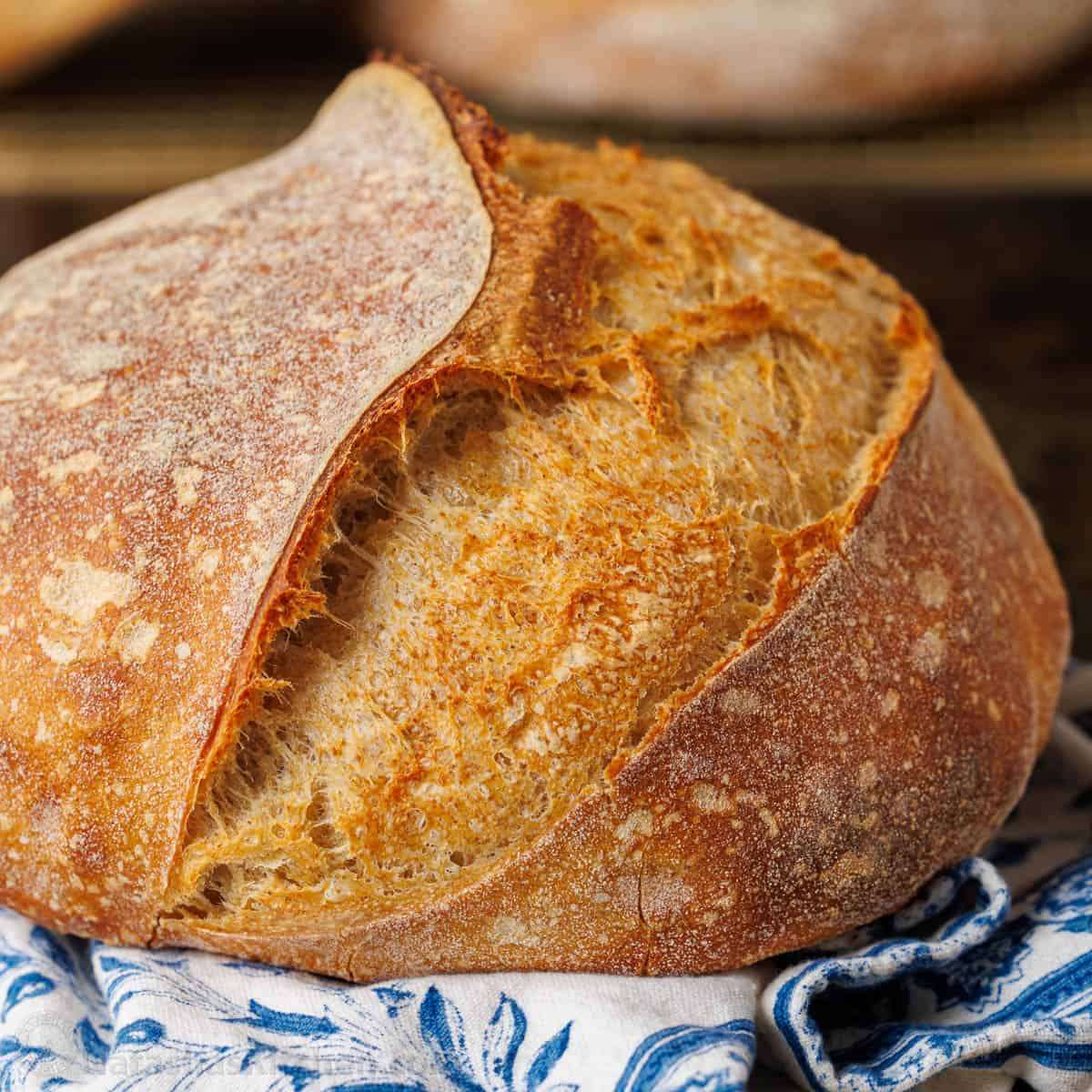
Care in banneton preparation, including a light flour coating and drying after use, prolongs its usefulness. Rice flour is preferred for dusting, though bread or all-purpose flour can substitute. The final bread typically features an open crumb with a crust that is crisp and slightly chewy from the sourdough fermentation.
Adjust water amounts as needed depending on local humidity, and use dechlorinated or filtered water warmed to about 85°F for best fermentation activity.
Ingredients
- 400 g bread flour or all-purpose flour, plus more to dust
- 55 g rye flour or whole wheat or bread flour
- 10 g salt fine sea salt
- 345 g water or dechlorinated water or spring water, luke-warm up to 85˚F, filtered
- 100 g sourdough starter active
- rice flour optional for dusting the bread basket
Instructions
- Feed your sourdough starter 1 or 2 times before making your sourdough bread, depending on how healthy it is. For a single loaf, (using a kitchen scale to measure) mix 50g of starter with 50g of bread flour and 50g of lukewarm water. Cover with a loose fitting lid and let it rise at room temperature until more than doubled in size, about 4-6 hours.*
- Make the Dough: In a large mixing bowl, whisk together bread flour, rye, and salt. Add water and sourdough starter and stir together with a wooden spoon then use your hand to thoroughly mix together, pinch the dough as you mix to make sure it's very well combined. It will be a very sticky dough. Scrape down the bowl, cover with a clean kitchen towel, and let the dough rest at room temperature for 4 hours in a warm spot (bulk fermentation).
- Bulk Fermentation Stage: After every hour, do a round of “stretch and fold” - with wet hands to prevent sticking, gently lift up on one side of the dough and stretch it upwards (avoid tearing the dough), and then fold it over onto itself. Rotate the bowl a quarter turn and continue to stretch and fold about 3 more times or until the dough resists pulling. Keep the bowl covered with a towel between your stretch and fold rounds. After 4 hours, you’ll stretch and fold the dough for the fourth and final time to tighten it up.
- Shape the Loaf: Turn the dough out onto a lightly floured surface (cut it in half if you’ve doubled the dough for 2 loaves). With floured hands, gently stretch out the dough then shape the dough to match the shape of your banneton (bread basket) and pot.(*see notes below)
- Bench Rest: Turn the dough seam-side down, cover it with a towel, and let it ‘bench rest’ for 20 minutes.
- Tighten the Dough: If it loosens up too much during the bench rest and loses shape, gently re-shape it again to tighten the loaf. With floured hands, cup your hands around the sides of the dough and tuck the sides underneath. Pull the dough down the counter towards you in a circular motion to tighten up the shape.
- Cold Fermentation: Transfer the dough seam-side up into your floured banneton.* Cover with a tea towel and refrigerate for at least 8 hours or up to 48 hours.
- Preheat the Oven: At least 30 minutes before baking, set the Dutch oven or combo cooker into your oven (set your pizza stone on the bottom rack if using*) and preheat the oven to 500 ̊F.
- Score your Bread: Turn the bread out into a parchment lined combo cooker or onto a sheet of parchment paper if using a Dutch Oven. Using the bread lame, score the bread starting at the base on one side, (keeping at a 45-degree angle and making a 1/4 to 1/2" deep crescent shape) cut around the top of the bread, from one side to the other. If using a Dutch Oven use the parchment to transfer your dough into the pot.
- Bake: Using oven mitts, cover with the hot lid and put it into the oven. Immediately reduce heat to 450 ̊F, and bake for 20 minutes covered. Remove the lid and bake another 20-25 minutes uncovered or until it reaches your desired color.
Notes
- Feed the starter 1 or 2 times before baking to ensure it is active and bubbly.
- Adapt water volume based on local humidity; less water may be needed in high-humidity areas.
- For a round loaf, fold dough in quarters; for an oval banneton, roll dough tightly from top to bottom.
- Use a pizza stone on the bottom rack to prevent the bread bottom from burning or darkening too much.
- Season banneton by moistening and dusting heavily with rice flour before use; dry and scrape out old flour after use.
User Reviews
Overall Rating
5
You'll Also Love