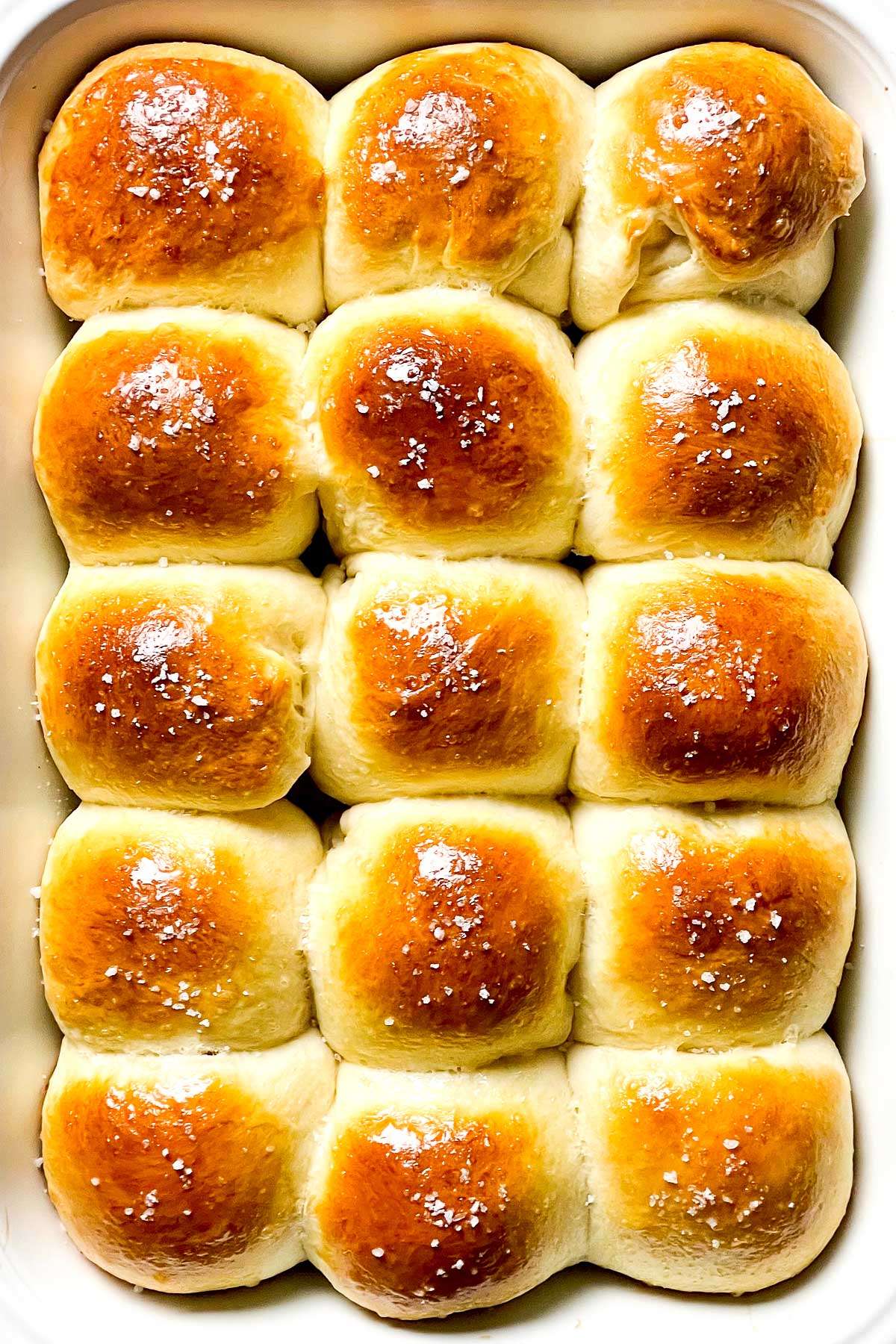
The BEST Dinner Rolls Recipe
User Reviews
5
The BEST Dinner Rolls Recipe
Description
The BEST Dinner Rolls Recipe uses full-fat buttermilk combined with melted butter and sugar as the liquid base to activate yeast, creating a slightly sweet and tender dough. Mixing and kneading the dough until smooth and elastic develops gluten needed for a soft, airy texture. Eggs add richness and structure to the rolls. After kneading, the dough is left to rise in a warm place until doubled, which helps create the light crumb.
The rolls are brushed with softened butter after baking, adding a glossy finish and enhanced flavor to their golden crust. Maldon sea salt is recommended for sprinkling on top to provide a subtle finishing touch. These rolls are suitable served warm alongside main dishes, excellent for making sandwiches or dinner accompaniments.
The notes detail options like substituting honey for sugar and activating active dry yeast if rapid-rise yeast is unavailable. The dough or shaped rolls can be proofed overnight in the refrigerator to suit busy schedules. Storage instructions include reheating wrapped in foil and freezing with oven rewarming methods, preserving freshness and softness. The recipe yields around 15 rolls but can be halved for smaller needs, cautioning against doubling the batch.
Ingredients
- 1 ⅓ cup buttermilk full fat
- ½ butter plus 3 tablespoons softened butter for the bowl, pan, and brushing the rolls after they’ve baked, unsalted, stick
- ⅓ cup sugar
- 5 cups all-purpose flour
- 2 yeast rapidrise or quick rise, packets
- 2 teaspoons kosher salt , I prefer Diamond Crystal brand, see note below
- 3 egg divided
- sea salt for serving, Maldon
Instructions
- Add buttermilk, ½ stick of butter, and sugar to a small saucepan and heat over medium low, stirring occasionally with a spatula. Heat just until butter has melted, then remove from heat. Use a thermometer to check the temperature. It should be warm but not hot and read somewhere between 100 and 110°F. If your mixture registers hotter than that, let it cool on the counter for a bit, or pop it in the fridge for a couple of minutes, then recheck with your thermometer. Otherwise, if the liquid is too hot it could kill your yeast.You can also warm your buttermilk, butter, and sugar in the microwave. Just use a microwave-safe bowl and cook 1 minute at a time, stir, check, repeat until your butter has fully melted. Don't forget a microwave shield or your liquid will spatter.
- Add the flour, yeast, and salt to the bowl of a stand mixer fitted with the dough hook. Add the buttermilk mixture, followed by 2 eggs. Mix on medium speed for about 5-7 minutes, or until dough is smooth, elastic, and comes free from the sides of the bowl. (If you don’t have a stand mixer and dough hook, you can mix this in a bowl with a spatula or wooden spoon, and then knead with your hands for about 10 minutes.)
- Preheat oven as low as it will go (mine is 170°F) just for one minute, then turn it off (the oven will be just warm enough for proofing your dough). Brush a large bowl with softened butter. Transfer the dough to the bowl and cover with a kitchen towel. Place in the oven to proof for 1 hour (the dough will double in size).
- Divide the dough in half, cutting it with a bench scraper or sharp knife. Cut each half in half and those halves in half. You’ll want to have 15 equal pieces of dough (for 15 rolls). I recommend weighing each with a kitchen scale if you want, to ensure they’re all the exact same size, about 70g each. If you have any dough leftover, cut off little pieces and add to each roll.
- To shape your rolls, you want to allow some friction between the dough and your work surface. Lightly flour your work surface. Cup your hand around the dough ball, resting the side of your hand on your work surface as you gently roll in quick, tight, circular motions until you have a smooth, round shape (don't worry about the bottom as much). As you're rolling, cover your other dough portions with a kitchen towel so they don't dry out.
- Brush a 9x13-inch baking dish with softened butter. Arrange each of your rolls in the pan in three rows of five across. Cover with a dish towel and let sit someplace warm for the rolls to proof (I like stashing mine in the microwave), for 1 hour (if the rolls have not doubled in size by then, you may need to allow another 30 minutes of proofing time).
- Once the rolls have finished proofing, preheat your oven to 350°F. Break your remaining egg into a small bowl and whisk well. Brush each roll with your egg wash (you will not use all of it) and place rolls in the oven to bake for about 20-23 minutes, or until golden brown. Once the rolls are done, brush them with more softened butter and top with a sprinkling of flaky sea salt.
Notes
- If using Morton’s kosher salt, reduce quantity to 1¼ teaspoons as it is saltier than Diamond Crystal.
- Honey can be used instead of sugar; reduce to ¼ cup due to its sweetness.
- Active dry yeast can replace rapid-rise yeast but must be proofed beforehand with warm water and sugar.
- Dough or rolls can be proofed overnight in the refrigerator for convenience and enhanced flavor.
- Reheat rolls wrapped in foil at 350°F for 7-10 minutes to restore softness.
- Frozen rolls are best defrosted and warmed in a 325°F oven for 20-30 minutes.
- Recipe yields about 15 rolls; halve for smaller batches but avoid doubling to maintain quality.
Nutrition Information
Show DetailsNutrition Facts
Serving: 15Serving
Amount Per Serving
Calories 195 kcal
% Daily Value*
| Calories | 195kcal | 10% |
| Carbohydrates | 37g | 12% |
| Protein | 6g | 12% |
| Fat | 2g | 3% |
| Saturated Fat | 1g | 5% |
| Polyunsaturated Fat | 1g | 6% |
| Monounsaturated Fat | 1g | 5% |
| Trans Fat | 1g | 50% |
| Cholesterol | 35mg | 12% |
| Sodium | 346mg | 14% |
| Potassium | 87mg | 2% |
| Fiber | 1g | 4% |
| Sugar | 6g | 12% |
| Vitamin A | 84IU | 2% |
| Vitamin C | 1mg | 1% |
| Calcium | 36mg | 4% |
| Iron | 2mg | 11% |
* Percent Daily Values are based on a 2,000 calorie diet.
User Reviews
Overall Rating
5
You'll Also Love