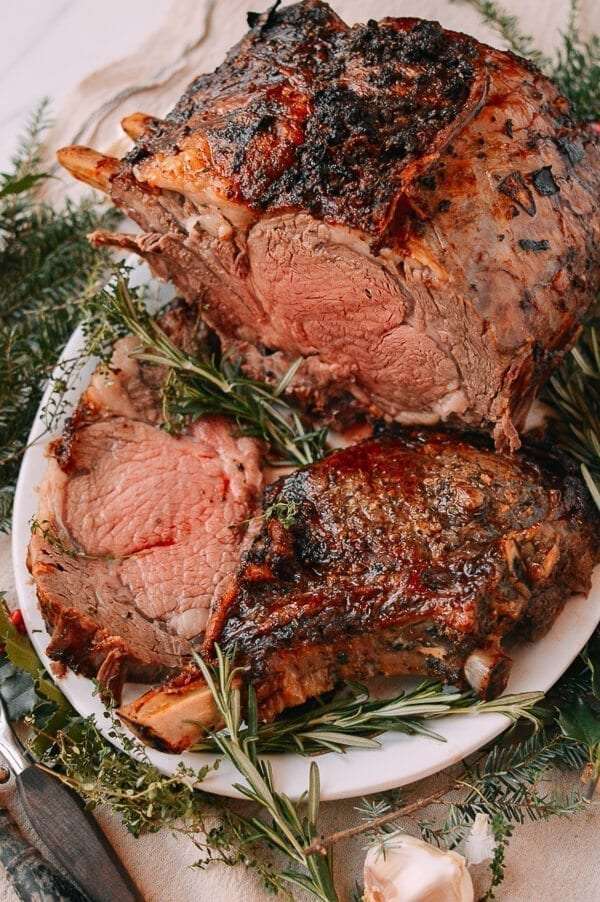
The Perfect Prime Rib Roast Family Recipe
User Reviews
5
-
Prep Time
12 hrs
-
Cook Time
3 hrs
-
Total Time
15 hrs
-
Servings
1 pound
-
Calories
709 kcal
-
Cuisine
American
The Perfect Prime Rib Roast Family Recipe
Description
The Perfect Prime Rib Roast Family Recipe features a bone-in prime rib roast seasoned liberally with kosher salt, black pepper, garlic, rosemary, thyme, and olive oil. The roast is placed over a bed of diced onions, which helps with even cooking and flavor infusion. After an overnight marination, the cooking process begins with a high oven temperature to sear the exterior, creating a crust that locks in juices.
The roast is then cooked at a lower temperature to ensure the interior reaches the desired doneness without overcooking. The careful balance of seasoning and cooking time highlights the roast’s natural beef flavor and tender texture. This recipe accounts for varying sizes of roasts and offers adjustments for smaller cuts.
Such a roast makes for an impressive centerpiece at a family meal or special occasion. The onions used as a roasting bed can be served alongside the meat or used in a pan sauce. Proper planning for resting and cooking times will yield the best eating experience.
For smaller roasts under 6 pounds, the initial searing time is reduced. It’s critical to use a meat thermometer to check internal temperature due to oven variations and roast size. Boneless roasts cook faster and require earlier temperature checks. The recipe encourages scaling ingredients per pound for consistent seasoning intensity.
Ingredients
- prime rib roast see note 2 if your roast is 6 lbs or less, bone-in
- 1/3 onion large dice or thickly sliced; approx. 1/3 medium onion per pound, up to 4-5 onions total; see note 3, medium
- 1 teaspoon kosher salt 1 tsp per lb/450g, or coarse sea salt, per pound
- ½ teaspoon black pepper 1/2 tsp per lb/450g, freshly ground, per pound
- 1 teaspoon garlic 1 tsp per lb/450g, minced, per pound
- 1 teaspoon rosemary 1 tsp per lb/450g, fresh, per pound
- 1 teaspoon thyme 1 tsp per lb/450g, fresh, per pound
- ½ teaspoon olive oil 1/2 tsp per lb/450g, per pound
Instructions
Marinate the roast:
- The butcher knows how much fat to leave on the roast, so no additional trimming is generally needed. Your prime rib roast should have a nice layer of fat on top, so it will baste itself. Before marinating, give your prime rib roast a quick rinse with cold water, and pat it dry with paper towels.
- Place a flat roasting rack inside a roasting pan large enough to fit your roast, and spread the onions on top of the rack (you can also forgo the rack, and rest the roast directly on the onions). Place the roast in the pan.
- Mix the salt, pepper, garlic, herbs and olive oil in a bowl until well-combined. Rub the roast all over with the marinade mixture, coating the surface evenly.
- Use plastic wrap to cover the roast, and marinate overnight (at least 8 hours) in the refrigerator. We don’t expect the flavors to penetrate the roast completely, but it will work its way into the fatty collar of the roast.
Cook the roast:
- Take the roast out of the refrigerator 2 hours before cooking time, so it's not stone cold when you transfer it to the oven. Preheat the oven to 450°F/230°C, and place your roast on a lower oven rack. You may want to put the roast at the bottom of the oven for the first hour. Placing the oven rack too high up will cause your roast to brown too quickly and burn.
- After 30 minutes in the oven, add ½ cup water to the bottom of the roasting pan. The key is to allow the onions to brown and caramelize while roasting, and to prevent the fat/drippings from burning and smoking. Adding the water gradually limits the steam in the oven—you want the beef to roast, not steam.
- Turn your roast 180° and cook for another 30 minutes, until it begins to brown. If there is more fat on one side that has not browned yet, make sure you position that side of the prime rib roast toward the inside of the oven. Use your judgement!
- Once the prime rib roast is browned on the outside (1 hour total should do it, but times may vary depending on your oven and roast size; see note 2), lower the heat to 350°F/175°C.
- Continue cooking for 90-120 minutes, basting every 30 minutes and adding hot water 1/2 cup at a time if the roasting pan gets dry. A general rule I use to approximate roasting time is a total of 15 minutes per pound, so for a 12 pound roast, the total roasting time should be 180 minutes. With temperature changes, that means roasting at 450°F/230°C for 60 minutes followed by 120 minutes at 350°F/175°C. That said, these times are approximate; using a meat thermometer is a must. We always cook for medium rare, or when the prime rib roast reaches an internal temperature of 125°F/51°C. This gives you two more well-done Prime Rib end cuts and a couple of medium pieces mixed in with the medium rare cuts. If you like it rare, then roast for less time, taking the roast out of the oven when the internal temperature reaches 120°F/49°C. If you like it super-rare, then 115°F/46°C may be for you. The roast will continue to cook a bit while it rests on the kitchen counter, raising the temp another 5-7 degrees, so these temperature guidelines have taken that into account.
- If the top of the roast starts to char, put a small piece of foil to lightly cover the top, leaving the sides exposed. Again, turn the roast 180° if needed for even roasting.
Rest & Serve:
- When ready, set your prime rib on a cutting board or serving platter, and lightly cover it with a piece of aluminum foil to rest for 20 minutes. While the prime rib is resting, pour the pan juices through a fine mesh strainer into a fat separator. If there is not enough liquid, add a ½ cup of water to the hot pan, and stir lightly. Pour the juices from the fat separator into a small pot or sauté pan and set aside. Warm up the au jus, and serve alongside the prime rib. You can further dilute it with some hot water to taste if it’s too salty.
Notes
- Plan about 1 pound of prime rib per person when serving, and adjust seasoning accordingly.
- For roasts 6 pounds or smaller, reduce the initial high-heat roasting time to avoid overcooking.
- Use a meat thermometer to accurately monitor doneness, especially for boneless roasts which cook faster.
- Three to five onions provide a sufficient onion bed for most roast sizes; add more for very large roasts.
Nutrition Information
Show DetailsNutrition Facts
Serving: 1pound
Amount Per Serving
Calories 709 kcal
% Daily Value*
| Calories | 709kcal | 35% |
| Carbohydrates | 7g | 2% |
| Protein | 32g | 64% |
| Fat | 62g | 95% |
| Saturated Fat | 26g | 130% |
| Cholesterol | 137mg | 46% |
| Sodium | 2430mg | 101% |
| Potassium | 581mg | 12% |
| Fiber | 1g | 4% |
| Sugar | 2g | 4% |
| Vitamin A | 95IU | 2% |
| Vitamin C | 8.2mg | 9% |
| Calcium | 30mg | 3% |
| Iron | 3.6mg | 20% |
* Percent Daily Values are based on a 2,000 calorie diet.
User Reviews
Overall Rating
5
You'll Also Love