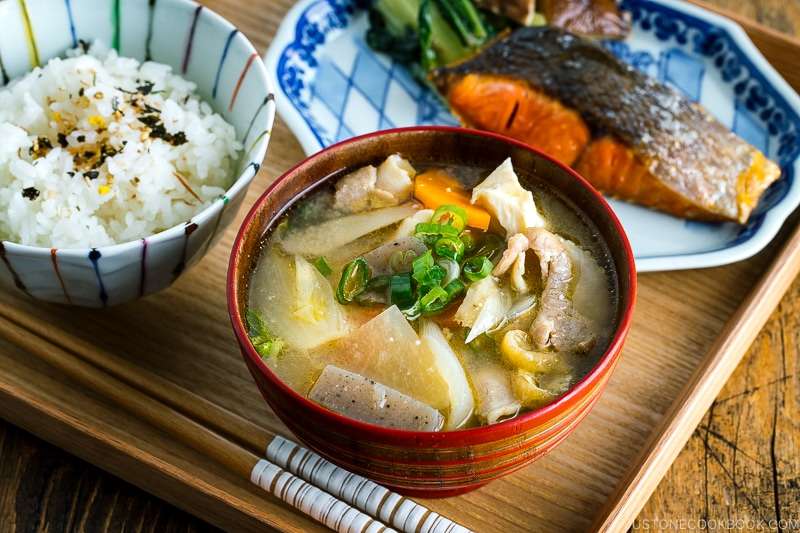
Tonjiru (Pork and Vegetable Miso Soup)
User Reviews
4.8
-
Prep Time
20 mins
-
Cook Time
20 mins
-
Total Time
40 mins
-
Servings
8 (miso
-
Calories
276 kcal
-
Course
Main Course, Soup
-
Cuisine
Japanese
Tonjiru (Pork and Vegetable Miso Soup)
Description
Tonjiru (Pork and Vegetable Miso Soup) involves preparing pork belly cut into chunks and an assortment of vegetables including burdock root, taro, daikon radish, carrot, and konnyaku. The ingredients are prepared with care, such as scraping and shaving burdock root to retain flavor and soaking taro to reduce starch. These are cooked together in toasted sesame oil and dashi stock, then flavored with miso paste. The addition of tofu and green onions provides further texture and color.
The soup offers a richly savory umami flavor thanks to miso and dashi combined with the fatty pork and starchy vegetables. The simmering method softens ingredients while keeping distinct textures, for example firm tofu and slightly tender vegetables. It can be garnished with green onions and optional shichimi togarashi for a spicy note.
Tonjiru suits colder seasons or when a nourishing, filling soup is desired. It is a traditional dish frequently served alongside rice and other Japanese meals. Using a combination of pork belly and less fatty pork loin modifies richness. Vegetarians can omit pork and add mushrooms or extra tofu for protein.
Ingredients
For the Ingredients
- 9.6 oz pork belly at least 8 oz, 227 g of pork belly; I sometimes use a combination of pork belly and less-fatty pork loin; for vegetarian/vegan, skip the meat and add more tofu, mushrooms, or veggies, sliced
- 3.5 oz burdock root ½ length, aka gobo
- 8 oz taro 3 pieces, aka satoimo
- 1 onion (6 oz, 170 g)
- 8.7 oz daikon radish (2 inches, 5 cm)
- 4.3 oz carrot (4 inches, 10 cm)
- ½ block konnyaku 4.5 oz, 128 g, aka konjac
- ¼ tsp kosher salt for cleaning the konnyaku, Diamond Crystal brand
- 1 green onion aka Tokyo negi, naga negi, long green onion
- 1 piece tofu pouch deep-fried, aka aburaage
- 1 tsp ginger (grated, with juice)
For the Soup
- 1 Tbsp sesame oil toasted
- 6 cups dashi use standard Awase Dashi, dashi packet or powder, or Vegan Dashi, Japanese soup stock
- 6 Tbsp miso paste each miso brand/type tastes different, so adjust the amount to taste
- 7 oz tofu ½ package; or use silken tofu, medium-firm, aka momen dofu
For the Garnish
- 1 green onion or scallion
- Japanese seven spice optional, for a spicy kick, aka shichimi togarashi
Instructions
- It‘s easier to cut the pork belly if it‘s slightly frozen, so put it in the freezer for 15 minutes before you cut it. Meanwhile, gather all the ingredients.
To Prepare the Ingredients
- Take out 9.6 oz sliced pork belly from the freezer and cut it into 1-inch (2.5-cm) pieces.
- Scrape the skin from 3.5 oz gobo (burdock root) with the back of your knife. The flavor of the gobo is right underneath the skin; therefore, you only need to scrape off the outer skin. Do not use a peeler.
- Make a cross incision on the end of the gobo about 1 inch (2.5 cm) deep. This helps make shaving the gobo easier. Rotate the root as you shave the end of the gobo, like how you would sharpen a pencil with a knife. Soak the shaved gobo in water to prevent discoloration.
- Discard the dirty water and rinse the gobo under running water.
- Cut off both ends of 8 oz taro (satoimo) and peel the sides with the knife (or peeler).
- Cut the taro into ⅓-inch (8 mm) slices and soak them in water to remove the sliminess.
- Cut 1 onion in half lengthwise and cut it into thin slices.
- Peel 8.7 oz daikon radish and cut it in half lengthwise.
- Cut the daikon halves in half lengthwise again (now they are quartered) and cut into ⅛-inch (3-mm) slices. If your daikon is skinny, cut it into thin half-moon-shaped slices.
- Peel and cut 4.3 oz carrot in half lengthwise, and then slice thinly.
- Cut ½ block konnyaku (konjac) into small and thin rectangular pieces.
- Sprinkle ¼ tsp Diamond Crystal kosher salt on the konnyaku and rub it well with your hands. Let it stand for 5 minutes. Tip: The salt releases moisture along with the unwanted odor from the konnyaku.
- In the meantime, bring a small saucepan of water to a boil. Once boiling, add the konnyaku.
- Cook the konnyaku for 2–3 minutes, drain the water, and set aside. Tip: This helps to remove the unwanted odor.
- Slice 1 Tokyo negi (naga negi; long green onion) diagonally.
- Remove the excess oil from 1 piece aburaage (deep-fried tofu pouch) with a piece of paper towel.
- Cut the aburaage in half lengthwise and thinly slice it.
- Peel and grate the ginger (I use a ceramic grater) and measure 1 tsp ginger (grated, with juice).
- Cut 1 green onion/scallion into thin small rounds to use as garnish on top of the miso soup. Keep them in a bowl and set aside.
To Cook the Tonjiru
- Preheat a large pot (I use a Le Creuset Dutch oven) over medium heat. When hot, add 1 Tbsp toasted sesame oil.
- Add the pork belly and stir-fry with a spatula.
- When the pork is no longer pink, add the onion.
- Stir-fry the onions. Then, add the daikon and carrot slices.
- When the ingredients are coated with oil, add the gobo and taro.
- Add the konnyaku, aburaage, negi, and 6 cups dashi (Japanese soup stock). There should be just enough dashi to cover the ingredients. If not, add more dashi or water.
- Stir to mix, cover with a lid, and bring it to boil.
- When boiling, lower the heat and skim off the scum and fat from the soup.
- Simmer, covered with the lid, until the root vegetables are tender, about 10–15 minutes.
- The Tonjiru is done cooking when a skewer inserted into a tough and thick vegetable pierces through. Turn off the heat. If you are preparing this dish ahead, stop here and let it cool completely before storing the pot in the refrigerator.
To Serve
- For the best flavor and aroma, add the miso right before serving, if possible. Dissolve 6 Tbsp miso into the soup using a strainer. (Tip: Always start adding a little less than the recipe calls for; each brand/type of miso has different saltiness.) If you don’t have a strainer, let the miso completely dissolve in the ladle first before releasing it to the soup. Taste the soup. If it's too salty, add dashi or water to dilute.
- If the soup needs more seasoning, add more miso (I added 1 Tbsp). When you are done adding the miso, add the grated ginger. Tip: When you add the tofu (always add tofu after the miso as it is delicate), make sure your miso soup has a slightly stronger taste because the moisture from the tofu will dilute the flavor.
- Tear 7 oz medium-firm tofu (momen dofu) into small pieces and add them to the soup. Alternatively, you can cut the tofu into cubes instead of tearing it. Tip: Tearing adds more surface area to the tofu and will help it absorb more miso flavor from the soup.
- When you are ready to serve, reheat the Tonjiru on medium-low heat and keep it at a low simmer. NEVER let the miso soup boil because miso will lose its flavor.
- Serve the Tonjiru in miso soup bowls, sprinkle with green onion, and serve immediately. Sprinkle in some shichimi togarashi (Japanese seven spice) at the table for an optional spicy kick.
To Store
- Let the Tonjiru cool completely before storing it in the refrigerator. Consume within 5 days.
Nutrition Information
Show DetailsNutrition Facts
Serving: 8(miso
Amount Per Serving
Calories 276 kcal
% Daily Value*
| Calories | 276kcal | 14% |
| Carbohydrates | 13g | 4% |
| Protein | 8g | 16% |
| Fat | 22g | 34% |
| Saturated Fat | 7g | 35% |
| Cholesterol | 24mg | 8% |
| Sodium | 433mg | 18% |
| Potassium | 290mg | 6% |
| Fiber | 3g | 12% |
| Sugar | 4g | 8% |
| Vitamin A | 2589IU | 52% |
| Vitamin C | 11mg | 12% |
| Calcium | 71mg | 7% |
| Iron | 1mg | 6% |
* Percent Daily Values are based on a 2,000 calorie diet.
User Reviews
Overall Rating
4.8
You'll Also Love