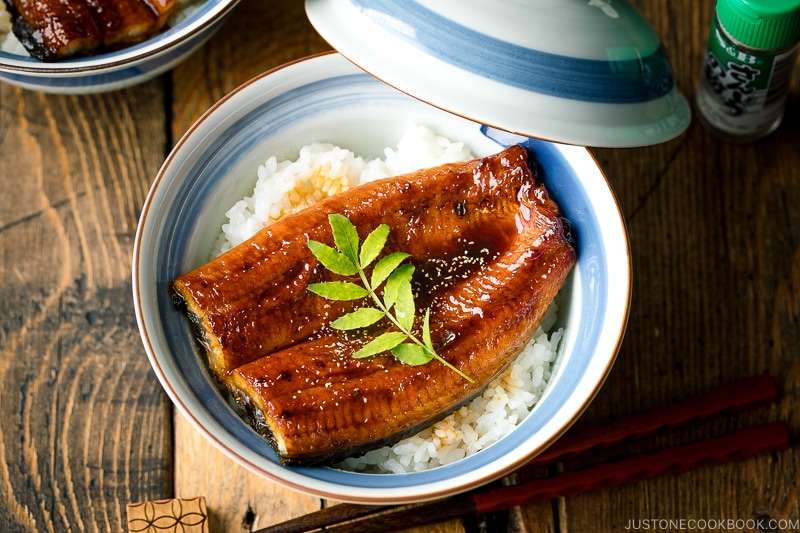
Unadon (Unagi Don)
User Reviews
4.8
-
Prep Time
5 mins
-
Cook Time
10 mins
-
Additional Time
15 mins
-
Total Time
30 mins
-
Servings
4
-
Calories
116 kcal
-
Course
Main Course
-
Cuisine
Japanese
Unadon (Unagi Don)
Description
Unadon (Unagi Don) presents freshwater eel fillets prepared by broiling with a rich, thick sauce made from mirin, sake, sugar, and soy sauce. The sauce is simmered to reduce and develop a syrupy consistency, coating the eel with sweet and savory layers. This preparation involves carefully watching the simmer to achieve the proper thickness.
The result is eel with a tender, silky texture and a glossy caramelized surface. The sweet soy glaze balances the natural richness of the eel, and a touch of sansho pepper provides a subtle citrus-like bite if used. This dish is typically served on a bed of steamed rice, highlighting its comforting qualities.
Ingredients
- 2 freshwater eel fillet one fillet is roughly 5.6 oz or 160 g; defrosted, unagi
- cooking spray (or neutral-flavored oil, for broiling)
For the Unagi Sauce (double or triple the amount for extra sauce)
- ¼ cup mirin (or substitute 3 parts sake or water + 1 part sugar)
- 1½ Tbsp sake (or substitute Chinese rice wine or water)
- 2½ Tbsp sugar
- ¼ cup soy sauce (use GF soy sauce for gluten free)
For Serving
- sansho pepper optional, Japanese
Instructions
- Gather all the ingredients. Since the unagi sauce can keep for 3 months, I recommend making double or triple the amount for future unagi recipes or Yaki Onigiri.
To Make the Unagi Sauce
- To a small saucepan, add ¼ cup mirin, 1½ Tbsp sake, and 2½ Tbsp sugar.
- Set the saucepan on the stove over medium heat and whisk the mixture together. Then, add ¼ cup soy sauce and bring the mixture to a boil.
- Once boiling, reduce the heat to maintain a gentle simmer; you should see small bubbles around the edge of the pan. Continue simmering until the liquid is reduced to roughly one-third of the original amount, about 10-15 minutes. Tip: To check how much the sauce has reduced, dip the tip of a wooden chopstick into the liquid to mark the original amount; then, insert the chopstick again later to compare the sauce level against the original mark.
- Toward the end of cooking, the sauce will thicken and you will see more bubbles. Use the chopstick to confirm that the thickened sauce is one-third of the original amount. Then, remove it from the heat. As it cools, the sauce will thicken more. Tip: If you feel you've reduced it too much, add a bit of water to loosen up the sauce; you also can simmer it again a bit more to get the right consistency.
To Cut the Unagi
- Cut 2 unagi (freshwater eel) fillets in half or thirds to fit the size of your donburi serving bowl.
To Broil (recommended)
- Preheat the broiler* on High (550ºF/288ºC) for 5 minutes with a rack placed about 8 inches (20 cm) away from the top heating element (in the center of the oven). *The broiler settings are Low (450ºF/232ºC), Medium (500ºF/260ºC), and High (550ºF/288ºC). I usually broil on High (8 inches away) or Medium (6 inches away). When broiling, you don't control the temperature in the oven; instead, you control the distance between the broiler and the surface of the food. It's similar to using hotter and cooler zones on your grill.
- Line a baking sheet with foil for easy cleaning and brush or spray the oil onto the foil. Place the unagi pieces on the foil, skin side down. Broil the unagi until the surface is blistered a bit, about 5-7 minutes. Broil it on one side only; there's no need to flip it over.
- Open the oven and brush the sauce on top of the unagi. Then, broil again for 30-60 seconds until you see the sauce bubbling on top.
To Bake
- Preheat the oven to 425°F/218ºC with a rack placed in the middle position. Line a baking pan with parchment paper and place the unagi pieces on top. Bake until the surface is blistered a bit, about 10-12 minutes. Bake on one side only; no need to flip. Brush the sauce on top of the unagi. Then, bake again for 30-60 seconds until you see the sauce bubbling on top.
To Heat in a Pan
- Prepare two 16 inch x 16 inch (40 x 40 cm) sheets of aluminum foil. Thinly spread some cooking spray in the center of each sheet. Place two pieces of unagi on a sheet of greased foil. Bring the top and bottom foil edges together above the unagi. Fold and press the edges together a few times. Then, tightly close either side of the foil to form a sack. Repeat this process for the other unagi pieces. Add the foil pouches to the pan and reheat on low heat for 5-8 minutes. Tip: Your unagi won't blister or char if you use this method.
To Serve
- Serve the hot steamed rice in individual bowls. Then, pour or brush some of the unagi sauce on top of the rice.
- Next, place one portion of the unagi on the rice in each bowl. Pour or brush more sauce on top of the unagi. Since I had a kinome (Japanese sansho pepper leaf), I placed it on top for garnish (optional). Serve immediately. You can also sprinkle ground Japanese sansho pepper on top (optional).
- To serve in a jubako (Japanese lacquered box), place a bed of hot rice in the box and brush some unagi sauce on top. For each serving, place 2 pieces of unagi (the entire fillet) on top, with the pieces overlapping each other and covering the rice. Brush more sauce on top of the unagi pieces and serve.
To Store
- You can keep the leftovers unagi in an airtight container and store it in the refrigerator for 3 days or in the freezer for 2 weeks. You can store any leftover sauce in an airtight jar and keep in the refrigerator for up to 3 months. You can use it to brush on grilled rice balls to make my favorite Yaki Onigiri.
Notes
Nutrition Information
Show DetailsNutrition Facts
Serving: 4Serving
Amount Per Serving
Calories 116 kcal
% Daily Value*
| Calories | 116kcal | 6% |
| Carbohydrates | 6g | 2% |
| Protein | 8g | 16% |
| Fat | 5g | 8% |
| Saturated Fat | 1g | 5% |
| Polyunsaturated Fat | 1g | 6% |
| Monounsaturated Fat | 3g | 15% |
| Cholesterol | 50mg | 17% |
| Sodium | 500mg | 21% |
| Potassium | 109mg | 2% |
| Sugar | 6g | 12% |
| Vitamin A | 1380IU | 28% |
| Vitamin C | 1mg | 1% |
| Calcium | 8mg | 1% |
| Iron | 1mg | 6% |
* Percent Daily Values are based on a 2,000 calorie diet.
User Reviews
Overall Rating
4.8
You'll Also Love