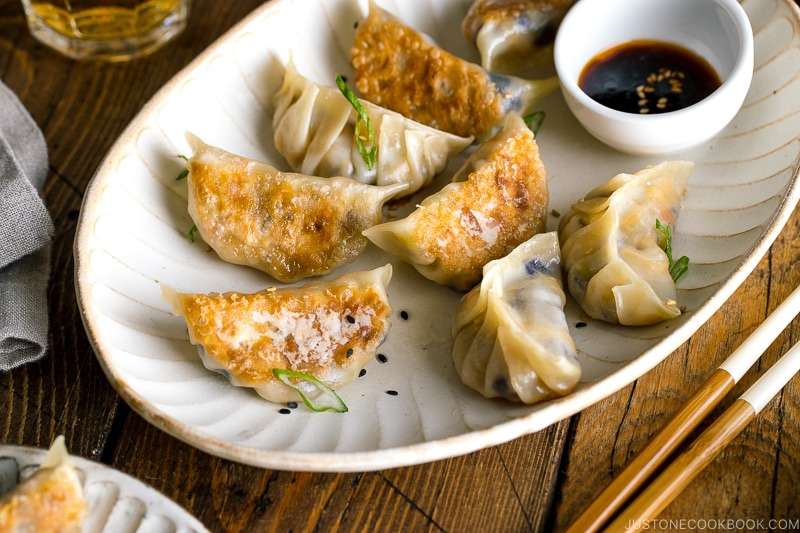
Vegetable Gyoza (Vegan/Vegetarian)
User Reviews
4.6
-
Prep Time
30 mins
-
Cook Time
30 mins
-
Additional Time
1 hr
-
Total Time
2 hrs
-
Servings
80 gyoza
-
Calories
23 kcal
-
Course
Main Course
-
Cuisine
Japanese
Vegetable Gyoza (Vegan/Vegetarian)
Description
Vegetable Gyoza feature a filling made from extra firm tofu pressed to remove moisture, combined with finely chopped green and red cabbage, carrots, onions, green onions, king oyster, and shiitake mushrooms. The vegetables and tofu provide a mixture of textures, with soft and slightly chewy elements.
The filling is seasoned with a mixture of soy sauce, miso paste, toasted sesame oil, kosher salt, and white pepper for a bold umami flavor balanced with a hint of earthiness from the miso. The seasoned filling is wrapped in gyoza wrappers, sealed, and cooked by frying briefly in oil before adding water to steam and finishing with toasted sesame oil for aroma and crispness.
These gyoza are typically served with a dipping sauce made from rice vinegar and soy sauce, with optional chili oil for heat, making them suitable as appetizers or a main dish in a vegan or vegetarian meal.
The recipe includes tips on pressing tofu for moisture removal and using a food processor for chopping vegetables, which help achieve the ideal texture in the filling.
Ingredients
For the Filling
- 1 package tofu 12 oz, 340 g, extra firm
- 2 leaves cabbage (5 oz, 142 g)
- ⅛ head red cabbage (3.5 oz, 100 g)
- 1 tsp kosher salt for the cabbage, Diamond Crystal brand
- 2 inches carrot (2 oz, 57 g)
- ½ onion (3 oz, 85 g)
- 2 green onion 1.6 oz, 44 g, or scallions
- 4 king oyster mushrooms 5 oz, 142 g, eringi
- 2 shiitake mushrooms (1.75 oz, 50 g)
- 1 clove garlic
- 1 tsp ginger (grated, with juice; from 1-inch, 2.5-cm knob)
- 2 Tbsp potato starch or cornstarch
For the Seasonings
- 2 Tbsp soy sauce
- 1 Tbsp miso paste I recommend awase or red miso, as they have a bolder flavor than white miso
- 2 tsp sesame oil toasted
- 1 tsp kosher salt Diamond Crystal brand
- ⅛ tsp white pepper powder
For Folding the Gyoza
- 80 gyoza wrappers (approximately; buy 2 packages of Myojo brand gyoza wrappers (52 wrappers per package); or make Homemade Gyoza Wrappers)
- water (to fold and seal the wrappers)
For Frying
- neutral oil (1 Tbsp per batch)
- water (¼ cup, 60 ml per batch)
- sesame oil 1 tsp per batch, toasted
For the Dipping Sauce
- rice vinegar 1 Tbsp per person, unseasoned
- soy sauce (1 Tbsp per person)
- Chili oil optional; ⅛ tsp per person; you can make my Homemade La-yu, Japanese style la-yu
Instructions
- Gather all the ingredients. Tip: You can use a food processor to chop all the vegetables like Chef David Chang did when he followed my recipe in an episode of the podcast Recipe Club.
To Drain the Tofu
- Wrap 1 package extra firm tofu with a paper towel and place it on a tray/plate. Put another tray/plate on top of the tofu and press it down with a heavy object for roughly 30 minutes to 1 hour. (I pressed for 2 hours this time; my single tofu block weighed 400 g before pressing and 355 g after.) If you‘re in a hurry, you can microwave the tofu without plastic wrap for 1½ minutes (at 1000 watts) and drain the water.
To Mix the Seasonings
- While you're waiting for the tofu to drain, mix the seasonings. In a small bowl, add 2 Tbsp soy sauce, 2 tsp toasted sesame oil, 1 Tbsp miso, 1 tsp Diamond Crystal kosher salt, and ⅛ tsp white pepper powder.
- Whisk it all together and set aside.
To Make the Filling
- Discard the tough core of 2 leaves cabbage (green). Cut the leaves into julienned pieces.
- Mince the julienned cabbage into small pieces. Tip: It‘s usually easier to tuck smaller pieces in the gyoza wrapper rather than chunkier pieces.
- Repeat with ⅛ head red cabbage: Discard the tough core of the red cabbage leaves and cut the leaves into julienned pieces. Then, mince into small pieces.
- Put the minced green and red cabbage in a bowl and add 1 tsp Diamond Crystal kosher salt. Rub the salt into the cabbage with your hands and set aside until it releases its liquid.
- Cut 2 inches carrot into slabs, then sticks, and mince them.
- Mince ½ onion finely: Lay the onion flat side down on the cutting board. With the knife tip pointing toward the root end, make ⅛-inch vertical slices to within ½ inch of the root end. Then, with the knife edge toward the root end, make ⅛-inch horizontal slices, again keeping the root intact. Finally, make perpendicular cuts down through the vertical slices you made.
- Cut 2 green onions/scallions into white and green parts. Save the green part for garnish. Mince the white part into small pieces for the filling.
- Cut off and discard the root end of 4 king oyster mushrooms (eringi). Cut the mushrooms into sticks and then mince them.
- Discard the stems of 2 shiitake mushrooms. Cut the mushroom caps into strips, and then mince them.
- To a large bowl, add the onion, two kinds of mushrooms, carrots, and white part of the green onions. Then, mince or press 1 clove garlic (I use my garlic press here) and add it to the bowl.
- Peel and grate the ginger (I use a ceramic grater). Measure 1 tsp ginger (grated, with juice) and add it to the filling ingredients.
- Squeeze and discard the liquid from the cabbage. Add the cabbage to the bowl with the other ingredients.
- Remove the paper towel and slice the tofu into thin slabs roughly ⅛ inch (3 mm) thickness (pencil width).
- Next, cut the tofu slabs into sticks, and then cut the sticks into cubes.
- Add the tofu cubes and the seasonings mixture to the bowl. Mix it all together. Once the ingredients are well coated with the seasonings, add 2 Tbsp potato starch or cornstarch and mix thoroughly. If the filling seems watery, add more potato starch to absorb any extra moisture.
To Fold the Gyoza
- Prepare a tray or plate with parchment paper and sprinkle some potato starch (cornstarch). This will prevent the gyoza from sticking to the paper. Gather 80 gyoza wrappers and prepare a small bowl of water.
- Take a wrapper and place it in the palm of your non-dominant hand. Use a teaspoon to scoop a small amount of filling and put it in the center of the wrapper. Dip one finger in the bowl of water and draw a circle around the outer ¼ inch (6 mm) of the wrapper with your wet finger until it’s moistened all around.
- Here, I show you how to fold the gyoza with the pleats leaning toward the center. Fold the wrapper in half over the filling and pinch it in the center with your fingers, but don’t seal it yet. Using the thumb and index finger of your right hand, start making a pleat about every ¼ inch (6 mm) on the top part of the wrapper from the center toward the right side, making 3–4 pleats.
- As you fold each pleat, press the folded pleat tightly against the back part of the wrapper using your other thumb and index finger. Make 3–4 pleats.
- Continue with the left side of the gyoza. Making 3–4 pleats with your left hand, starting in the center and moving toward the left side.
- Press the pleats tightly, making sure there are no air pockets. Shape the gyoza to look pretty. Repeat folding the remaining wrappers. Tip: See my Gyoza recipe for an alternative folding method where the pleats all lean toward one side.
To Freeze Uncooked (optional)
- This recipe may make more gyoza than you wish to serve now. If you want to store some uncooked gyoza to cook later (optional), now is the time to freeze them. Before the filling starts to release moisture and make the wrappers soggy, cover the gyoza with plastic wrap and “flash freeze” them in the freezer until solid (or at least frozen on the outside). Make sure to lay out the gyoza in a single layer on a sheet pan or plate. Once the gyoza are solid, pack them in an airtight bag. Because you flash froze them, the gyoza won’t stick to each other in the bag. You can store the gyoza in the freezer for up to a month. When you‘re ready to use the gyoza, do not defrost them. Place the frozen gyoza in your frying pan and steam them for an extra 1–2 minutes.
To Cook the Gyoza
- To cook the gyoza that you just folded, heat a large nonstick frying pan over medium heat. When the pan is hot, add 1 Tbsp neutral oil. Then, place the gyoza in a single layer, flat side down and without touching each other, in a circular pattern (or place them in two rows). You will need to cook the gyoza in batches. As you can see from the photo, my large frying pan can fit about 12–13 pieces per batch.
- Cook until the bottoms of the gyoza turn golden brown, about 3 minutes. Next, add ¼ cup water to the pan.
- Immediately cover with a lid and steam the gyoza for about 3 minutes or until most of the water evaporates. Tip: If you‘re cooking frozen gyoza, steam them for an extra 1–2 minutes.
- Remove the lid to evaporate any remaining water. Drizzle 1 tsp toasted sesame oil around the gyoza in the frying pan. Cook, uncovered, until the bottom of the gyoza are golden brown and crisp.
To Serve
- Transfer the cooked gyoza to a plate. Repeat the process to cook the other batches. Serve the Vegetable Gyoza with a small bowl of dipping sauce for each person. To make the dipping sauce, combine 1 Tbsp rice vinegar (unseasoned), 1 Tbsp soy sauce, and ⅛ tsp la-yu (Japanese chili oil) in each dipping bowl and mix it all together.
- Cut the green part of a green onion for garnish, if you‘d like.
To Store
- You can keep the leftovers in an airtight container and store in the refrigerator for up to 3 days or in the freezer for a month.
Notes
- Press extra firm tofu for 30 minutes to 1 hour to remove excess moisture for a better filling texture.
- Mix the seasoning ingredients thoroughly before combining with vegetables and tofu to evenly distribute flavor.
- Use a food processor to chop vegetables finely if desired for uniform filling consistency.
Nutrition Information
Show DetailsNutrition Facts
Serving: 80gyoza
Amount Per Serving
Calories 23 kcal
% Daily Value*
| Calories | 23kcal | 1% |
| Carbohydrates | 4g | 1% |
| Protein | 1g | 2% |
| Fat | 1g | 2% |
| Saturated Fat | 1g | 5% |
| Trans Fat | 1g | 50% |
| Cholesterol | 1mg | 0% |
| Sodium | 65mg | 3% |
| Potassium | 30mg | 1% |
| Fiber | 1g | 4% |
| Sugar | 1g | 2% |
| Vitamin A | 141IU | 3% |
| Vitamin C | 2mg | 2% |
| Calcium | 4mg | 0% |
| Iron | 1mg | 6% |
* Percent Daily Values are based on a 2,000 calorie diet.
User Reviews
Overall Rating
4.6
You'll Also Love