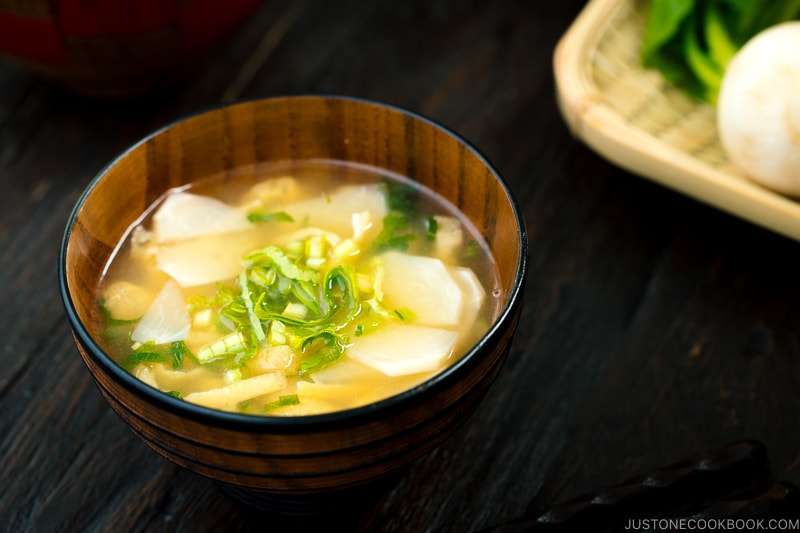
Vegetable Miso Soup
User Reviews
4.7
Vegetable Miso Soup
Description
Vegetable Miso Soup offers three variations using basic ingredients like miso paste dissolved in water and different vegetables including tender Japanese turnip slices, aburaage (deep-fried tofu pouch), bamboo shoots, wakame seaweed, green onions, and snap peas. The preparation gently simmers the vegetables to maintain their textures and sweetness while infusing the liquid with miso’s savory umami richness.
The Japanese turnip version uses thinly sliced kabu and aburaage, softened until translucent, imparting mild sweetness and a subtle depth through the tofu pouch. The bamboo shoot and wakame combination introduces earthiness and sea flavors, while snap pea and aburaage deliver a fresh, bright green vegetable character.
Served hot, this miso soup pairs well with a variety of meals, offering a nourishing and light complement. Some of the turnip leaves can be stir-fried separately for a side dish, preventing waste and adding a nutty, sweet note to meals. Flavor can be adjusted with varying miso amounts according to taste, considering miso’s saltiness.
Ingredients
Basics Ingredients for 3 Kinds of Miso Soup Below
- 1½ cups water (for vegan/vegetarian, make Vegan Dashi and use regular miso)
- 2 Tbsp miso you can add up to ½ Tbsp more, to taste, dashi-included
1) For the Japanese Turnip Miso Soup
- 1 turnip with leaves attached, Japanese, kabu
- ½ tofu pouch 0.3 oz, 10 g, deep-fried, aka aburaage
2) For the Bamboo Shoot & Wakame Miso Soup
- 1 Tbsp dried wakame seaweed
- 1 green onion or scallion
- ¼ bamboo shoot 1.8 oz, 50 g, boiled
3) For the Snap Pea Miso Soup
- ½ piece tofu pouch 0.3 oz, 10 g, deep-fried, aka aburaage
- 7 oz snap peas
Instructions
- Gather all the ingredients.
1) To Make the Japanese Turnip Miso Soup
- Cut off the ends of 1 Japanese turnip (kabu) and peel.
- Cut the turnip in half and thinly slice the halves.
- To remove the oil from ½ aburaage (deep-fried tofu pouch), you can either pour boiling water over the tofu pouch in a sieve over the sink or have a quick blanch over the boiling water in a small pot for 15 seconds (flipping 1–2 times). Once that’s done, cut the aburaage in half widthwise, and cut thinly. Keep the other half for future use.
- In a small saucepan, add 1½ cups water, the sliced turnip, and the aburaage.
- Cover with the lid, but keep it slightly ajar to avoid boiling over. Bring it to a boil over medium heat. Once boiling, lower the heat to simmer and cook the turnip for 5–6 minutes, or until it’s transparent.
- If you wish to add the turnip leaves into the soup, quickly chop the green leafy part of the turnip. Add some into the soup and save the remaining greens. At this stage, make sure the soup is hot and you’re about to serve miso soup. What to do with the rest of the chopped leaves? Read the Notes for a quick, delicious recipe.
- Make sure the soup is hot as we will not reheat and turn off the heat. Add 2 Tbsp dashi-included miso into the ladle, NOT into the soup. Use a pair of chopsticks (or fork) to dissolve the miso completely in the ladle before releasing it into the soup.
- ALWAYS taste the miso soup before adding more miso. Serve immediately. If you need to reheat the miso soup, make sure not to let it boil, once you see steam coming off, you can turn off the heat.
2) To Make the Bamboo Shoot & Wakame Miso Soup
- Soak 1 Tbsp dried wakame seaweed in water for 5 minutes. Drain, squeeze water out, and set aside.
- Cut 1 green onion/scallion thinly and set aside.
- Cut ¼ boiled bamboo shoot into small bite-size thin pieces.
- In a small saucepan, add 1½ cups water and the sliced bamboo shoots.
- Cover with the lid, but keep it slightly ajar to avoid boiling over. Bring it to a boil over medium heat. Once boiling, turn off the heat.
- Make sure the soup is hot at this stage as we will not reheat. Add 2 Tbsp dashi-included miso into the ladle, NOT into the soup. Use a pair of chopsticks (or fork) to dissolve the miso completely in the ladle before releasing it into the soup. ALWAYS taste the miso soup before adding more miso.
- Serve immediately. If you need to reheat the miso soup, make sure not to let it boil, once you see steam coming off, you can turn off the heat.
3) To Make the Snap Pea Miso Soup
- To remove the oil from ½ piece aburaage (deep-fried tofu pouch), you can either pour boiling water over the tofu pouch in a sieve over the sink or have a quick blanch over the boiling water in a small pot for 15 seconds (flipping 1–2 times). Once that’s done, cut the aburaage in half widthwise, and cut thinly. Keep the other half for future use.
- Pull off the tough string that runs along the length of each pod from 7 oz snap peas. Then cut in half diagonally.
- In a small saucepan, add 1½ cups water and the aburaage. Place the lid, keeping it slightly ajar to avoid boiling over. Bring it to a boil over medium heat, and once boiling, lower the heat to simmer.
- Add the snap peas and warm them for 2 minutes on a simmer (don’t overcook). Turn off the heat.
- Make sure the soup is hot at this stage as we will not reheat. Add 2 Tbsp dashi-included miso into the ladle, NOT into the soup. Use a pair of chopsticks (or fork) to dissolve the miso completely in the ladle before releasing into the soup. ALWAYS taste the miso soup before adding more miso. Serve immediately. If you need to reheat the miso soup, make sure not to let it boil, once you see steam coming off, you can turn off the heat.
To Store
- You can keep the leftovers in an airtight container (or in a pot) and store in the refrigerator for up to 3 days.
Notes
- Adjust miso quantity to taste; typically 1 tablespoon per ¾ cup of liquid is guideline due to varying saltiness among miso brands.
- Japanese turnip (kabu) is milder and sweeter than common turnips; substitution may change the flavor slightly.
- Turnip leaves can be stir-fried with sesame oil, mirin, and soy sauce for a flavorful side dish, sprinkled with sesame seeds.
Nutrition Information
Show DetailsNutrition Facts
Serving: 2(for
Amount Per Serving
Calories 55 kcal
% Daily Value*
| Calories | 55kcal | 3% |
| Carbohydrates | 10g | 3% |
| Protein | 3g | 6% |
| Fat | 1g | 2% |
| Saturated Fat | 1g | 5% |
| Polyunsaturated Fat | 1g | 6% |
| Monounsaturated Fat | 1g | 5% |
| Sodium | 486mg | 20% |
| Potassium | 142mg | 3% |
| Fiber | 2g | 8% |
| Sugar | 3g | 6% |
| Vitamin A | 10IU | 0% |
| Vitamin C | 14mg | 16% |
| Calcium | 58mg | 6% |
| Iron | 1mg | 6% |
* Percent Daily Values are based on a 2,000 calorie diet.
User Reviews
Overall Rating
4.7
You'll Also Love