Vegetable Tempura
User Reviews
4.7
-
Prep Time
25 mins
-
Cook Time
45 mins
-
Total Time
1 hr 10 mins
-
Servings
2
-
Calories
652 kcal
-
Course
Main Course
-
Cuisine
Japanese
Vegetable Tempura
Description
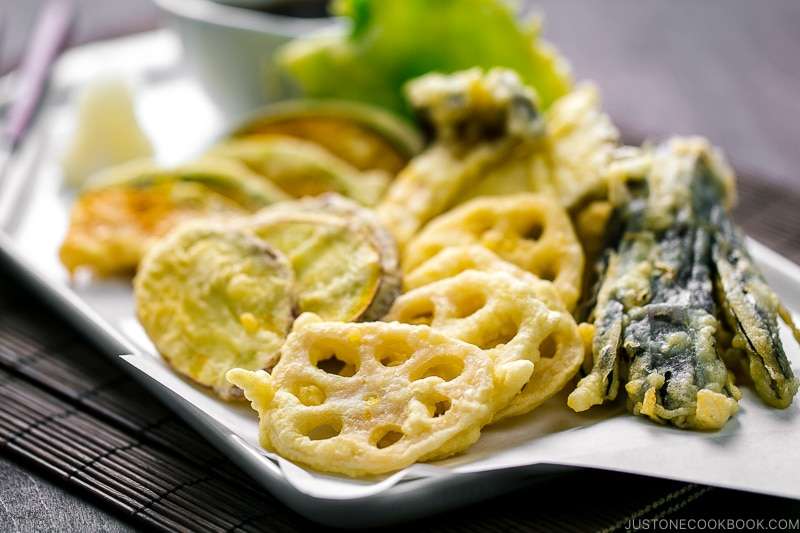
Vegetable Tempura involves dipping assorted vegetables into a light, cold batter made from chilled flour, iced water, and a single egg, then deep-frying them in neutral oil until crisp and golden. The choice of vegetables includes starchy and fibrous types such as Japanese sweet potato rounds soaked briefly to remove excess starch, slices of unpeeled kabocha squash, precooked lotus root, king oyster mushrooms, slices of Japanese eggplant, and delicate shiso leaves dusted with flour before frying. The batter ensures a thin, crunchy coating that contrasts with the softness of the cooked vegetables inside. Accompanying the tempura is a traditional tentsuyu dipping sauce, a balance of dashi broth, soy sauce, mirin, and sugar simmered until the sugar dissolves, adding salty-sweet depth. The dish is typically served with freshly grated daikon radish to complement the richness of the fried batter. Exact flour measurement and handling techniques help maintain the lightness of the batter.
Ingredients
For the Dipping Sauce (Tentsuyu)
- ¾ cup dashi use standard Awase Dashi, dashi packet or powder, or Vegan Dashi, Japanese soup stock
- 3 Tbsp soy sauce
- 2 Tbsp mirin
- 2 tsp sugar
For the Tempura
- 1 sweet potato unpeeled, Japanese variety, Satsumaimo
- ⅛ kabocha squash (unpeeled and seeded)
- 2 inch lotus root peeled and precooked; I used boiled lotus root (renkon no mizuni) from a Japanese grocery store, aka renkon
- 2 king oyster mushrooms eringi
- 1 Japanese eggplant or Chinese eggplant
- 4 shiso leaves aka perilla, ooba
For Deep-Frying
- neutral oil (enough for 1½ inches or 3 cm of oil in the pot; or use a 10-to-1 ratio of neutral oil to sesame oil)
- flour (for dusting the shiso leaves)
For the Batter
- 1 cup all-purpose flour chilled; weigh your flour or use the “fluff and sprinkle“ method and level it off
- 200 ml water ¾ cup + 4 tsp, iced
- 1 egg chilled, large, 50 g each without shell
For Serving
- 2 inches daikon radish (grated)
Instructions
Before You Start...
- I encourage you to weigh your flour in metric using a kitchen scale. Click on the “Metric“ button at the top of the recipe to convert the ingredient measurements to metric. If you‘re using a cup measurement, please follow the “fluff and sprinkle“ method: Fluff your flour with a spoon, sprinkle the flour into your measuring cup, and level it off. Otherwise, you may scoop more flour than you need.
To Make the Dipping Sauce (Tentsuyu)
- Gather all the ingredients.
- Combine ¾ cup dashi (Japanese soup stock), 3 Tbsp soy sauce, 2 Tbsp mirin, and 2 tsp sugar in a small saucepan and bring it to a boil. Then, lower the heat and let it simmer until the sugar is completely dissolved. Remove from the heat and set aside.
To Prepare the Ingredients
- Gather all the ingredients.
- Slice 1 Japanese sweet potato (Satsumaimo) into ¼-inch (6 mm) rounds and soak in water for 15–30 minutes to remove the excess starch. Then, pat dry them with paper towels.
- Cut ⅛ kabocha squash and 2 inch lotus root (renkon) into ¼-inch (6 mm) slices. Soak the lotus root in vinegar water (2 cups water + 1 tsp vinegar) for 5 minutes and pat dry them with paper towels.
- Cut 2 king oyster mushrooms (eringi) into thin slices.
- For 1 Japanese or Chinese eggplant, set it aside for now and prepare it right before you deep-fry. Cut off and discard the stem and calyx, then cut in half lengthwise. Place the halves flat side down on the cutting board and cut lengthwise into very thin slices (⅛ inch or 3 mm), leaving 1 inch (2.5 cm) of the bottom tip intact so the slices stay connected. Then, gently press down to fan out the slices. Keep 4 shiso leaves (perilla/ooba) whole.To get crispy tempura, make sure your ingredients are dry; pat them dry with a paper towel, if needed. Any excess moisture will make the tempura soggy.
To Prepare the Oil
- Once the ingredients are ready, add neutral oil to a deep fryer or pot to a depth of 1½ inches (3 cm) and heat to 320°F (160°C). Use a thermometer for precise temperature control. To check with wooden chopsticks, dip them in the oil; when small bubbles form around the tips, the oil is ready. Tip: For enhanced aroma and taste, I like to add 1 part sesame oil for every 10 parts neutral oil.
To Make the Batter
- While the oil is heating up, prepare the tempura batter. We‘ll use a 1-to-1 ratio (by volume) of flour to egg + water. Gather all the ingredients.
- Sift 1 cup all-purpose flour (plain flour) into a large bowl.
- Add 200 ml iced water to a measuring cup or bowl. Then, add 1 large egg (50 g each w/o shell).
- Whisk the egg and water mixture vigorously and discard the foam on the surface.
- Slowly pour the egg mixture into the flour while mixing the batter with chopsticks in a figure 8 pattern for about 15–20 seconds. Do not overmix to avoid activating the wheat gluten; it‘s fine to leave some lumps in the batter. Keep the batter cold at all times by adding 1–2 ice cubes to the batter or by putting the batter bowl in a larger bowl of iced water.
To Deep-Fry
- Deep-fry starting with the root vegetables, which need a lower oil temperature than the non-root vegetables. For the root vegetables, deep-fry at 320°F (160°C) for 3–4 minutes. For the other vegetables and mushrooms, deep-fry at 338–356°F (170–180°C) for 1–2 minutes. Deep-fry the shiso leaves for 15–20 seconds.When the oil reaches the right temperature, dip one piece of vegetable in the batter, let the excess drip off for a second or two, and very gently place it into the hot oil.
- Continue dipping and adding one piece at a time. Do not add too many ingredients at once, and make sure to maintain the right temperature at all times. Tip: When you deep-fry, do not crowd the pot because the oil temperature will drop quickly. Your ingredients should take up no more than about half of the oil surface area at any one time. For more helpful hints, read my post on how to deep-fry food.To batter the shiso leaves, sprinkle a bit of sifted flour on the back of the leaves and dip only the back of the leaf into the batter. Tip: Dusting the shiso with extra flour before dipping helps the batter adhere better. We do this with Shrimp Tempura and Kakiage, too. The flour acts as a glue and the batter tends to stay on the ingredients better.
- Deep-fry until golden and remove from the oil. Transfer the tempura to a wire rack or paper towel to remove the excess oil.
- Continue to deep-fry until you‘ve cooked all your ingredients. Between batches, use a fine-mesh skimmer to remove the tempura crumbs, which will burn and turn the oil darker if you leave them in the oil.
To Serve
- Peel and grate 2 inches daikon radish and gently squeeze out some of the liquid.
- Prepare 3–4 Tbsp of warm tentsuyu in each individual dipping bowl with 1 Tbsp grated daikon per serving on the side. Serve the tempura immediately. Mix some grated daikon into the dipping sauce for a refreshing taste and dip the tempura pieces in the dipping sauce to enjoy.
To Store
- If you have unused dipping sauce, you can store it in the refrigerator for up to 1–2 weeks.You can keep the leftovers in a single layer between paper towels and put in an airtight container or a resealable plastic bag. Store in the freezer for 2 weeks. To reheat, place the tempura on a wire rack in the preheated oven (400ºF or 200ºC) or the toaster oven for 5 minutes or until crisp on the outside and heated through on the inside.
Nutrition Information
Show DetailsNutrition Facts
Serving: 2Serving
Amount Per Serving
Calories 652 kcal
% Daily Value*
| Calories | 652kcal | 33% |
| Carbohydrates | 82g | 27% |
| Protein | 16g | 32% |
| Fat | 30g | 46% |
| Saturated Fat | 23g | 115% |
| Polyunsaturated Fat | 1g | 6% |
| Monounsaturated Fat | 4g | 20% |
| Trans Fat | 1g | 50% |
| Cholesterol | 65mg | 22% |
| Sodium | 843mg | 35% |
| Potassium | 1559mg | 33% |
| Fiber | 12g | 48% |
| Sugar | 16g | 32% |
| Vitamin A | 16993IU | 340% |
| Vitamin C | 14mg | 16% |
| Calcium | 93mg | 9% |
| Iron | 6mg | 33% |
* Percent Daily Values are based on a 2,000 calorie diet.
User Reviews
Overall Rating
4.7
You'll Also Love