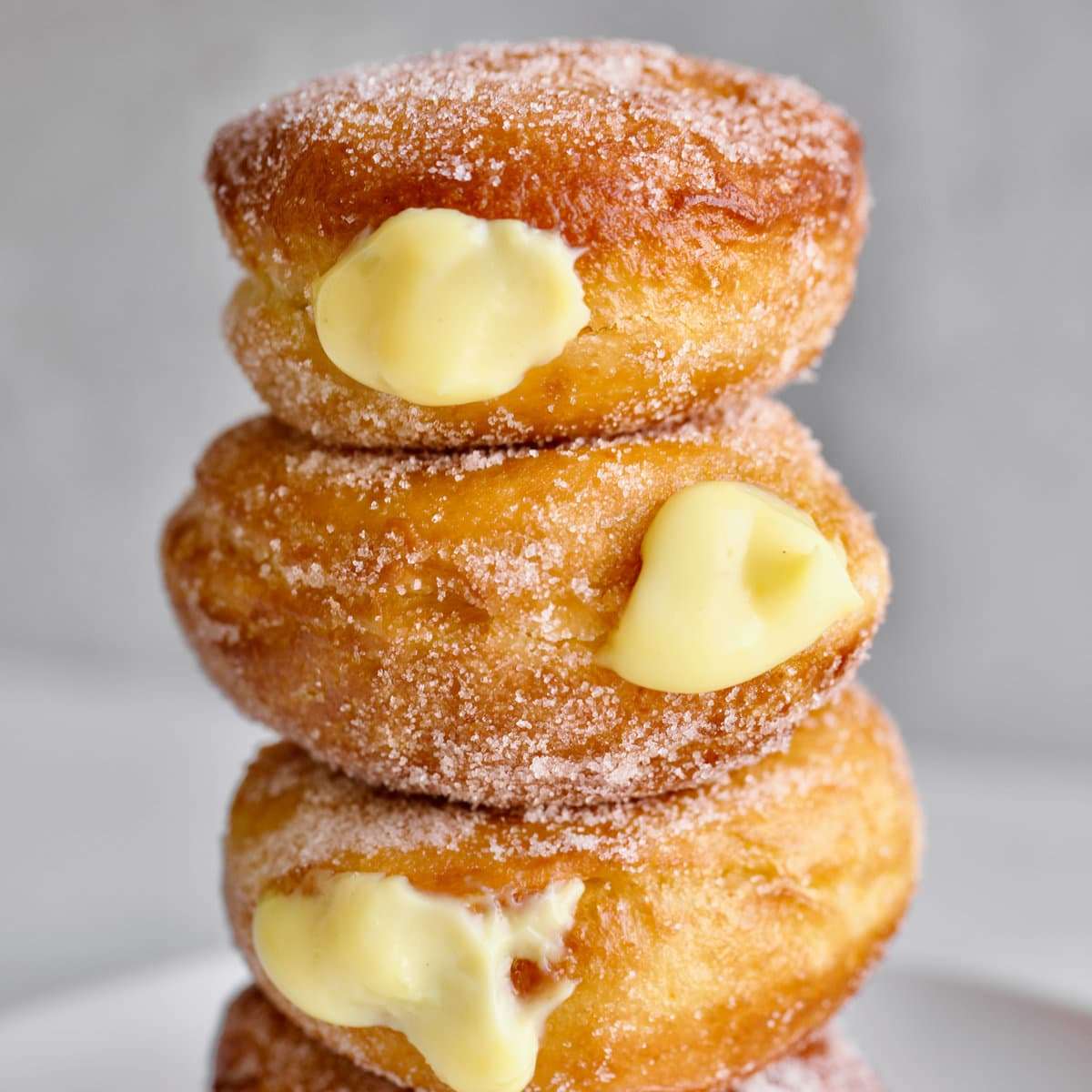
Bomboloni Recipe
User Reviews
5
Bomboloni Recipe
Description
The Bomboloni dough starts by activating yeast in warm milk, then mixing it with flour, sugar, salt, eggs, vanilla, and citrus zest. Butter is incorporated during kneading to create a smooth, elastic dough typical of enriched yeast breads. After resting, the dough is divided and shaped for frying. The doughnuts are fried in sufficient oil at around 350°F to achieve a golden crust without absorbing excess oil.
The pastry cream filling adds a rich, creamy interior, and alternatives like pistachio or chocolate pastry cream offer flavor variety. Rolling the warm bomboloni in granulated or confectioners sugar provides a sweet coating that adheres well while warm.
This recipe also covers tips for baking as an alternative to frying, proper storage for fresh and filled bomboloni, and best reheating methods that preserve texture. Maintaining the right dough temperature and oil heat ensures the dough rises properly and fries evenly.
Working in batches prevents overcrowding and uneven cooking. Cooling the doughnuts before filling avoids melting the cream inside. Freezing is not recommended as it affects texture and freshness.
Ingredients
Donuts (Bomboloni)
- 4 cups 00 flour 480 gr, or all-purpose flour
- 3 large egg beaten at room temperature
- 6 tablespoon butter softened and cut into cubes
- ½ cup granulated sugar
- ½ cup milk warmed, whole
- 1 teaspoon vanilla extract
- 2 ¼ teaspoons active dry yeast
- 1 small pinch salt
- orange zest optional, but traditional to Italian donuts, or lemon zest
- ½ cup granulated sugar or confectioners sugar; for rolling doughnuts
- sunflower oil or vegetable oil for frying
Pastry Cream
- 1 recipe pastry cream classic Italian
Other flavors to try:
- pistachio cream Italian; best quality
- Chocolate Pastry Cream Italian
Instructions
Pastry Cream
- 1 recipe for Classic Italian Pastry Cream
- Make the pastry cream first and store it in the refrigerator for up to 24 hours.
Make Donut Dough
- In a small bowl, add the warm milk and sprinkle the yeast on top; let it sit for five minutes, then mix. If the yeast does not bubble after 5 minutes- try with new yeast.
- Place the flour, sugar, and salt in the bowl of a stand mixer and whisk to combine.
- Add the milk and yeast mixture, beaten eggs, orange zest, and vanilla. Attach a dough hook attachment to the mixer and knead until combined. Scrape down the sides and bottom of the bowl.
- Scatter butter cubes over the dough mixture so it's evenly distributed, then knead on a low speed for 10 minutes.
- After 10 minutes, the dough will be smooth, elastic, and slightly sticky. With greased hands, shape the dough into a smooth ball by kneading it 2-3 times on a clean cutting board or work surface (do not add extra flour here).
- Place the dough in a clean, lightly oiled bowl and cover it with plastic wrap. Let the dough rest for the first rise in a warm place without drafts for 2-3 hours or until triple in size.
Shape Donuts
- After the dough rises, transfer it onto a lightly floured and clean work surface, punch down once, and knead it a few times back into a smooth ball.
- Flatten the dough with your hands, then roll it out with a rolling pin into a rectangle- about ½ inch thick.
- Use a round cookie cutter or glass to cut out round doughnuts about 3.5 inches in diameter. TIP: save the scraps for frying or re-knead them and roll them out again to cut out more doughnuts.
- Place the cut-out doughnuts on a baking sheet lined with parchment and cover them loosely with plastic wrap or a clean towel. Let the dough proof for the second rise for 1 to 1.5 hours or until it triples in size.
Fry the Donuts
- When ready to fry, heat a large deep pan or dutch oven pot with oil until it reaches 170-175°C/340-350°F. Test with a frying thermometer. Set out a baking sheet lined with paper towels for laying the fried donuts. Prepare a bowl of sugar for rolling the donuts.
- Cut the parchment paper into squares so that each doughnut is on an individual square of parchment. Try not to touch the donuts, or they might deflate after rising.
- Carefully drop the doughnuts into the oil and quickly remove the parchment paper with tongs and discard. Fry the doughnuts in batches and don't overcrowd the pan so they can fry evenly.
- Fry the doughnuts for about 2 minutes on each side.
- Remove the donuts from the oil with a slotted spoon. Drain on paper towels for a few minutes to absorb excess oil, then roll the doughnuts in the bowl with sugar. Leave to cool before filling.
Assembly
- Once the pastry cream is cooled and the donuts are rolled in sugar and cooled slightly, fill the donuts.
- To fill the bomboloni, insert a small knife into the side of a doughnut and move it around to make a small incision.
- Fill a piping bag with the pastry cream or desired filling option and pipe it into the hole in the donut.
- Serve immediately for best results or store in plastic containers for 1-2 days.
Notes
- These bomboloni are best when fried, though baking for about 20 minutes at 350°F is an option; cool before filling and sprinkle with powdered sugar.
- Store unfilled bomboloni at room temperature for 1-2 days in an airtight container; filled ones refrigerate for a few days.
- Reheat wrapped in foil in the oven at 350°F for about 10 minutes to restore softness; this works for frozen bomboloni as well.
- Use room temperature eggs and butter to promote a better dough rise and elasticity.
- Activate yeast in properly warmed milk (around 110°F) to ensure good rise; discard inactive yeast.
- Maintain frying oil temperature near 350°F to avoid greasy or undercooked doughnuts.
- Use enough oil (about 3 inches deep) and fry in batches, stirring occasionally to prevent sticking and ensure even browning.
- Roll bomboloni in sugar while still warm to make the sugar coat stick better; fill only once cooled to prevent melting.
Nutrition Information
Show DetailsNutrition Facts
Serving: 10-12 large donuts
Amount Per Serving
Calories 439 kcal
% Daily Value*
| Calories | 439kcal | 22% |
| Carbohydrates | 74g | 25% |
| Protein | 10g | 20% |
| Fat | 11g | 17% |
| Saturated Fat | 6g | 30% |
| Polyunsaturated Fat | 1g | 6% |
| Monounsaturated Fat | 3g | 15% |
| Trans Fat | 0.3g | 15% |
| Cholesterol | 63mg | 21% |
| Sodium | 152mg | 6% |
| Potassium | 274mg | 6% |
| Fiber | 2g | 8% |
| Sugar | 25g | 50% |
| Vitamin A | 386IU | 8% |
| Vitamin C | 1mg | 1% |
| Calcium | 144mg | 14% |
| Iron | 3mg | 17% |
* Percent Daily Values are based on a 2,000 calorie diet.
User Reviews
Overall Rating
5
You'll Also Love