Eggplant Agebitashi
User Reviews
4.9
Eggplant Agebitashi
Description
Eggplant Agebitashi begins by preparing a seasoned broth combining dashi stock with mirin, sake, soy sauce, and sugar, brought briefly to a boil and kept warm. Japanese or Chinese eggplants are cut, lightly scored on the skin to enhance texture and oil absorption, and deep-fried in neutral oil at 320ºF until cooked without a batter coating.
Immediately after frying, the eggplant is immersed in the warm broth to absorb its savory-sweet flavors while maintaining its tender texture. The scoring facilitates penetration of the broth into the flesh, ensuring each piece is richly flavored.
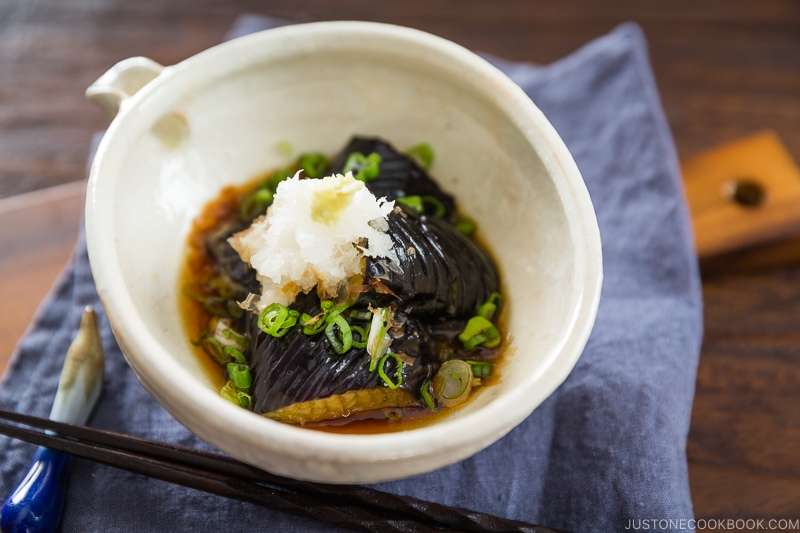
This dish is served chilled or at room temperature, often garnished with grated daikon radish, green onion, ginger, and optionally katsuobushi flakes. It works well as a refreshing side dish during warmer months, balancing soft textures and bright umami notes.
Ingredients
- 2 Japanese eggplant 10 oz, 283 g, or Chinese eggplant
- 2 cups neutral oil (for deep-frying)
- 3 inches daikon radish (use the green top part for a sweet taste)
- 1 green onion or scallion
- 1 knob ginger (1 inch, 2.5 cm per knob)
- ⅓ cup katsuobushi skip for vegan/vegetarian, dried bonito flakes
For the Broth
- ¾ cup dashi use standard Awase Dashi, dashi packet or powder, or Vegan Dashi, Japanese soup stock
- 3 Tbsp mirin
- 3 Tbsp sake
- 3 Tbsp soy sauce (for this recipe, I used Kikkoman Gluten-Free Soy Sauce)
- 1 heaping Tbsp sugar
Instructions
- Gather all the ingredients.
- In a saucepan, combine the broth ingredients: ¾ cup dashi (Japanese soup stock), 3 Tbsp mirin, 3 Tbsp sake, 3 Tbsp soy sauce, and 1 heaping Tbsp sugar. Mix it all together. Bring it to a boil and turn off the heat. Keep it covered so the broth doesn’t evaporate.
- In a deep-frying pot/saucepan, add 2 cups neutral oil and bring it to 320ºF (160ºC). While waiting for the oil, prepare the eggplants.
To Prepare the Eggplants
- You must cut the eggplant right before deep-frying to avoid discoloration. First, discard the tops of 2 Japanese or Chinese eggplants and cut in half lengthwise. Tip: While we usually soak eggplant in water to prevent discoloration, we will not soak in water for this recipe because we will deep-fry it without a coating.
- Lightly score the eggplant with diagonal incisions on the skin side at ⅛-inch (3-mm) intervals. You could also score in a crisscross pattern. Do not cut through.
- After scoring, cut each piece into 3–4 sections. Make sure to wipe off any moisture with a paper towel.
To Deep-Fry
- Check if the oil has reached at 320ºF (160ºC) with an instant-read thermometer or by sticking wooden chopsticks into the oil. If you see small bubbles forming around the tips, the oil is ready.
- Gently place a few pieces of eggplant in the oil, skin side down, and deep-fry for 2 to 2½ minutes. Fry in batches and do not overcrowd the pot. Remove from the oil and drain on a wire rack, skin side up. Repeat until all the eggplant pieces are deep-fried. Tip: When you deep-fry, do not crowd the pot because the oil temperature will drop quickly. Your ingredients should take up no more than about half of the oil surface area at any one time. If the oil temperature gets too low, take out the eggplant and wait until the oil reaches the right temperature. For more helpful hints, read my post How to Deep-Fry Food.
To Soak in the Broth
- When the eggplants have cooled, place them skin side up in a rimmed container or dish. Heat the broth until hot, then pour it over the eggplants to soak for at least 1 hour and up to several hours. To serve this dish chilled, put it in the refrigerator.
- While soaking, peel the skin of 3 inches daikon radish and grate it.
- Thinly slice 1 green onion/scallion and grate 1 knob ginger.
To Serve
- Put the eggplant pieces in individual serving bowls. Sprinkle with ⅓ cup katsuobushi (dried bonito flakes), then top with the grated daikon and grated ginger. Pour the soaking broth on top of the eggplant pieces (avoiding the toppings) and garnish with green onion. Serve chilled or at room temperature.
To Store
- You can keep the leftovers in an airtight container and store in the refrigerator for up to 2–3 days.
Notes
Nutrition Information
Show DetailsNutrition Facts
Serving: 4Serving
Amount Per Serving
Calories 163 kcal
% Daily Value*
| Calories | 163kcal | 8% |
| Carbohydrates | 8g | 3% |
| Protein | 1g | 2% |
| Fat | 14g | 22% |
| Saturated Fat | 2g | 10% |
| Polyunsaturated Fat | 8g | 47% |
| Monounsaturated Fat | 3g | 15% |
| Trans Fat | 1g | 50% |
| Sodium | 190mg | 8% |
| Potassium | 264mg | 6% |
| Fiber | 3g | 12% |
| Sugar | 5g | 10% |
| Vitamin A | 46IU | 1% |
| Vitamin C | 10mg | 11% |
| Calcium | 19mg | 2% |
| Iron | 1mg | 6% |
* Percent Daily Values are based on a 2,000 calorie diet.
User Reviews
Overall Rating
4.9
You'll Also Love