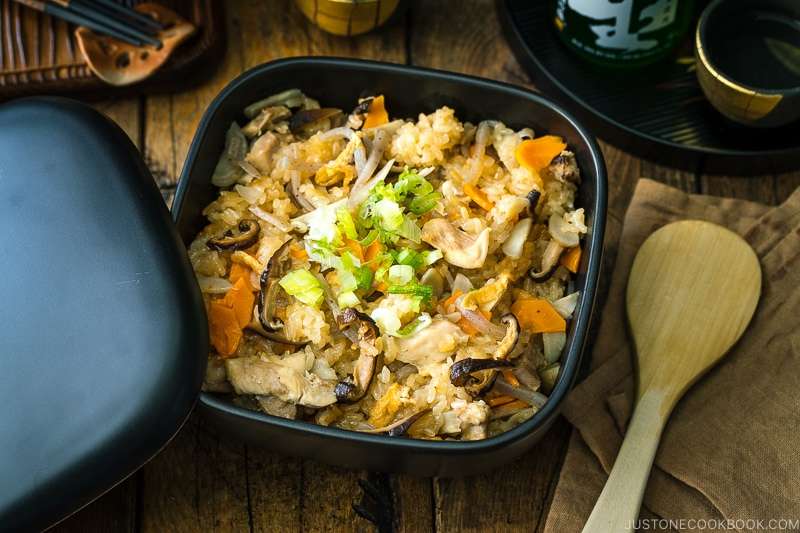
Japanese Sticky Rice with Chicken and Vegetables (Okowa)
User Reviews
4.5
Japanese Sticky Rice with Chicken and Vegetables (Okowa)
Description
This recipe uses sweet glutinous rice cooked with a broth made from dashi, mirin, soy sauce, and salt, infusing the rice with umami and subtle sweetness. Shiitake mushrooms are rehydrated in dashi for added flavor, while aburaage and konnyaku provide varied textures. Burdock and carrot add earthiness and natural sweetness.
The rice-to-water ratio is 1:1 for sticky rice, ensuring the rice cooks to a sticky yet tender consistency without becoming mushy. All ingredients are cut into small, thin pieces for even cooking and integration with the rice.
Okowa is typically garnished with chopped green onions or scallions, adding a fresh bite. The dish serves as a hearty meal or side dish, combining protein, vegetables, and rice in one pot.
Ingredients
- 3 dried shiitake mushrooms (0.7 oz, 20 g)
- 1 tofu pouch 0.7 oz, 20 g, deep-fried, aka aburaage
- ⅓ konnyaku 3 oz, 85 g, aka konjac
- ⅓ burdock root 2.5 oz, 70 g, aka gobo
- ⅓ carrot (1.8 oz, 50 g)
- ½ chicken thigh (1.5 oz, 43 g; omit for vegan/vegetarian and use more vegetables)
- 2 Tbsp sake (for marinating the chicken)
- 2¼ cups sweet rice uncooked; 3 rice cooker cups, 3合, 540 ml); use 540 ml cooking liquid (see below); the glutinous rice-to-water ratio is 1:1, aka glutinous rice/mochigome
- 1 green onion chopped; for garnish, or scallion
For the Rice Cooking Broth (you‘ll need 540 ml)
- 2 cups dashi use standard Awase Dashi, dashi packet or powder, or Vegan Dashi, Japanese soup stock
- 2 Tbsp mirin
- 2 Tbsp soy sauce (use gluten-free soy sauce for GF)
- 1 tsp kosher salt Diamond Crystal brand
Instructions
- Gather all the ingredients.
To Prepare the Ingredients
- Soak 3 dried shiitake mushrooms in 2 cups dashi (Japanese soup stock) for 20 minutes. Meanwhile, work on the other ingredients.
- Once the shiitake mushrooms are fully hydrated and tender, squeeze to drain the liquid back to the dashi. If the liquid is less than 2 cups (480 ml), add water. Discard the tough stems with a knife.
- Thinly slice the shiitake mushroom caps and set them aside.
- While waiting for the mushrooms to rehydrate, bring a small pot of water to a boil and blanch 1 aburaage (deep-fried tofu pouch) for 15 seconds on each side to get rid of the factory oil from deep-frying the tofu. Drain the water. Keep the boiling water for the konnyaku.
- Cut the aburaage in half and thinly slice into short strips.
- Cut ⅓ konnyaku (konjac) into thin short strips, a size similar to the aburaage pieces.
- In the same boiling water, cook the konnyaku for 2–3 minutes to get rid of the unwanted odor. Drain the water and set it aside.
- Cut ⅓ carrot in half lengthwise and thinly slice into a half-moon shape.
- Scrape off the skin of ⅓ gobo (burdock root) with the back of the knife. We do not use a vegetable peeler for gobo because the its earthy flavor is right underneath the skin and we do not want to discard it. Cut the gobo in half lengthwise.
- Diagonally cut the gobo into thin slices. Soak them in water to remove astringency and prevent the change of color.
- Cut ½ chicken thigh into small, flat pieces. I recommend using the Japanese sogigiri cutting technique. This creates more surface area and helps the chicken cook faster. Put the chicken in a small bowl and add 2 Tbsp sake to remove the unwanted odor. Set it aside on the counter.
To Rinse the Rice
- To 2¼ cups sweet rice/glutinous rice (mochigome), add just enough water to submerge all the rice. Then, discard the water immediately since the glutinous rice absorbs water quickly.
- Use your fingers to gently agitate or “wash“ the rice grains in a circular motion for 15–20 seconds. Add more water to rinse the rice.
- Drain and repeat this washing process.
- Add water and drain, and repeat this process until the water is almost clear.
- Drain the rice into a sieve, shake off the excess water, and set it aside.
To Cook the Rice
- Transfer the well-drained rice to the pot and add 2 cups dashi (Japanese soup stock).
- Add 2 Tbsp mirin, 2 Tbsp soy sauce, and 1 tsp Diamond Crystal kosher salt.
- Mix all together with chopsticks (or a wooden spoon). Drain the sake from the chicken and place the drained chicken pieces on top of the rice. DO NOT MIX. In order to cook rice evenly, the rice and other ingredients cannot be mixed together prior to cooking.
- Next, sprinkle the root vegetables on top. (Start with the tough/dense ingredients first.)
- Then, scatter the softer ingredients on top. Start cooking. Use the Regular or Sweet Rice setting on your rice cooker. The Sweet Rice setting is shorter in cooking time since glutinous rice cooks faster than regular Japanese short-grain white rice. If you want to cook this in a pot on the stove, see my blog post above for instructions.
To Serve
- Once the rice is cooked, fluff the rice. Don‘t stir or mix; insert the rice paddle vertically, then scoop up the rice from the bottom, turn it over, and break up the scooped pieces with a “cutting“ motion. Repeat until all the rice is scooped up and fluffed.
- Serve the rice into individual rice bowls or an ohitsu (rice container). Thinly slice 1 green onion/scallion and sprinkle on top. I also love making Onigiri (rice balls) with Okowa.
To Store
- You can keep the leftovers in an airtight container and store in the freezer for up to a month. I recommend not refrigerating the cooked rice even you are eating it the next day, as the rice gets hard.
Nutrition Information
Show DetailsNutrition Facts
Serving: 4Serving
Amount Per Serving
Calories 526 kcal
% Daily Value*
| Calories | 526kcal | 26% |
| Carbohydrates | 106g | 35% |
| Protein | 12g | 24% |
| Fat | 3g | 5% |
| Saturated Fat | 1g | 5% |
| Polyunsaturated Fat | 1g | 6% |
| Monounsaturated Fat | 1g | 5% |
| Trans Fat | 1g | 50% |
| Cholesterol | 11mg | 4% |
| Sodium | 791mg | 33% |
| Potassium | 293mg | 6% |
| Fiber | 5g | 20% |
| Sugar | 4g | 8% |
| Vitamin A | 2127IU | 43% |
| Vitamin C | 3mg | 3% |
| Calcium | 37mg | 4% |
| Iron | 2mg | 11% |
* Percent Daily Values are based on a 2,000 calorie diet.
User Reviews
Overall Rating
4.5
You'll Also Love