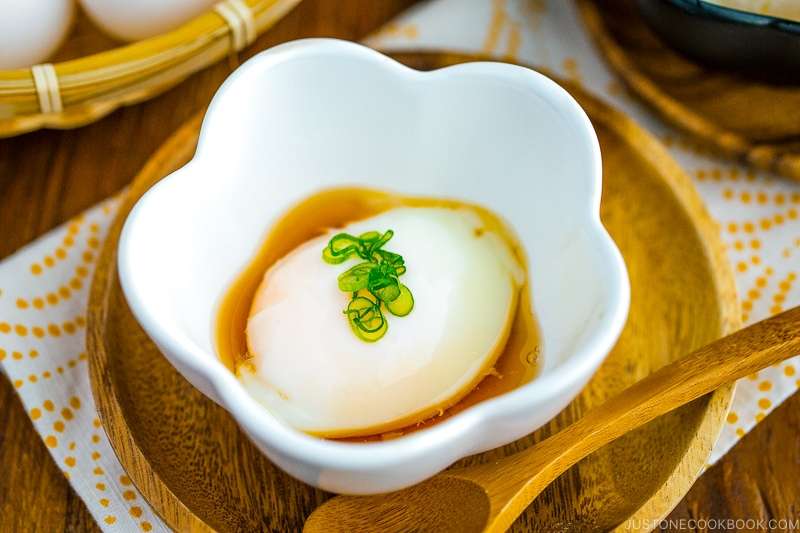
Onsen Tamago (Japanese Hot Spring Egg)
User Reviews
4.8
Onsen Tamago (Japanese Hot Spring Egg)
Description
This recipe for Onsen Tamago begins by heating water in a heavy-bottomed saucepan to just boiling, then cooling it slightly by adding colder tap water to reach the ideal poaching temperature of about 180°F (82°C). Four refrigerated large eggs are gently placed whole, shells on, into this water and left to cook gently.
The controlled temperature cooks the eggs slowly so that the whites are softly set but still tender, while the yolks remain creamy, resembling the texture sought in traditional Japanese hot spring eggs. The gentle cooking technique avoids the firmness of typical hard-boiled eggs.
Once cooked, the eggs are served with a simple sauce made from dashi stock, mirin, soy sauce, and optionally katsuobushi flakes, which add umami depth. Chopped green onions are sprinkled on top. This dish is often enjoyed as a breakfast or side dish in Japanese cuisine.
Ingredients
- 4¼ cups water (1 L)
- 4 egg refrigerated, large, 50 g each, without shell
- ¾ cup water 200 ml; colder than room temperature, tap
For the Sauce
- ¼ cup dashi 4 Tbsp; use standard Awase Dashi, dashi packet or powder, or Vegan Dashi, Japanese soup stock
- ½ Tbsp mirin
- 1½ Tbsp soy sauce
- 2 Tbsp katsuobushi skip for vegetarian, dried bonito flakes
For the Garnish
- green onion or scallion
Instructions
- Before You Start: You must use a small, heavy-bottomed saucepan (I use All-Clad Copper Core 2 QT saucepan) that retains heat well and is small enough to completely submerge the eggs in the measured water. If you don‘t have one, please see my FAQs section of the blog post for my suggestion. Also, you need exactly 4 refrigerated large eggs for this recipe to achieve the correct water temperature for poaching. Now, gather all the ingredients.
To Poach the Eggs
- To the heavy-bottomed saucepan, add 4¼ cups water (1 L). Cover with a tight-fitting lid and bring it to a boil.
- Once boiling, turn off the heat and remove the pot from the stove. I moved my saucepan to a hot pad on my countertop. Next, remove 4 large eggs (50 g each w/o shell) from the refrigerator.
- To the pot of just-boiled water, add ¾ cup tap water (200 ml) that's colder than room temperature and stir. The hot water in the saucepan should be roughly 180°F (82°C). Then, gently submerge the cold eggs, one at a time, into the hot water using a fine-mesh skimmer. Tip: If you‘re using a lightweight or thin-bottomed pot, try adding only ⅓–½ cup (100–150 ml) of cold tap water instead.
- Immediately cover with the lid and set a timer for 17–20 minutes. Poach 17 minutes for runnier yolks and 20 minutes for creamier yolks. If you follow my method precisely, the water temperature will be 154°F (68°C) when you open the lid after 20 minutes. Note: If you prefer a firmer yolk, you can experiment with a longer poaching time.
To Make the Sauce
- Meanwhile, make the sauce. Combine ¼ cup dashi (Japanese soup stock), ½ Tbsp mirin, 1½ Tbsp soy sauce, and 2 Tbsp katsuobushi (dried bonito flakes) in a small saucepan and bring it to a boil.
- Once boiling, turn off the heat.
- Strain through a sieve and set the sauce aside.
To Finish the Onsen Tamago
- After 17–20 minutes, gently take the eggs out of the water, one at a time. Set them aside for 5 minutes. The residual heat will continue to cook the eggs.
- Meanwhile, cut the green onion/scallion into thin slices and set aside.
To Serve
- Enjoy the Onsen Tamago either warm or at room temperature. Crack the egg into a small bowl, pour the dashi-based sauce into the bowl, and garnish with the sliced green onion as a part of a Japanese breakfast. Try the egg on top of steamed rice with a splash of soy sauce. It’s also delicious in a rice bowl, on top of Japanese curry rice, in hot noodle soup, or on a plate of cold udon or ramen noodles. See below for serving ideas.
To Serve Onsen Tamago in Other Dishes
- Top a rice dish: Onsen Tamago is a protein-rich topping for fried rice like Kimchi Fried Rice and Garlic Fried Rice. Try adding one to finish a Japanese curry rice plate like Japanese Dry Curry, Keema Curry, Chicken Curry, Vegetarian Curry, and Beef Curry.
- Add it to a rice bowl: It‘s a silky and rich topping for Gyudon (simmered beef bowl) and Yakiniku Don (grilled beef bowl). It also works beautifully in a poached-egg version of Tamago Kake Gohan.
- Put it in noodle soup: Up the protein and add one to your Kake Udon (classic udon noodle soup), Vegetarian Udon, Cold Tanuki Udon, and classic Soba Noodle Soup. It‘s also great in Shio Ramen, Miso Ramen, Vegetarian Ramen, Shoyu Ramen, and Mazesoba (Japanese brothless ramen).
- Top a main dish: Add one to your Hambagu (Japanese hamburger steak), Nikomi Hambagu (stewed hamburger steak), Loco Moco, and spaghetti carbonara (my favorite). It also works well on Avocado Toast.
- Put it in your soup and hot pot: Bulk up your Japanese soups by adding one to classic Miso Soup, Cabbage and Onsen Tamago Miso Soup, Cold Miso Soup (Hiyajiru), and Zosui (Japanese rice soup). It‘s delicious in Nabeyaki Udon, Miso Nikomi Udon, and Hot Pot for One, too.
To Store
- You can keep the uncracked Onsen Tamago for 1–2 days in the refrigerator. To reheat, remove it from the refrigerator and bring it to room temperature. To warm it up further, place it in a bowl of 160ºF (70ºC) water for 10 minutes. Do not reheat higher than that; otherwise, the heat will cook the egg. Keep any leftover sauce in the refrigerator for 4–5 days.
Nutrition Information
Show DetailsNutrition Facts
Serving: 4onsen
Amount Per Serving
Calories 83 kcal
% Daily Value*
| Calories | 83kcal | 4% |
| Carbohydrates | 1g | 0% |
| Protein | 7g | 14% |
| Fat | 5g | 8% |
| Saturated Fat | 2g | 10% |
| Polyunsaturated Fat | 1g | 6% |
| Monounsaturated Fat | 2g | 10% |
| Trans Fat | 1g | 50% |
| Cholesterol | 186mg | 62% |
| Sodium | 433mg | 18% |
| Potassium | 70mg | 1% |
| Fiber | 1g | 4% |
| Sugar | 1g | 2% |
| Vitamin A | 270IU | 5% |
| Calcium | 28mg | 3% |
| Iron | 1mg | 6% |
* Percent Daily Values are based on a 2,000 calorie diet.
User Reviews
Overall Rating
4.8
You'll Also Love