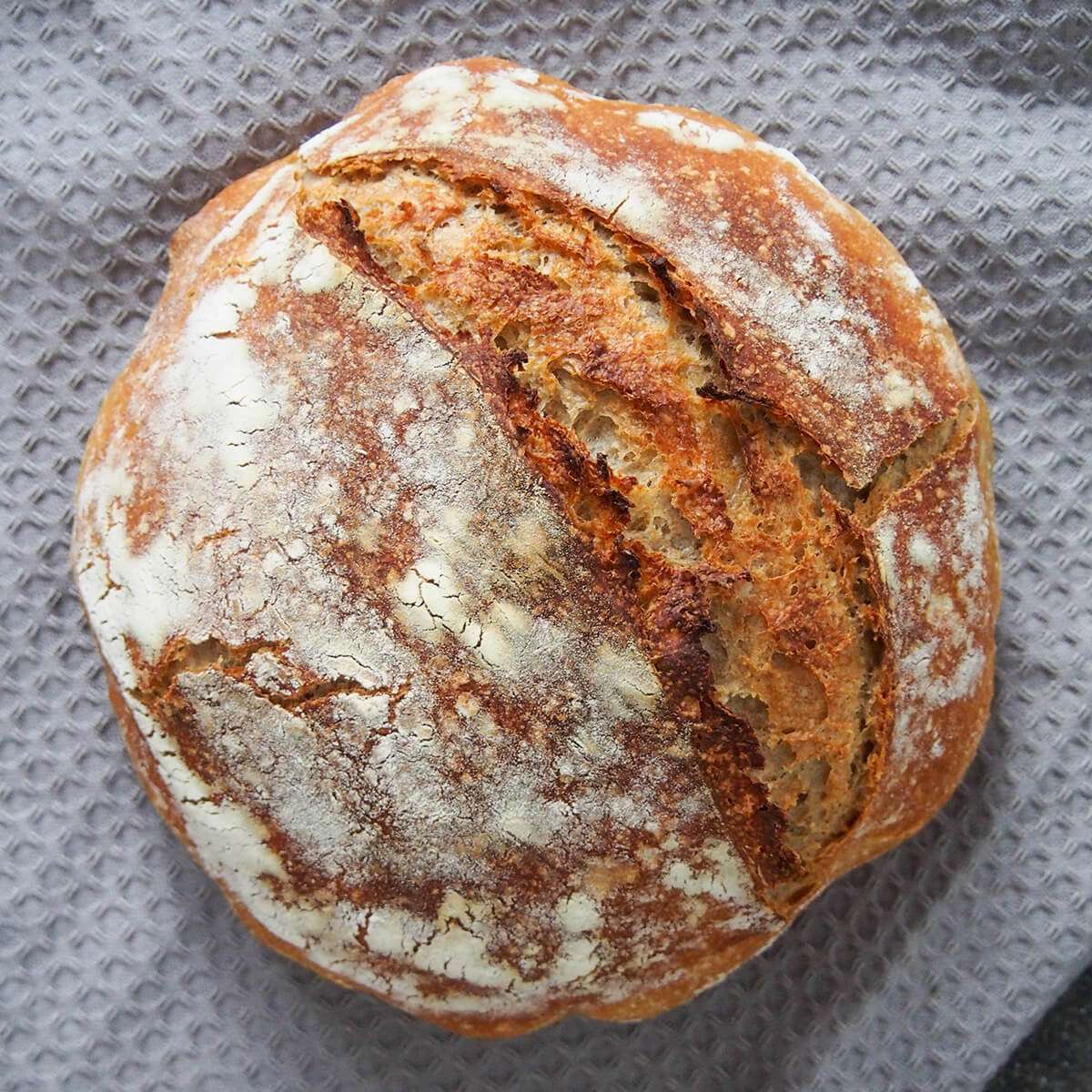
Pain de campagne (French country bread)
User Reviews
5
Pain de campagne (French country bread)
Description
This recipe begins with preparing a levain comprising active sourdough starter, rye, whole wheat, and bread flour mixed with water and left to ferment for 20-24 hours. The next day, the levain is combined with additional bread, whole wheat, and rye flours, water, and salt, followed by gentle kneading to develop the dough. Resting and proofing steps promote gluten structure while maintaining softness.
The resulting dough is shaped into a round loaf, typically proofed in a banneton basket to support its rise, yielding a crisp crust and open yet slightly chewy crumb characteristic of country breads. The rye and whole wheat flours contribute subtle earthiness and depth of flavor.
For best results, keep the levain at a cool room temperature during initial fermentation and watch for bubbling as an indicator of activity. Adding a small amount of instant yeast can help if the levain is sluggish.
Ingredients
For the levain (day 1)
- 75 g sourdough starter (active)
- 75 g rye flour
- 25 g whole wheat flour (wholemeal)
- 25 g bread flour or use all purpose/plain flour
- 100 g water 100ml
For rest of loaf
- 225 g bread flour or use all purpose/plain flour
- 50 g whole wheat flour (wholemeal)
- 25 g rye flour
- 200 g water 200ml
- 7 g salt
Instructions
Evening day 1:
- Prepare the sourdough base, also called the 'levain'. Mix the active sourdough starter with the flours and water listed in the levain ingredients to make a relatively thick paste. Cover the bowl with cling wrap/film and leave it for 20-24 hours at a cool room temperature.
Evening day 2:
- The levain might not look like much from above, but if you have a clear bowl you should see bubbles from the side. Add all of the other ingredients to the levain and mix to combine.
- Lightly flour a work surface, tip the dough out and knead the dough for around 3-5 minutes, adding a little extra flour if needed. It will be soft and a little sticky, but shouldn't be so sticky that you can't handle it.
- Leave the dough as a ball on the counter and cover with an up-tuned bowl for an hour (if the bowl is only slightly larger than the dough, lightly oil it so it doesn't stick).
- Prepare a round banneton by dusting with flour, or else either line a relatively large bowl with a clean towel and dust with flour, or simply dust a large bowl with flour, turning so it covers up the sides. Fold in the sides of the dough tightly to form a round ball and transfer to the prepared banneton/bowl, join side up. Cover and place in the fridge to rise slowly overnight.
Morning day 3:
- Preheat the oven to 450F/230C. Cut a rectangle of parchment paper large enough to cover the bottom of a Dutch oven ad come up the sides slightly - I typically test it as I'm about to cut. Then put the Dutch oven in the oven to warm as the oven heats up.
- Take the bread dough from the fridge and ease it away from the sides gently, if needed. Turn the dough upside down, onto the middle of the piece of parchment (so the join side is now down). If the top of the dough doesn't look a little floured, dust it with a bit more flour.
- Once the oven comes to temperature, slash the top of the dough with a lame or sharp knife, and carefully use the sides of the parchment to lower it in to the warmed Dutch oven. Bake the loaf for 20 minutes with the lid on, then remove the lid and cook for a further 20-25 minutes, until it has an even brown color and is hollow sounding when tapped. Allow the bread to cool at least 20-30 minutes on a cooling rack before slicing.
Notes
- If the levain appears inactive after the initial rise, adding ¼ teaspoon of instant dried yeast during the second day mixing can boost fermentation.
Nutrition Information
Show DetailsNutrition Facts
Serving: 8approx
Amount Per Serving
Calories 197 kcal
% Daily Value*
| Calories | 197kcal | 10% |
| Carbohydrates | 41g | 14% |
| Protein | 7g | 14% |
| Fat | 1g | 2% |
| Saturated Fat | 1g | 5% |
| Sodium | 342mg | 14% |
| Potassium | 109mg | 2% |
| Fiber | 3g | 12% |
| Sugar | 1g | 2% |
| Calcium | 9mg | 1% |
| Iron | 1mg | 6% |
* Percent Daily Values are based on a 2,000 calorie diet.
User Reviews
Overall Rating
5
You'll Also Love