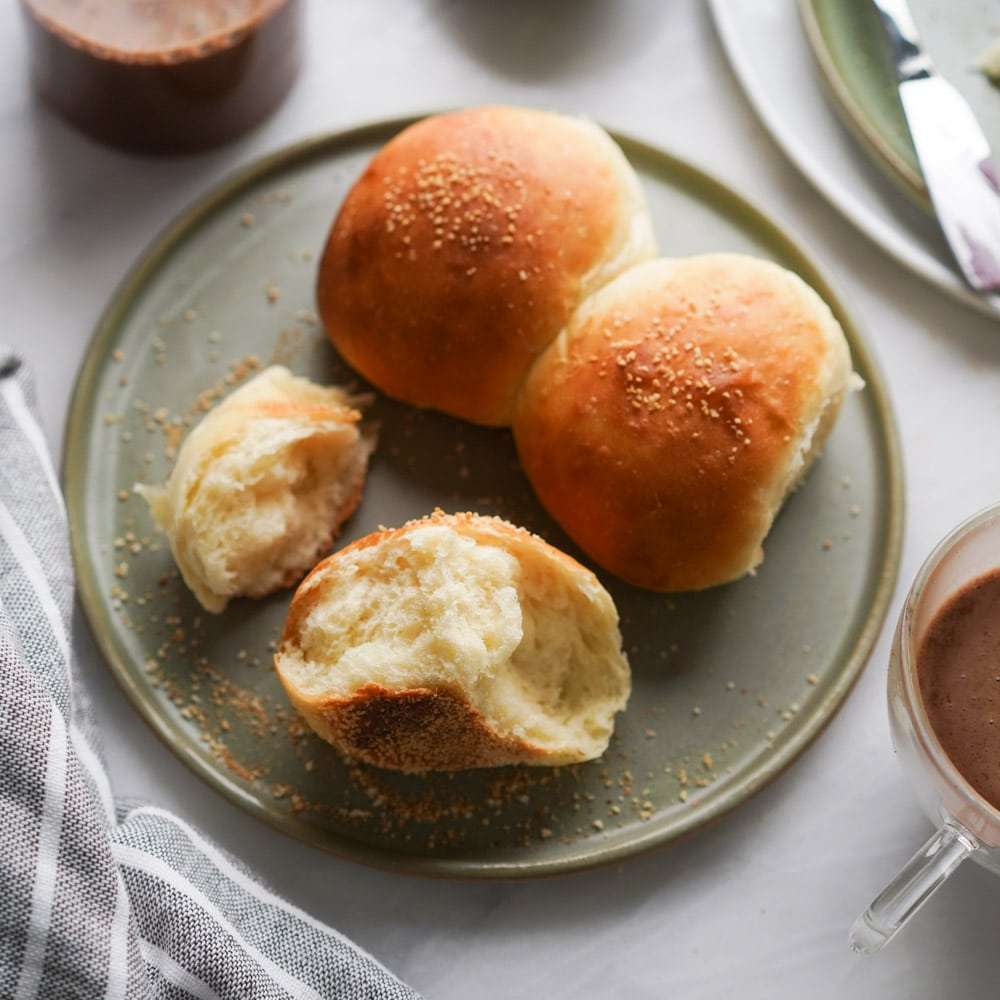
Pandesal (Soft & Fluffy Filipino Bread Rolls)
User Reviews
5
Pandesal (Soft & Fluffy Filipino Bread Rolls)
Description
Pandesal uses active dry or instant yeast combined with both bread and all-purpose flours to achieve a tender yet structured dough. Sugar and salt season the dough, while milk, eggs, and softened butter enrich it, resulting in a soft crumb and subtle sweetness. Initial yeast blooming in warm milk is suggested for active yeast; instant yeast can be added directly.
The dough is mixed and kneaded until the gluten forms well, tested by the windowpane method. After rising, the dough is divided and rolled into balls, coated with breadcrumbs for a slightly crunchy exterior, and baked to a warm golden tone.
These rolls serve well with butter, jams, or fillings and are integral to Filipino meals. Baking by weight ensures precise ingredient ratios and consistent results, though volumetric measures are provided as alternatives.
Ingredients
- 7.3 .3 g active dry yeast or active dry yeast (see instructions below, instant
- 260 g all-purpose flour
- 2 tbsp all-purpose flour for kneading
- 260 g bread flour
- 100 g white sugar
- 6 g salt
- 8 oz milk about 110 °F, warm
- 2 egg
- 56.7 .7 g butter softened to room temperature
- 6 tbsp bread crumbs
Instructions
- If using active dry yeast bloom it first. In a bowl with the warm milk (not hotter than 110 °F), add the active dry yeast and wait 10 minutes for the yeast to bloom. If using instant active yeast, there's no need to bloom.
- In a large mixing bowl (or your stand up mixer bowl with the dough hook attachment), combine all dry ingredients: all purpose flour, bread flour, sugar, salt, and yeast.
- Combine the milk (unless you used it in step 1 for active dry yeast) and eggs into the large mixing bowl with the dry ingredients.
- If you are using a stand mixer, place it on the lowest mixing setting (mine is 2) until the dough is incorporated, sometimes scraping sides if necessary (about 3 min).
- Then transfer to a floured surface and knead by hand. This is super sticky, buttery to not add too much flour during this time. I sprinkle about 2 tbsp of all purpose flour during this kneading process. I knead for about 8 to 10 minutes. TIP: Do the windowpane test to make sure the gluten has formed. Take a piece of dough and carefully stretch it to form a rectangle or square shape. The dough should stretch and become translucent in the middle without breaking. This tells you the gluten has formed enough.
- Now, slowly knead in the softened butter into the dough. Do not add additional flour during this period. Continue to hand knead until the butter is completely incorporated and the texture of the dough has smoothed over. It will seem like the butter is hard to incorporate at first, it took about five minutes of kneading.
- Here's what it looks like after kneading butter into the dough.
- Oil a mixing bowl and place the dough inside with a cover. Proof the dough for 1 hour or until the dough has doubled in size. See picture here for what it looks like after proofing.
- Carefully punch your dough in the bowl to remove the excess gas inside the dough.
- Cut your dough in half and set aside one half. With one half, use your hands to roll the dough into an 8 inch log and then use a knife or pastry cutter to split the log into 8 equal portions. Repeat with the other half of the dough. You should end up with 16 pieces.
- In a baking sheet, sprinkle about 2-4 tbsp of breadcrumbs onto the bottom of the pan.
- Take one piece and use your hands to shape it into a ball. I also like to form my hands in a claw-like shape, covering the ball of dough, and roll it around to get a better round shape. Place the ball of dough onto the sheet pan. Repeat with all the pieces of dough.
- Sprinkle more bread crumbs on top of all of the pandesal balls.
- Cover with a towel and allow the pandesal to proof again for 1 hour or until they double in size. Here's what it looks like after proofing again.
- Preheat the oven to 375 °F. Bake for 10-15 minutes until it reaches a golden brown. Serve immediately and enjoy.
Notes
- Weight measurements are preferred for accuracy, especially in baking; volumetric measures are approximate.
- If using active dry yeast, bloom it in warm milk before mixing; instant yeast can be used without blooming.
- The windowpane test confirms adequate gluten development during kneading.
- Coating rolls in breadcrumbs before baking contributes to their characteristic texture and appearance.
Nutrition Information
Show DetailsNutrition Facts
Serving: 16rolls
Amount Per Serving
Calories 2003 kcal
% Daily Value*
| Calories | 200.3kcal | 10% |
| Carbohydrates | 34.1g | 11% |
| Protein | 5.5g | 11% |
| Fat | 4.5g | 7% |
| Saturated Fat | 1.1g | 6% |
| Cholesterol | 21.9mg | 7% |
| Sodium | 221.1mg | 9% |
| Potassium | 71.6mg | 2% |
| Fiber | 1.1g | 4% |
| Sugar | 7.3g | 15% |
| Vitamin A | 179.4IU | 4% |
| Calcium | 31.9mg | 3% |
| Iron | 1.2mg | 7% |
* Percent Daily Values are based on a 2,000 calorie diet.
User Reviews
Overall Rating
5
You'll Also Love