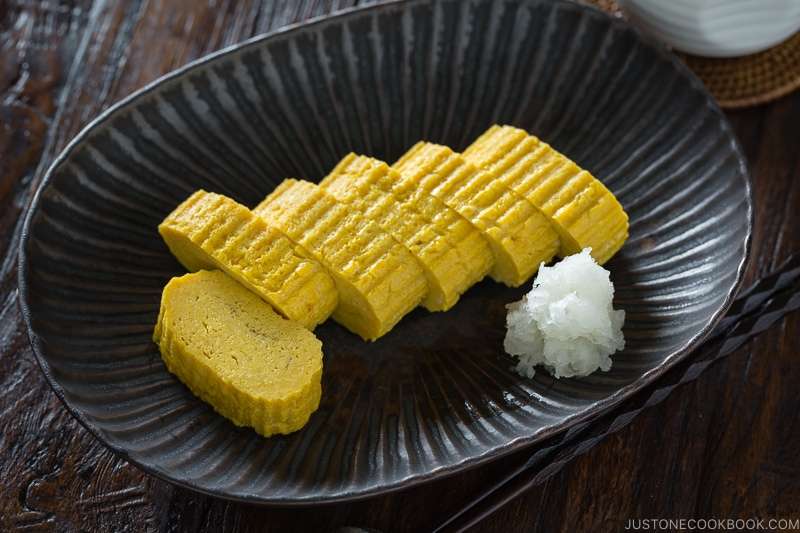
Tamagoyaki (Japanese Rolled Omelette) — Dashimaki Tamago
User Reviews
4.6
Tamagoyaki (Japanese Rolled Omelette) — Dashimaki Tamago
Description
This version of Tamagoyaki is prepared by gently whisking large eggs without overmixing, then combining them with a seasoning mix of dashi (a Japanese soup stock), sugar, soy sauce, mirin, and salt. The mixture is poured in small amounts into a heated tamagoyaki pan or round frying pan, cooked in thin layers, and rolled carefully into a layered cylinder while cooking.
The addition of dashi adds a subtle umami flavor and moisture, creating a tender and slightly fluffy texture. The careful layering and rolling technique gives the omelette a firm but delicate structure with a balanced sweetness and savory depth from the soy and mirin.
Often served with a garnish of grated daikon radish and soy sauce, Tamagoyaki offers a refined flavor profile suitable for breakfast or bento boxes. Using pasteurized eggs or sous vide eggs is recommended for safety if serving with raw egg.
Ingredients
- 3 egg large, 50 g each, without shell
For the Seasonings
- 3 Tbsp dashi use standard Awase Dashi, dashi packet or powder, or Vegan Dashi, Japanese soup stock
- 2 tsp sugar
- 1 tsp soy sauce (use GF soy sauce for gluten-free)
- 1 tsp mirin
- 2 pinches kosher salt Diamond Crystal brand
For Cooking
- 2 Tbsp neutral oil
- 1½ heets nori optional; see Method 2 below, dried laver seaweed
For the Garnish
- 3 oz daikon radish (1 inch, 2.5 cm; use the sweeter, greenish part near the top of the radish)
- soy sauce (use GF soy sauce for gluten-free)
Instructions
- Before we start... Among all the types of tamagoyaki, this is the most challenging to make as the egg mixture is very watery. If you're new to tamagoyaki making, start practicing with my 3-Ingredient Simple Tamagoyaki recipe without dashi.Gather all the ingredients.
- In a bowl, gently whisk 3 large eggs (50 g each w/o shell). It‘s best to “cut“ the eggs with chopsticks in a zig-zag motion; do not overmix.
- In another bowl, combine the seasonings: 3 Tbsp dashi (Japanese soup stock), 2 tsp sugar, 1 tsp soy sauce, 1 tsp mirin, and 2 pinches Diamond Crystal kosher salt. Mix well.
- Pour the seasonings mixture into the eggs and whisk gently to combine. Then, pour the mixture into a measuring cup with a spout and handle so that it‘ll be easier to pour into the frying pan. Next, I‘ll show you how to make your omelette in either a tamagoyaki pan or a round frying pan.
(Method 1) To Cook in a Tamagoyaki Pan
- Heat the pan over medium heat. Then, dip a folded paper towel in 2 Tbsp neutral oil and apply a thin layer of oil to the pan. To check if the pan is hot enough, put a drop of the egg mixture in the pan. When you hear a sizzling sound, the pan is ready.
- Pour a thin layer of the egg mixture into the pan, quickly tilting the pan so that the egg mixture coats the entire cooking surface.
- Poke any air bubbles to release the air. After the bottom of the egg has set but is still soft on top, start rolling the egg into a log shape from one side to the other, starting from the far side of the pan and rolling toward the pan handle.
- Move the rolled omelette to the far side of the pan where you started to roll, and apply more oil to the pan with a paper towel, even under the omelette.
- Pour in a thin layer of the egg mixture to just cover the bottom of the pan again. Make sure to lift the omelette to spread the mixture underneath.
- When the new layer of egg has set and is still soft on top, start rolling it from one side to the other.
- Move the rolled omelette to the side where you started to roll and apply more oil to the pan with a paper towel, even under the omelette.
- Pour in a thin layer of the egg mixture to just cover the bottom of the pan again. Make sure to lift the omelette to spread the mixture underneath.
- When the new layer of egg has set and is still soft on top, start rolling it from one side to the other.
- Repeat the process. This is now the third round.
- This is the fourth round. Pour in more egg mixture and make sure it thinly coats the bottom of the pan, including under the rolled omelette.
- Continue rolling it into a log shape. Tip: Control the temperature of the pan by lifting the frying pan rather than adjusting the stove heat. If the heat is too weak, the egg will stick to the frying pan, so be careful.
- This is the fifth round.
- This is the sixth and final round.
- You can brown the omelette a little bit.
- Remove it from the pan and place the omelette on a bamboo sushi mat. While it’s still hot, roll up the omelette in the bamboo mat to help set its shape. Let it stand for 5 minutes.
(Method 2) To Cook in a Round Frying Pan
- Heat the pan over medium heat. Then, dip a folded paper towel in 2 Tbsp neutral oil and apply a thin layer of oil to the pan. To check if the pan is hot enough, put a drop of the egg mixture in the pan. When you hear a sizzling sound, the pan is ready. Then, pour a thin layer of the egg mixture into the pan, quickly tilting the pan so that the egg mixture coats the entire cooking surface.
- Poke any air bubbles to release the air. After the bottom of the egg has set but is still soft on top, start rolling the egg into a log shape from one side to the other, starting from the far side of the pan and rolling toward the pan handle. Here, I added ½ sheet of nori (optional) to my omelette and then rolled.
- Move the rolled omelette to the far side of the pan where you started to roll and apply more oil to the pan with a paper towel, even under the omelette. Pour in a thin layer of the egg mixture to just cover the bottom of the pan again. Make sure to lift the omelette to spread the mixture underneath.
- When the new layer of egg has set and is still soft on top, start rolling it from one side to the other. This is optional, but I placed another layer of ½ nori sheet on top before rolling.
- Move the rolled omelette to the far side of the pan where you started to roll and apply more oil to the pan with a paper towel, even under the omelette. Then pour in a thin layer of the egg mixture to just cover the bottom of the pan again. Make sure to lift the omelette to spread the mixture underneath.
- When the new layer of egg has set and is still soft on top, start rolling it from one side to the other. I placed another ½ sheet of nori here before rolling. Continue until you’ve used all of the egg mixture.
- Remove it from the pan and place the omelette on a bamboo sushi mat. While it’s still hot, roll up the omelette in the bamboo mat to help set its shape. Let it stand for 5 minutes.
To Serve
- Slice the omelette into ½-inch (1-cm) pieces.
- Peel and grate 3 oz daikon radish. Gently squeeze the water out and place in a small dish or bowl. Pour soy sauce over the grated daikon and serve on the side with the Tamagoyaki.
To Store
- You can put the Tamagoyaki in an airtight container and store in the freezer for up to 2 weeks. Defrost overnight in the refrigerator or microwave.
Nutrition Information
Show DetailsNutrition Facts
Serving: 2Serving
Amount Per Serving
Calories 199 kcal
% Daily Value*
| Calories | 199kcal | 10% |
| Carbohydrates | 7g | 2% |
| Protein | 10g | 20% |
| Fat | 14g | 22% |
| Saturated Fat | 8g | 40% |
| Trans Fat | 1g | 50% |
| Cholesterol | 279mg | 93% |
| Sodium | 347mg | 14% |
| Potassium | 207mg | 4% |
| Fiber | 1g | 4% |
| Sugar | 6g | 12% |
| Vitamin A | 503IU | 10% |
| Vitamin C | 10mg | 11% |
| Calcium | 55mg | 6% |
| Iron | 2mg | 11% |
* Percent Daily Values are based on a 2,000 calorie diet.
User Reviews
Overall Rating
4.6
You'll Also Love