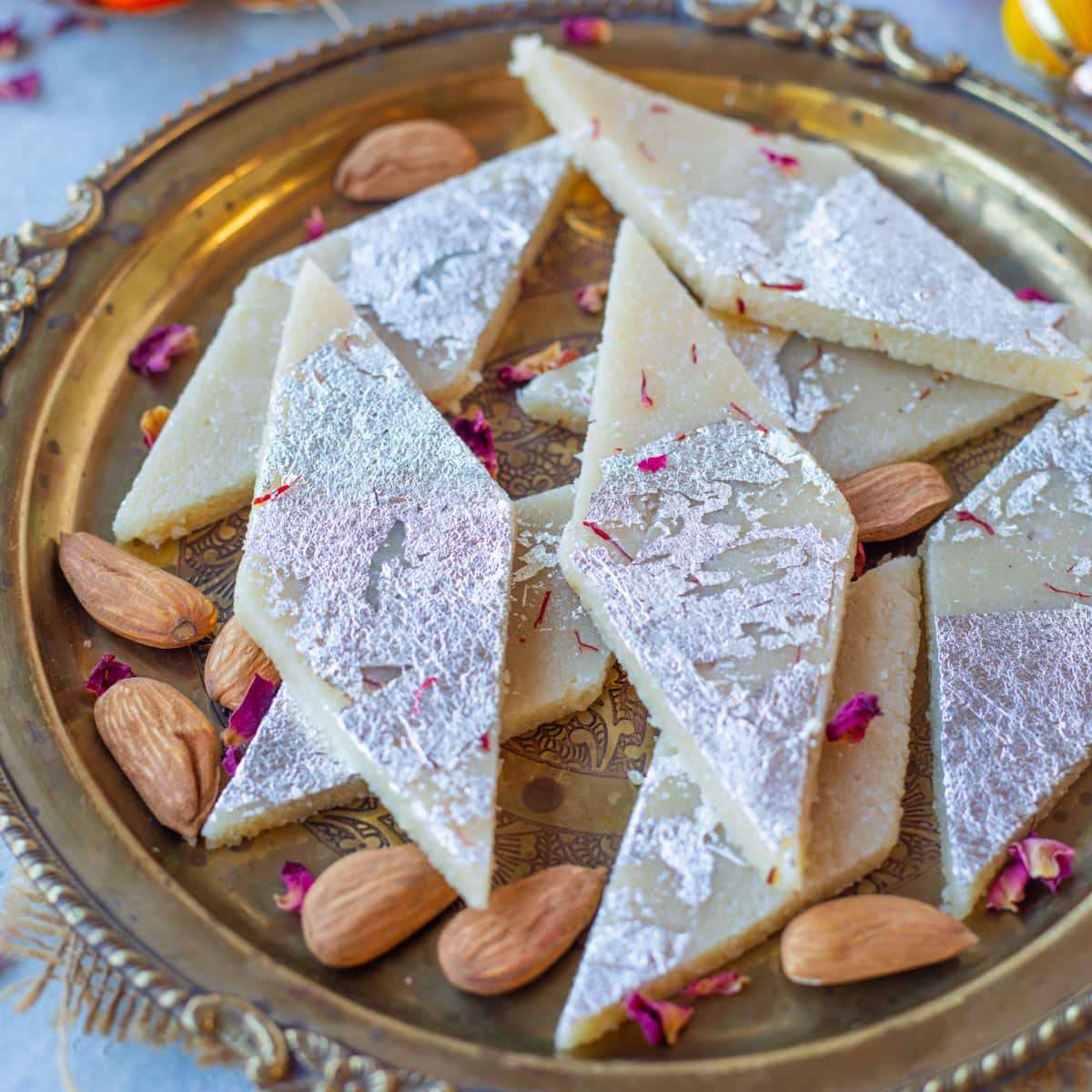
Badam Katli (with Almond Flour)
User Reviews
5
Badam Katli (with Almond Flour)
Description
Badam Katli (with Almond Flour) transforms almond flour and sugar syrup into a smooth, fragrant sweet treat scented with rose water, cardamom, and saffron. The cooking process involves boiling sugar, water, and spices before adding almond flour. Stirring continuously over low heat encourages the mixture to thicken and come together into a dough that leaves the pan's sides. Adding a bit of ghee balances the texture, ensuring the katli remains pliable and sets properly.
The final dough is rolled out warm on ghee-lined parchment to avoid cracking and then cut into diamond shapes. The texture is tender and slightly chewy, with floral and nutty notes from the aromatics.
This dessert is typically enjoyed during festivals or special occasions, served at room temperature, and pairs well with tea or coffee. Garnishing with edible silver leaves adds a festive appearance and a subtle metallic shimmer, though it's optional.
Using finely ground almond flour is crucial for smoothness; coarse almond meal results in a grainier burfi. Monitor the cooking closely: undercooked dough won't hold shape, and overcooked dough becomes crumbly. Work quickly while rolling the warm dough, as it cracks upon cooling.
Ingredients
- 1/2 cup sugar
- 1/4 cup water
- 1 teaspoon rose water
- 1/4 teaspoon cardamom powder aka Elaichi
- 1 pinch saffron aka Kesar
- 1 cup almond flour
- 1 teaspoon ghee
- edible silver leaves optional
Instructions
- Place parchment paper on a large baking tray or cutting board and apply ghee lightly with your fingers. Prepare another piece of parchment paper of the same size. Set aside.
- On medium heat, combine sugar, water, and cardamom powder in a heavy bottom pan. Allow the sugar to dissolve and the mixture to come to a boil while stirring.
- When the mixture begins to boil, stir in the almond flour and rose water. Reduce the heat to low and stir everything together with a spatula to ensure there are no lumps.
- Continue to stir the mixture with a spatula over low heat. After about 5 minutes, the mixture begins to leave the sides of the pan. Mix in a teaspoon of ghee.
- Cook for 5 minutes more on low heat, stirring constantly. Now you must determine whether the mixture is ready to make barfi. Make a non-sticky ball with a small amount of the mixture in your hands. If not, cook the mixture for another 2-3 minutes. This test is crucial because if the dough mixture isn't ready, the katli won't set properly and will have a bite to it.
- Turn off the heat and transfer the dough to the prepared parchment paper with ghee. Allow it to cool for a few minutes before greasing your hands with ghee and kneading the dough for 1-2 minutes. Then, using your palms, flatten it.
- Cover with another piece of parchment paper. Roll the dough between two sheets of parchment paper to a thickness of about 1/2 to 3/4 centimeter.
- Remove the top parchment paper and sprinkle saffron strands on top of the flattened dough. Replace the parchment paper and lightly roll the dough to incorporate the saffron.
- This is optional - garnish with chandi ka vark (edible silver leaves) on top if desired. Cut the barfi into pieces with a sharp knife or a pizza cutter. You can cut diamonds or squares.
- Allow the badam katli to cool completely for about an hour. Then simply pick a piece, bite into it and enjoy. This Badam Katli can be stored in the refrigerator for up to a week.
Notes
- Use finely ground almond flour instead of almond meal for a smoother texture.
- Cook the mixture to testable consistency by forming a non-sticky ball; adjust cooking time accordingly.
- Roll out the dough while still warm to avoid cracks—cool dough is brittle.
- Prefer a non-stick pan to prevent sticking and uneven cooking.
Nutrition Information
Show DetailsNutrition Facts
Serving: 13pieces
Amount Per Serving
Calories 82 kcal
% Daily Value*
| Calories | 82kcal | 4% |
| Carbohydrates | 10g | 3% |
| Protein | 2g | 4% |
| Fat | 5g | 8% |
| Saturated Fat | 1g | 5% |
| Polyunsaturated Fat | 0.01g | 0% |
| Monounsaturated Fat | 0.1g | 1% |
| Cholesterol | 1mg | 0% |
| Sodium | 0.3mg | 0% |
| Potassium | 1mg | 0% |
| Fiber | 1g | 4% |
| Sugar | 8g | 16% |
| Vitamin A | 0.02IU | 0% |
| Vitamin C | 0.01mg | 0% |
| Calcium | 18mg | 2% |
| Iron | 0.3mg | 2% |
* Percent Daily Values are based on a 2,000 calorie diet.
User Reviews
Overall Rating
5
You'll Also Love