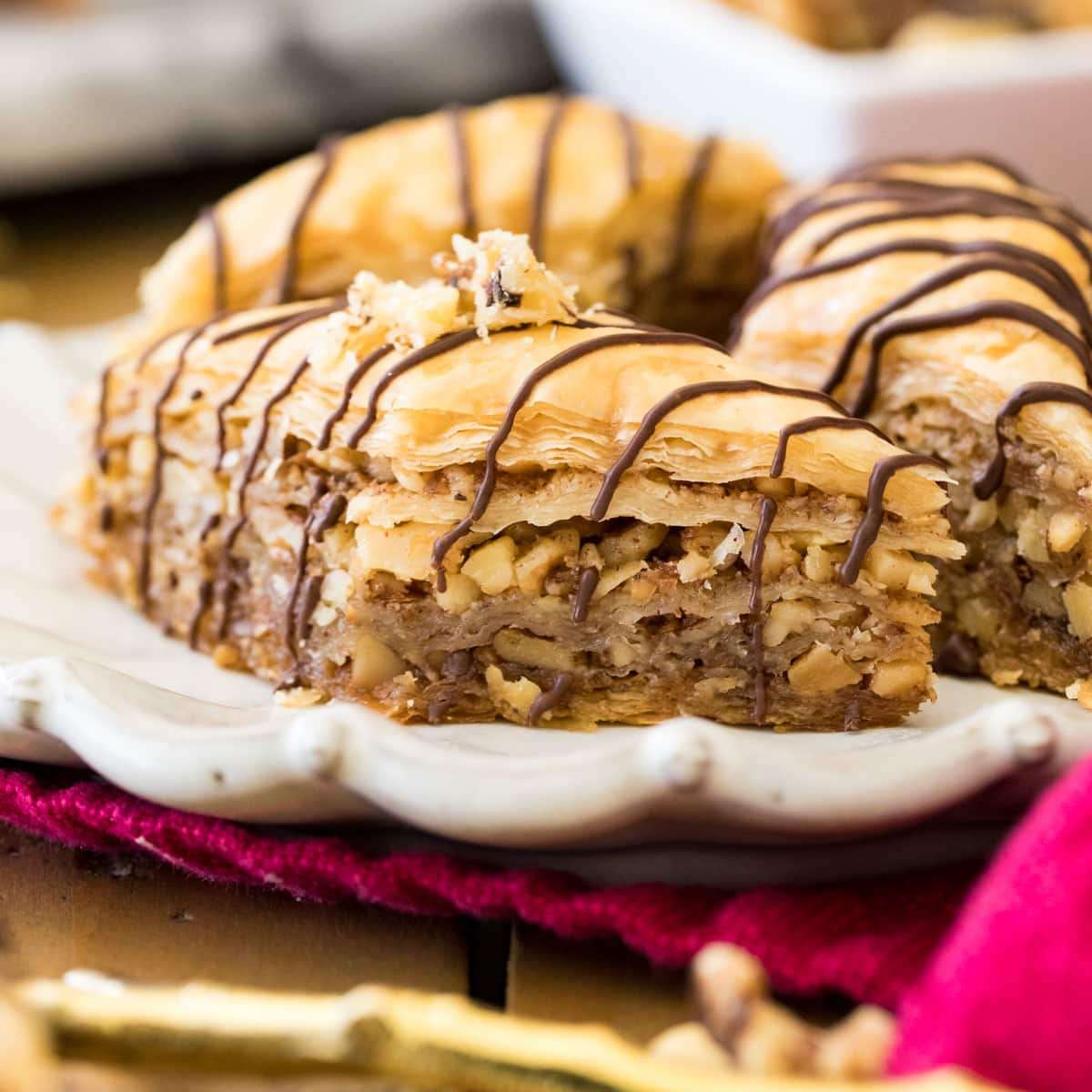
Baklava
User Reviews
5
-
Prep Time
1 hr 30 mins
-
Cook Time
1 hr 30 mins
-
Additional Time
4 hrs
-
Total Time
7 hrs
-
Servings
54 pieces
-
Calories
125 kcal
-
Course
Dessert
-
Cuisine
Greek, Middle Eastern
Baklava
Description
Baklava is a layered pastry using phyllo dough with finely chopped nuts mixed with sugar, cinnamon, and salt. The dough sheets are carefully brushed with melted butter and layered with nut filling, building a multi-textured pastry that crisps up during baking. The syrup combines water, sugar, lemon, honey, and spices, added after baking to penetrate the layers, imparting sweetness and moisture. This recipe calls for a deep baking pan to maintain the layers and catch the syrup.
The texture balances the crispness of the baked phyllo with the moist, richly spiced nut mixture and sticky syrup. The use of lemon and cinnamon in the syrup cuts through the sweetness, while optional chocolate drizzle adds a contrasting note. The layering sequence involves ten sheets of phyllo, then nuts, followed by several layers of phyllo and nuts to form a substantial pastry.
Baklava is best served at room temperature to maintain its crisp flakiness. It stores well wrapped at room temperature for about a week, retaining its texture better than refrigeration. It also freezes well when tightly wrapped and thawed overnight before serving. Nut choices such as walnuts or pistachios affect flavor and cost, while brown sugar adds a depth to the filling sweetness. Handling phyllo requires keeping sheets covered with a damp towel to prevent drying during assembly.
Chopping nuts finely, using unsalted butter, and controlling the syrup consistency are key to achieving the desired balance. The recipe notes suggest avoiding disposable pans to prevent syrup leakage. The making process is time-consuming but yields layered textures and flavors unique to this traditional pastry.
Ingredients
- 16 oz phyllo dough thawed
- ¾ lb nuts finely chopped
- ¼ cup light brown sugar firmly packed (you may substitute granulated sugar
- 1 teaspoon cinnamon
- ¼ teaspoon salt
- 1 cup butter melted, plus more as needed, unsalted
SYRUP
- 1 cup water
- 1 cup granulated sugar
- 1 lemon slice
- 2 Tablespoons lemon juice fresh-squeezed preferred
- 1 cinnamon stick
- 1 clove whole
- ½ cup honey
- ½ teaspoon vanilla extract optional
- semisweet chocolate for drizzling (optional, or dark chocolate
Instructions
- Combine nuts, sugar, cinnamon, and salt in the basin of a food processor⁵ and pulse until nuts are finely chopped (about eight 1-second pulses). Set aside.
- Brush melted butter evenly over the bottom and up the sides of a metal 9x13” baking dish⁶ (see note). Run a clean kitchen towel under water and thoroughly wring it out so it is still damp but not dripping. Remove the phyllo from the packaging and lay it on a clean workspace, then lay the damp towel overtop. It is important to re-cover the phyllo with this towel each time you take a sheet or it will dry out.
- Lay one sheet of phyllo onto the bottom of your pan, trim any excess (I use a paring knife). I have found the easiest way to transfer the thin, fragile phyllo is to carefully roll it up, move it to the pan and line up the edges, then carefully unroll. Most packages of Phyllo have a few more sheets than you actually need in case you accidentally tear some! Brush the surface of the phyllo all over with melted butter.
- Layer another sheet of phyllo over the first and lightly brush all over with butter. Repeat until you have 10 buttered sheets.
- Sprinkle approximately ¾ cup of the nut mixture (or one fourth of the mixture) evenly over the phyllo.
- Lay a sheet of phyllo over top and brush with melted butter, repeat until you have a layer of 5 buttered sheets (see note for final layout of phyllo and nuts).
- Evenly sprinkle another ¾ cup of the nut mixture, then add another 5 buttered phyllo sheets, then another ¾ cup of the mixture, 5 more buttered sheets, ¾ of the mixture, and then finally 10 buttered phyllo sheets. Be sure to brush the top with butter as well.
- Place the pan in the freezer for 20 minutes. While it chills, preheat the oven to 325F (160C).
- Remove the baklava from the freezer and using a sharp knife cut into diamond or square shaped pieces. I usually do 5 cuts straight down and 13 cuts diagonally for diamonds. Sprinkle a few drops of cold water over the surface to keep the phyllo from curling and bake on 325F (160C) for 60-75 minutes or longer, until baklava is golden brown on top.
Syrup (prepare while baklava is in oven)
- While baklava is baking, prepare the syrup by combining water, sugar, lemon slice and juice, cinnamon stick, and clove in a small saucepan and bringing to a boil. Reduce heat and simmer, stirring occasionally for 10 minutes.
- Remove from heat and stir in honey and vanilla extract. Allow mixture to cool while baklava finishes baking.
- Once baklava has finished cooking, remove the clove, cinnamon stick, and lemon slice from the syrup then immediately pour evenly over baklava.
- Allow baklava to cool uncovered at room temperature for at least 4-6 hours (preferably overnight) before enjoying.
Notes
- Keep phyllo sheets covered with a damp towel while assembling to prevent drying and breakage.
- Use an oven-safe metal pan at least 2 inches deep to hold the syrup without leakage during baking.
- Store baklava in an airtight container at room temperature for up to one week; refrigeration can soften the crisp layers.
- Baklava freezes well; tightly wrap and thaw in the refrigerator overnight before serving.
- Choose your favorite nuts: pistachios are traditional, walnuts offer a milder flavor, and pecans are also suitable.
- Brown sugar adds a richer flavor than white sugar in the nut filling.
- Finely chopping nuts by food processor works best, but hand chopping is possible if careful.
- Use extra melted butter if needed to keep phyllo sheets well lubricated and crisp.
Nutrition Information
Show DetailsNutrition Facts
Serving: 54pieces
Amount Per Serving
Calories 125 kcal
% Daily Value*
| Serving | 1piece | |
| Calories | 125kcal | 6% |
| Carbohydrates | 13g | 4% |
| Protein | 2g | 4% |
| Fat | 8g | 12% |
| Saturated Fat | 3g | 15% |
| Trans Fat | 1g | 50% |
| Cholesterol | 9mg | 3% |
| Sodium | 53mg | 2% |
| Potassium | 42mg | 1% |
| Fiber | 1g | 4% |
| Sugar | 8g | 16% |
| Vitamin A | 107IU | 2% |
| Vitamin C | 1mg | 1% |
| Calcium | 11mg | 1% |
| Iron | 1mg | 6% |
* Percent Daily Values are based on a 2,000 calorie diet.
User Reviews
Overall Rating
5
You'll Also Love